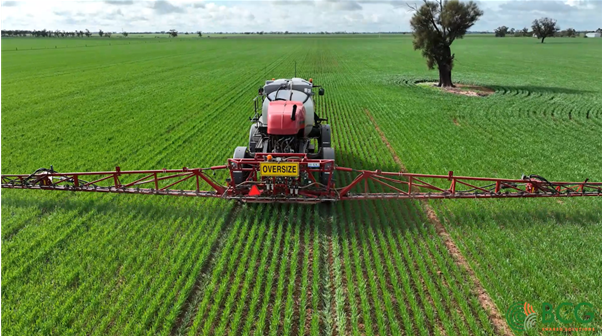


Growers are being urged to keep up their crop inspections after recent reports of Russian wheat aphid (RWA) activity in wheat crops in the northern Mallee, particularly around Tooleybuc and Balranald.
Predominately detected in crops not treated with Gaucho® at sowing, growers should prioritise inspecting these paddocks and look for aphids at the base of curled or rolling leaves with white/pink streaks running the length of the leaf.
BCG researcher Claire Browne said it is important to look for aphids on symptomatic tillers and not just the symptoms alone.
“Guideline thresholds are 20% of seedlings infested up to the start of tillering or 10% of plants infested thereafter,”
“If thresholds are reached, control options need to be considered.” she emphasised.
Where possible use ‘soft’ options to keep beneficial populations high. Pirimor® is a softer insecticide for RWA but requires warmer temperatures >15 degrees to be most effective. When spraying insecticides use a minimum water rate of 100L/ha and medium droplets, such as flat fan nozzles.
RWA infestations aren’t believed to be widespread due to a lack of a green bridge over summer resulting in low aphid pressure so far however cereal crops still need to be constantly monitored as the season progresses.
RWA are not an effective virus vector however they inject a toxin into the plants which causes the retardation of plant growth and can eventually kill the plant if there is heavy infestation of aphids.
A trial at Loxton in 2017 showed RWA numbers continued to build up on moisture stressed crops, however 2017 did start with higher RWA numbers than 2018.
A recent GRDC investment into RWA research, is being conducted by South Australian Research and Development Institution (SARDI) and cesar in collaboration with BCG (and other collaborators) on a project titled ‘Regional risks and thresholds for RWA’. A series of treated and untreated plots across trials in South Australia and Victoria will work towards understanding the risks of localised areas.
BCG is monitoring a GRDC research trial at its main research site at Narraport. Results thus far show 2.14 tillers/m2 or 0.13% of tillers showing symptoms in the non-infested plots. In the plots that were infested with RWA, the data is showing 9.74% of tillers with symptoms. No winged RWA have been observed yet.
Preliminary results from Keith in South Australia are showing 0.06% tillers with symptoms in the non-infested plots and 23.17% of tillers with symptoms in the artificially infested plots. Monitoring of these plots is continuing fortnightly.
For further information about the RWA trial come to the BCG Main Field Day on 12 September at Narraport, 18km north west of Birchip. Alternatively, phone BCG on 03 5492 2787.