
For more than three generations, Action Steel has been designing and building farm sheds for cropping and livestock enterprises across Australia. Based in regional Victoria, the family business has built its reputation on manufacturing sheds that perform, backed by a smooth process from first enquiry through to handover.
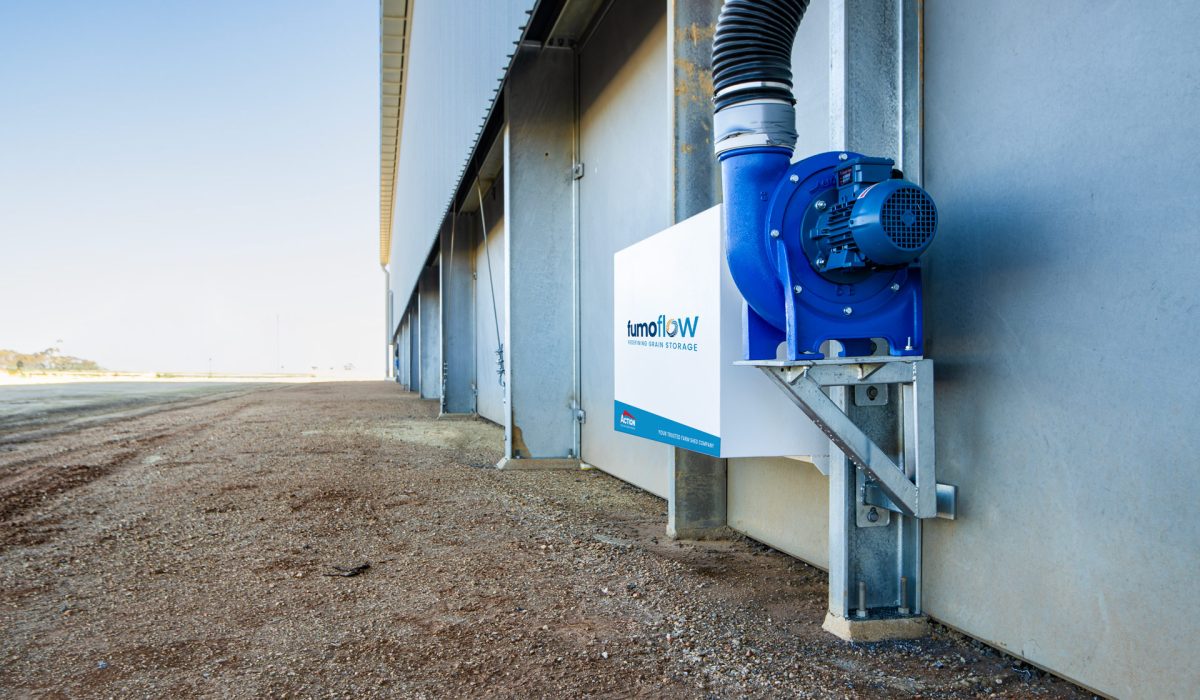
This season, Action Steel has expanded beyond the shed itself. FumoFlow is a patent-pending grain shed and fumigation system with recirculation and ventilation built in. It is the only system of its kind and now, Action Steel has the trial data to back it up.
What the data showed
In March 2026, Action Steel ran its first full-scale commercial phosphine fumigation trial using FumoFlow, on a shed storing 5,420 tonnes of wheat. The trial ran for 15 days across 12 independent monitoring probes, placed at both surface and floor level to capture readings across every part of the shed.
Two thresholds are commonly referenced across the industry as targets for effective phosphine fumigation. 550 ppm maintained for 7 days is the benchmark for addressing phosphine-resistant insect strains. 200 ppm maintained for 10 days covers susceptible populations at all life stages.
Across all 12 probe locations, phosphine concentration peaked at an average of 1,068 ppm within 49 hours of introduction. Every probe exceeded 550 ppm within that window and held above it for the full 7-day period. Every probe also held above 200 ppm for the full 10 days. Not one dropped below either threshold during the required exposure window.
Why gas distribution matters
In a passively sealed shed or silo, phosphine can pool and stratify. Concentrations near the fumigant source run high, while readings further away, particularly at floor level, often fall short. That is where failed fumigations start.
FumoFlow actively recirculates gas through the grain mass from the point of introduction. In this trial, probes at floor level and furthest from the fumigation boxes returned concentrations well above threshold, consistent with readings near the source, demonstrating uniform distribution across the whole grain stack.
Faster, safer ventilation
Once fumigation was complete, the FumoFlow fans switched to ventilation mode, and the shed reached safe re-entry levels in four days. Passive ventilation after tarp removal takes considerably longer and requires staff on site to start the process. With FumoFlow, the entire cycle is managed from outside the shed.
With tighter phosphine Workplace Exposure Limits coming into effect in December 2026, that speed and control matters. It is a compliance advantage, not just an efficiency one.
What this means for grain growers
Phosphine resistance is increasing. Regulatory requirements are tightening. And the cost of a failed fumigation, whether that is rejected grain at receival or a reinfestation, is real.
FumoFlow was developed over 18 months in consultation with growers and leading fumigation contractors. The results from the first full-scale trial suggest the work was worth it.
The results are in. FumoFlow delivers. Visit fumoflow.au or call 1800 68 78 88 to find out more.
FumoFlow is a product of Action Steel, The Big Shed People.