
Mineralisation is the biological process by which organic nitrogen is converted into plant-available mineral nitrogen forms, ammonium (NH₄⁺) and nitrate (NO₃⁻). While often considered ‘bonus’ nitrogen for crops, mineralisation also causes a drawdown of soil organic matter reserves, particularly from the labile pools. Soil test analyses from a BCG trial site at Karyrie, west of Birchip, on a Calcarosol soil showed that approximately 18 kg N/ha (equivalent to about 40 kg urea/ha) was mineralised between late December 2025 and mid-April 2026.
Introduction
Warm soil temperatures, adequate soil water and a sufficient supply of organic matter create favourable conditions for nitrogen mineralisation. Significant rainfall received across the region in early March 2026 likely stimulated microbial activity and triggered mineralisation, increasing the amount of mineral nitrogen available prior to sowing.
The dynamics of mineralisation are highly variable and influenced by multiple factors, including soil organic carbon levels, residue quantity and quality, microbial activity, soil temperature and soil water status. In broadacre cropping systems, summer rainfall events following dry periods can result in significant increases in soil mineral N, particularly where legume stubble loads and organic carbon levels are moderate to high.
The measured increase in mineral N of 18 kgN/ha at the Karyrie site is comparable with previous BCG research conducted near Birchip during 2013/14. In that study, a vetch termination timing trial recorded a 19 kg N/ha increase in soil mineral N over summer (late November to early April) where vetch was terminated on 17 November. The site received approximately 20 mm rainfall during February, which likely contributed to mineralisation and subsequent N accumulation (Ferrier, van Rees, Watson & Peoples, 2014).
Measuring soil mineralisation
Estimating nitrogen mineralisation over Summer and early Autumn is through repeated soil testing. This generally involves collecting deep soil samples after harvest in late spring or early summer (November–December) and repeating sampling prior to sowing in the following year. The difference in mineral N between the two sampling periods gives an estimate of net mineralisation. This ignores any potential N losses from volatilisation, denitrification or leaching.
Birchip Cropping Group trial at Karyrie
For a nitrogen trial at Karyrie which was sown to Scepter wheat in 2025, soil sampling was conducted on 23 December 2025 (T1) and 1 May 2026 (T2) to compare soil mineral N (ammonium-N and nitrate-N) and make estimate of mineralisation on a Calcarosol with a clay loam topsoil. This trial forms part of a broader national project funded by the Grains Research and Development Corporation investigating Enhanced Efficiency Fertilisers (EEFs).
Soil samples used to estimate mineralisation were collected from both nil-N control plots and plots that received conventional urea (50 and 100 kg/ha) during the 2025 season. Previous paddock history was lentil in 2023 and barley in 2024. Rainfall between T1 and T2 was 156mm.
For mineralisation over summer this was estimated to be 18 kgN/ha within the soil profile down to 120 cm, where initial and final levels were 58 and 76 kgN/ha respectively.
The distribution of mineral N down the soil profile also changed, where in the topsoil there was significantly less mineral N at sowing 2026 than at harvest 2025 (18 vs 11 kgN/ha) (Figure 1).
In contrast there were significantly higher levels of mineral N at depth (20 – 60 cm) at sowing 2026 (36 kgN/ha) compared with at harvest 2025 (16 kg/ha). This indicates that following substantial rainfall in early March there was significant mineralisation and the likely movement of nitrate-N down the soil profile. Where subsoil constraints are absent, crops may still access this nitrogen later in the growing season as root systems extend deeper into the profile. There was no effect of N treatment on mineral N levels between T1 and T2.
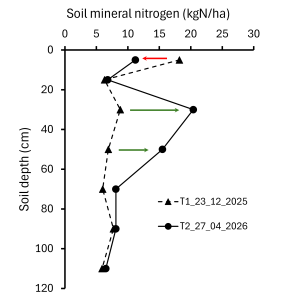
Figure 1. Difference in soil mineral N between 23 Dec 2025 (T1) and 27 Apr 2026 (T2) at the Karyrie nitrogen trial. Arrows represent direction of significant change between T1 and T2.
How to use this information in a 2026 N strategy
Understanding the quantity and distribution of soil nitrogen, including mineralised N present at the beginning of the growing season, assists growers in developing fertiliser strategies aligned with crop yield potential.
Crop models such as Yield Prophet®, can assist with in-season nitrogen decision making. Other approaches include nitrogen budgeting methods such as the Harries et al. (2022) framework and N banking concepts, which estimate crop nitrogen demand based on expected yield potential. Fertiliser decisions can then be based on balancing projected crop demand against available soil and fertiliser nitrogen supply.
Where crops utilise nitrogen derived from soil mineralisation, it is important to recognise that this nitrogen originates from soil organic matter reserves. Over time, continued net export of mineralised nitrogen without replacement may contribute to declines in soil organic carbon and long-term soil fertility. Consequently, maintaining system nutrient balance through fertiliser inputs and residue retention remains important.
Mineralisation at other times of the year
Nitrogen mineralisation continues throughout the growing season; however, once crops are established it becomes difficult to quantify total mineral N supply because plant uptake and mineralisation occur simultaneously.
In southern Australian cropping systems, mineralisation rates commonly increase during spring in response to rising soil temperatures, provided soil water remains adequate. However, peak mineralisation often occurs after the period of maximum crop nitrogen demand, which typically occurs between stem elongation and flowering in cereals. An exception can occur in higher rainfall environments where soil water persists later into spring and crop demand extends further into the season.
The upshot
Mineralisation of organic nitrogen into plant-available mineral nitrogen does occur over the summer period. The amount depends largely on rainfall and soil water status, levels of soil organic matter and temperature. In this article we also presented that there is likely movement of nitrogen down the soil profile, when rainfall is sufficient.
Best bet is, close to sowing take a 0-10 and 10-60 cm representative soil samples from the paddock and get it analysed for ammonium-N and nitrate-N. From here, calculate the kgN/ha of soil mineral N in the 0-60 cm of the soil profile and factor that into your fertiliser calculations. This method bypasses the complexity of trying to model or use rule of thumb estimates particularly when making such important decisions on N-fertiliser requirements.
Written by Louisa Ferrier, Dr James Nuttall and Matt Lade, BCG.