

French student Sebastien Sester is undertaking a six month practice-orientated internship at BCG, examining agronomic and farming systems research as part of his Masters of Science at Wageningen University in the Netherlands.
As part of his work experience Sebastien is providing fortnightly updates to his course supervisor. These updates also provide a valuable international perspective to BCG and our members.
Sebastien’s report from the past fortnight (July 1-15) follows:
BCG’s big event, ‘diversity is key’ and a snapshot of Northern American knowledge on no-till farming
By Sebastien Sester
It has been another pretty busy fortnight at BCG, namely with the organisation of one of BCG’s main event, the Future Farmers Expo. Work on trial sites has slowed down a bit because of damp conditions – which is after all not a bad thing… I also attended an eye-opening event at the Victorian No Till Farming Association Annual Conference.
On Wednesday July 4 BCG hosted its annual expo, with the theme Future Farmers. BCG members and non-members attended different presentations on climate forecasts, agronomic practices (Russian Wheat Aphid update, precision agriculture and tools in practice), and farm management (practicalities of having a farm board, buying land or investing off-farm, finding the right balance in enterprise mixes).
The Expo was a great success, as more than 300 people attended the event. Around 15 exhibitors were present too and promoted some of their products or services. The atmosphere was very enjoyable, and speakers, farmers and exhibitors showed great interest and participated in discussions.
Two farm consultants gave a very interesting presentation about succession planning and if it is best to invest off-farm or buying more land. With growing farm sizes, farmers are often challenged by the value and the efficiency of their current machinery. A number of times, farmers who bought more land ended up needing bigger machinery. But when they purchased new equipment, they realised that they need even more land to cover the costs of the new machinery. As a consequence, some farmers get caught in a loop having negative effects on their business performance and causing financial problems. To avoid such things from happening and to plan a good succession, the speakers advised farmers to clearly know their current positions, to spend time and money in determining long term goals and strategies for the farming business and to quantify all investments.
Before considering expanding the farm, it is advisable to have estate and succession plans, as well as to consider the risks of diversifying. The speaker emphasized the fact that without a plan, the security and the future of the business are at risk.
I had confirmation at this event that farmers have to deal with all sorts of problems, either being short term (operational problems, weather, machinery breakdowns) or long term (strategic management, buying land, succession planning). This event made me realise that it definitely takes more than just an agricultural diploma to be a successful farmer in 2016.
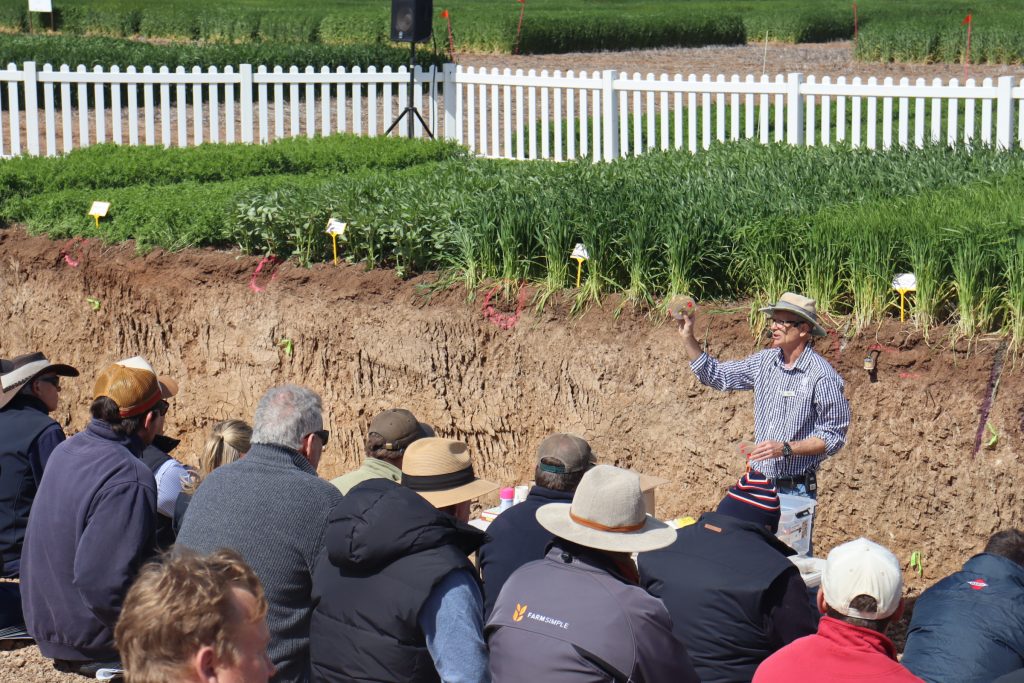
The other event I attended was the annual conference of the Victorian No Till Farming Association. This event was for me a real eye-opener: indeed renowned scientists from the USA and Canada joined the event, along with leading Australian no-till farmers.
Some speakers were very practical, while some others very holistic on their approach to farming. For instance, a South Australian farmer explained in details what machinery he uses to direct drill his crops (wheat-wheat-canola rotation) and cover crops, and how he modified it to obtain better results. Thanks to GPS-steering, controlled traffic and his modified disk seeder he is able to sow crops through big amounts of stubble, which provide him a permanent ground cover.
A former USDA researcher – fired for having publicly told the truth about the effects of neo-nicotinoids on bee populations – gave an inspiring presentation on the benefits of mixed cover crops in no till systems for insects populations.
The day after the presentation we went on a bus tour to a local grower who does no till with cover crops and visited some of his paddocks. The tour was very instructive, as the speakers showed us large diversity in below-ground and above-ground populations (earth worms, insects, plants, fungi), contributing to the increased system’s resilience. This farmer also works with companion crops (bean-wheat, bean-canola, vetch-canola), which allows him to reduce his inputs, as he does not apply urea after sowing.
I really enjoyed this event since I could meet and talk to innovative farmers and researchers. I think that they are doing progressive work, bringing valuable innovation into farming. It was good to see what they were able to achieve in their systems. This was definitely a source of inspiration for my personal development. The take home message from this event is that ‘diversity is key’.
Nevertheless, I felt like people around Birchip were not that enthusiastic about it. Indeed, some of the farming systems promoted at the Conference require more rainfall than what the Mallee gets, which is why farmers are not keen to adopt such practices. Farmers around here do not want to ‘waste’ any rain on a cover crop when they could grow a cash crop instead. It is a fair and understandable decision, but I still believe that by using low-disturbance stubble retention systems, farmers could keep more soil moisture from one year to another. In addition, using mixtures of legumes and cereals could work in dry conditions too, and would allow Mallee farmers to decrease their reliance on chemical fertilisers.
Hopefully BCG will undertake research in these domains in the coming years, in order to better assess the relevance and the application of these practices in the Mallee.
Last week, I visited different companies and organisations to learn how they work and what they do in the agricultural sector. I visited a canola pathology research centre, the Victorian Department of Agriculture, breeding program at Bayer CropScience and farms in the Wimmera with a Horsham-based agronomist. Once again, there are many things to learn.
More of Sebastien’s reports can be found here.