

The GRDC funded project “Application of controlled traffic farming (CTF) in the low rainfall zone” now has two complete years of data. This has provided some expected results but at the same time the results are raising new questions around the benefits of CTF in low rainfall environments.
At the projects four research sites (Minnipa and Loxton in South Australia, Nowie in Victoria and Lake Cargelligo in New South Wales), impact on crop performance has shown a measured difference of five to 30 per cent decrease in crop yield in severe traffic treatments. These differences are not as large or as constant as previous research conducted at other sites higher rainfall sites like the self-mulching clays of Queensland and Western Australia.
Results from hand cuts taken by Central West Farming Systems, Upper North Farming Systems and the Eyre Peninsula Agricultural Research Centre in 2015 and 2016 showed that most of the time, yields were higher on the non-wheel tracked areas compared to wheel tracks. However, this was not always the case. This season, the project will be investigating the cause of these discrepancies.
The Australian Control Traffic Farming Associations (ACTFA) greenhouse gas project, in partnership with this project, measured greenhouse gases on a site near Swan Hill. These results suggest that greenhouse gas emissions and denitrification losses are higher on trafficked soil. The project is again trying to seek answers to explain this.
Two pieces of equipment obtained through the project and available to Farmer group partners which will help answer emerging research questions are a digital penetrometer and a pullmeter
The penetrometer records soil resistance at varying depths as the rod is pushed into the soil, simulating root growth. This provides insight into how ‘tight’ a soil is across a length of ground and down to depth.
Figure 1 provides an example of interpreted data that has been collected using the penetrometer. The various colours represent the kPa (pressure) values with red being high pressure (poor root penetration). There is a clear spike in pressure at shallower depths at the one metre distance, which aligns with wheel compaction.
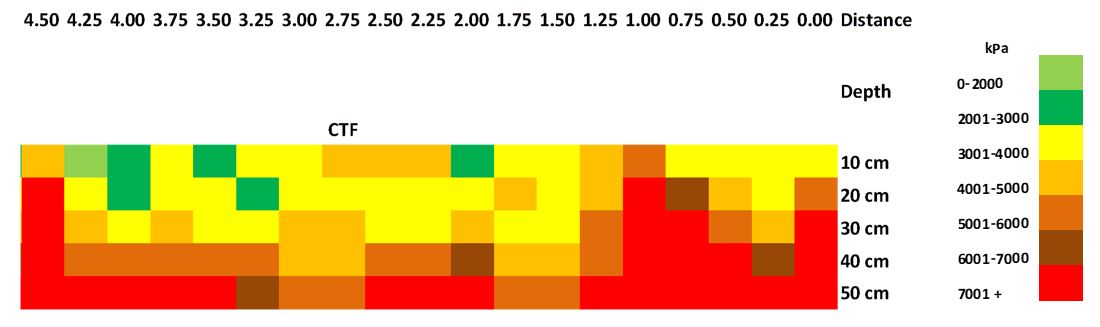
Figure 1: Soil resistance measured using a penetrometer for a CTF paddock at Nowie.
The pullmeter allows landholders to measure the impact on their equipment of the rolling resistance of soil both on and off compacted wheel tracks. Rolling resistance affects the energy and fuel required to move or pull machinery. Lower rolling resistance equates to less fuel used mean a saving in dollars to the farmer.
The “Application of controlled traffic farming (CTF) in the low rainfall zone” project includes many partners including ACTFA, Agriculture Victoria, South Australian Research and Development Institute, Birchip Cropping Group, Eyre Peninsula Agricultural Research Foundation, Upper North Farming Systems, Mallee Sustainable Farming, Central West Farming Systems and the Society of Precision Agriculture Australia.
Data from this project will become available to growers over the course of and at the completion of this project.