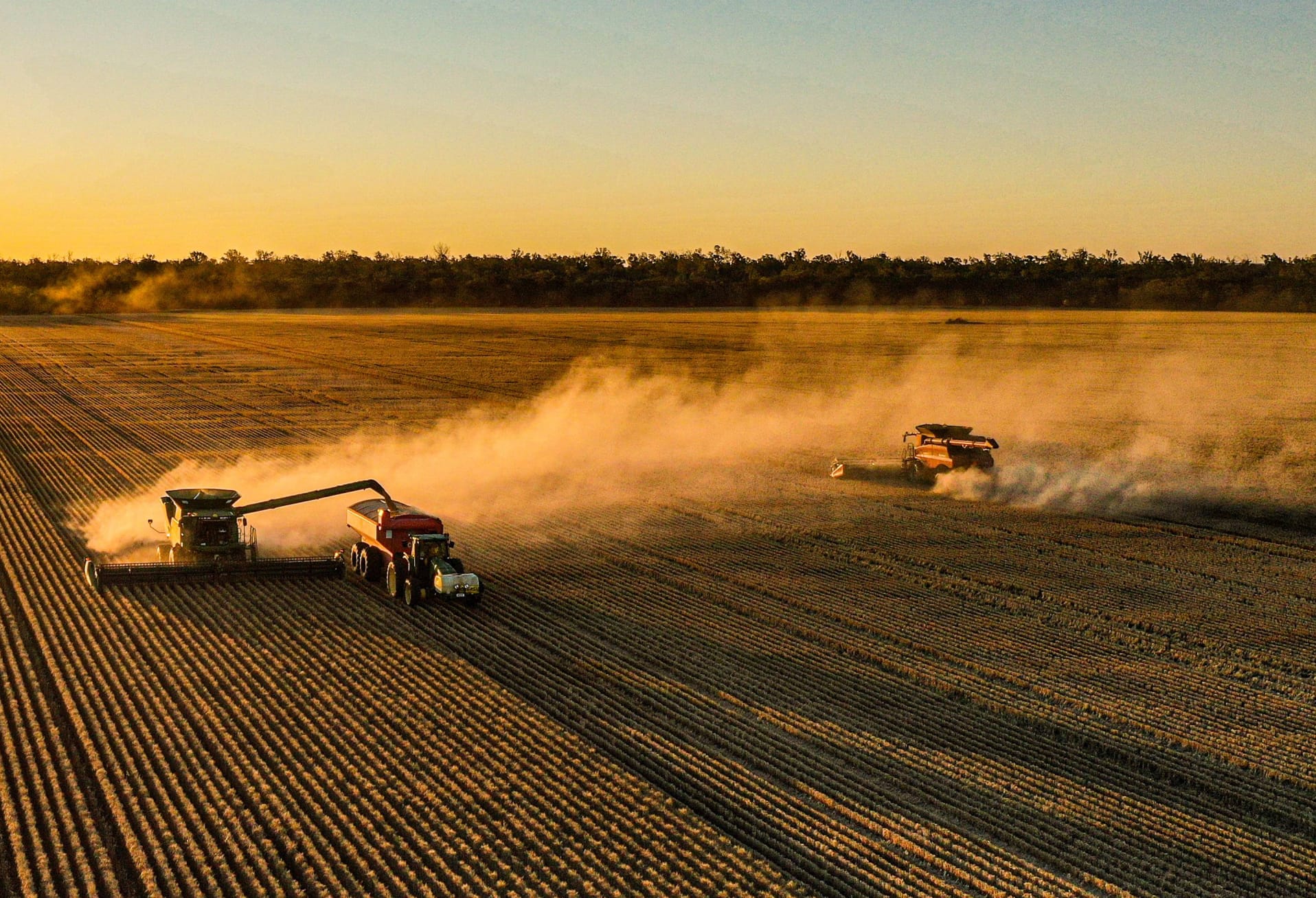
We recently caught up Catumnal farmer and BCG Board member Giles Cunningham.
Tell us about yourself, where you grew up, how you came to the farm, and what your role is today.
I grew up in Goulburn NSW, I never showed any interest in Ag at school. I was more interested in being a marine scientist when I left school, however I had a family connection at Lake Bolac and did a summer at a grain site followed up by a bit of header driving at uni and I was hooked on cropping. I finished Uni in Canberra and got a job as a graduate agronomist at a corporate farm in Hay growing cotton and durum wheat. After that I had a stint working for a seed company based out of Echuca and then moved out to Boort to manage a corporate farm when I was about 27 and I’ve been here since.
What does your farm operation look like?
Our enterprise is 100% cropping made up of Wheat, Barley, Canola, Legumes and Hay. We have some irrigatable country that we water opportunistically. We have 4 permanent staff who all live on farm and then we use contractors at different times over the year.
How is the season shaping up on your farm?
We have had a pretty reasonable season at Boort so far. We jagged a rain on ANZAC day and had a full profile into July. Unfortunately, we’ve had an exceptionally dry spring but it’s been cool which should get us through. We will be looking at slightly above long term yields if everything holds out from now. We will be extremely pleased with this is if it pulls off given the low rainfall year.
Are there any practices or pieces of equipment that have made a difference to productivity or cost control on your farm?
The things that really move the needle in terms of productivity and cost on this farm are pretty basic and can be difficult to pull off each year due to the huge variations we get in seasonal conditions. It’s mostly related to nailing summer weed control, timely sowing with good depth and placement and then making sure the crop has everything it needs to get the most out of what the season will give. We contract out sowing and harvest but internalise most other tasks like spreading and spraying which gives us more control over timeliness which really helps. We have just invested in a see’n’spray self propelled boom. The summers have been a bit too wet to fully test it but it’s allowed us to try newer tanks mixes, rates and chemistry during summer to give our usual summer knockdown chemicals a break.
Being a corporate farm, how do you think your approach to decision making and risk differs to a typical family farm? Do you have any advice to share with other farmers?
I get this question a lot. Obviously, all farms have their own risk appetite, machine capabilities and recency bias as to what they are happy to grow. Like a lot of family farms our budgets are developed early in the year for the following year. The budgets are developed in conjunction with our agronomist, the gross margins are stressed tested and then approved by the management team and finally the board. We still have financial parameters or KPI’s that we are measured on to remain profitable and as a manager we must recognise opportunities to increase revenue when the opportunity arises and also control our spending in a leaner year. When opportunities arise though we probably don’t have the same constraints in terms of cashflow to take them up so that can really help especially when the year starts off lean. We invest pretty heavily in our crops right up front which lends to more of that higher risk higher return approach as our crops are ready to go as soon as it rains, but also if it doesn’t there are not much input costs to cut down on. In terms of decision making, we are really held to accountable for what we do both to the corporate office and also the people we work with. So having good communication and using a range of sources of information is critical for me to do my job and makes for better decision making especially when times are a bit tight.
You’ve recently joined the BCG board. What inspired you to join? How are you finding your time on the board?
I joined the board several months ago, I was inspired by the forward-thinking nature of BCG and the opportunity to give back to the group that’s taught me so much. I’ve been attending BCG field days and events for over 10 years now. I’ve found it great to be an organisation with a passion for improving the farming landscape of North-Western Victoria.
Do you have a highlight of the recent BCG main field day?
I keep harping on about how good the discussions were at the oaten hay talk. The gross margins for Oaten hay on our farm has been really pleasing and our hay area is increasing with more experience we get growing it. The downside is the extra work but the upside in returns $/ha and the weed management has been excellent.
What do you love about farming?
I’ve never got to a Sunday and thought I don’t want to go to work on Monday. I love that no two days are the same and the people and equipment I get to work with are really great. This farm has also been so good to raise my young family, with a great community and a couple of ponies and dogs for them.
Drought is an inevitable aspect of the climate we farm in. How is your farm business preparing for future droughts, or potential financial shocks within the business?
I think recognising this is part of the deal and having eyes up about it all the time really helps. We have regular planning meetings every 3 months. This helps us stick to the plan. We can reevaluate and remove the external noises that arise when the seasons get a bit tough, and the pinch is on. We’ve invested in our skill and knowledge base around irrigation timing, hay production, IPM, nitrogen management, crop rotations. It’s about getting the basics right (sow on time, spray on time, spread on time, harvest on time) focus on what makes the most money. The worst decision you can make is none at all.
This project was supported by the Australian Government’s Future Drought Fund.

The Victoria Drought Resilience Adoption and Innovation Hub is a state-wide collaboration of 10 organisations.
Led by the University of Melbourne and with headquarters at UM’s Dookie Campus, the Vic Hub is a Partnership between five farming organisations (Birchip Cropping Group, Food & Fibre Gippsland, Mallee Regional Innovation Centre, Riverine Plains and Southern Farming Systems), four universities (UM, Deakin, Federation and La Trobe), and the State Government (through Agriculture Victoria).
One of eight hubs established nationally under the Australian Government’s Future Drought Fund (FDF), the Vic Hub works to enhance the drought preparedness and resilience of Victoria’s agricultural industries, the environment and regional communities, encompassing broader agricultural innovation. Engaging with a range of industry and community stakeholders, the Vic Hub links research with community needs for sustainable outcomes.