
With hopes of a promising harvest ahead, growers are turning their attention to fine tuning their harvester set up. There is a minimal room for waste in modern farming, with input prices soaring, every bit of grain in the bin makes can make a substantial difference.
BCG recently delivered GRDC Harvester Set Up Clinics in Bridgewater, Terrick Terrick and Ultima, giving growers the opportunity to fine tune their machines ahead of harvest.
GRDC Research indicates grain losses in Australian farming systems can be significantly higher than the commonly targeted two per cent, with estimated losses of:
- Wheat: 2 per cent
- Barley: 4.5 per cent
- Canola: 3.2 per cent
For example, consider a wheat crop yielding 4 tonnes per hectare and valued at $360/t:
4 t/ha x 2% = 80kg of grain lost per hectare
Across a 1,000 hectare wheat program, that equates to 80 tonnes of grain.
At $360/t, that represents $28,800 in potential lost income in a 1,000 hectare wheat program.
Grain loss is only one part of the profit equation when it comes to harvester set up, and the clinics demonstrated the range of factors growers can adjust to improve overall performance.
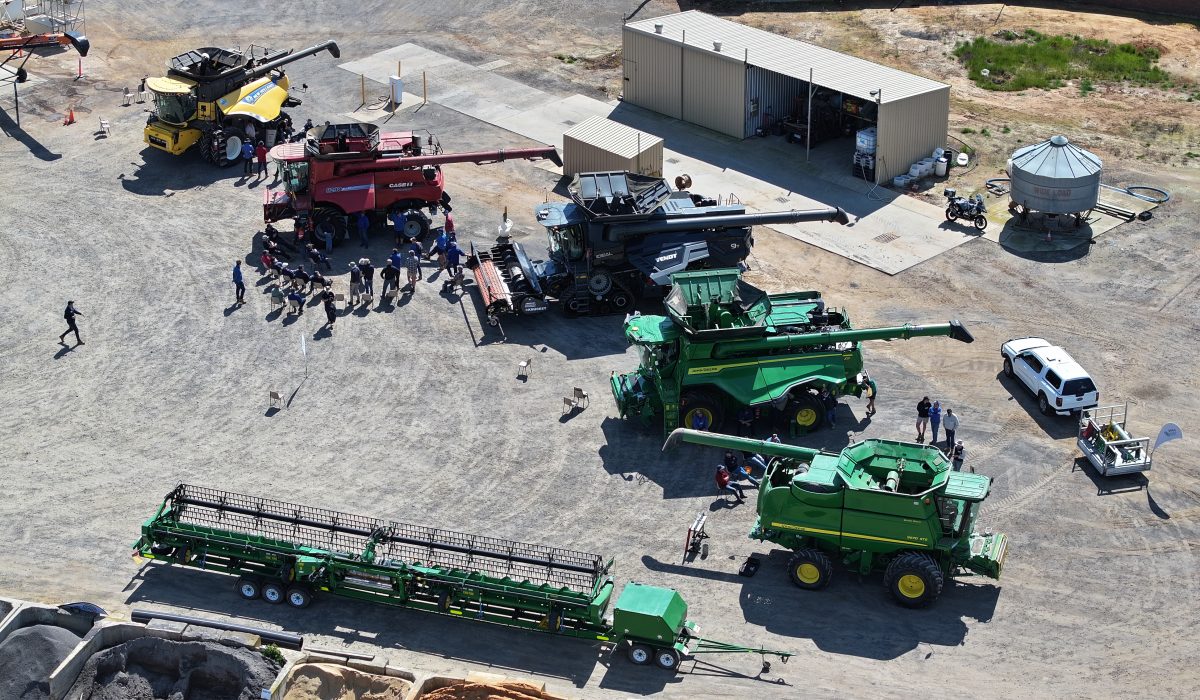
Growers worked directly with the different machines brought along to the clinics, including John Deere, Case IH, New Holland, Fendt and Claas harvesters.
Sessions covered measuring grain losses, reducing front losses, feeder house set up, threshing system configuration, cleaning area adjustments, harvest weed seed control, safety and more.
BCG staff member and Woomelang farmer Joe Collins said some of the key takeaways were challenging the common perception that slowing down is always the best way to reduce losses.
“If the header is set up correctly, you can potentially travel 1km/h faster while still maintaining grain quality and minimising losses.”
A key focus was understanding and configuring your particular machine, and knowing how to get the most out of it. Mr Collins was surprised just how closely you have to look at every part of your machine.
“I learnt you need to start right at the header front and work your way through, looking at everything sequentially to where the grain travels. Knife, feeder house, concaves, sieves, just to name a few. I’m guilty of adjusting one component and calling it a day, rather than looking at the machine as a whole.” Mr Collins said.
With crops expected to be heavy in many areas this season, making small, measured adjustments regularly will be important. The GRDC Harvester Set Up guide recommends adjusting settings in small increments, including:
- Concave gap in 1 mm steps
- Rotor or drum speed in 50 rpm steps
- Ground speed in 0.2 km/h steps
- Fan speed in 40-50 rpm steps in tougher conditions
- Fan speed in 20-30 rpm steps later in the day
These adjustments can be used to establish benchmarks for different times of the day, allowing growers to quickly fine tune their machines as crops and conditions change.
As always, you can only manage what you measure.
Factual information sourced from the GRDC Harvester Set Up Guide.
If you’ve lost your booklet, or didn’t get the chance to attend in person. Here is some helpful material from GRDC:
Reducing Harvest Fire – Back Pocket Guide
Harvester set up video series: 6/6 | Harvest Weed Seed Control