
Wheat growth response to different rates of phosphorus (P) applied at sowing when measured at the start of stem elongation were considered “massive” and hopefully, this will translate to yield this harvest.
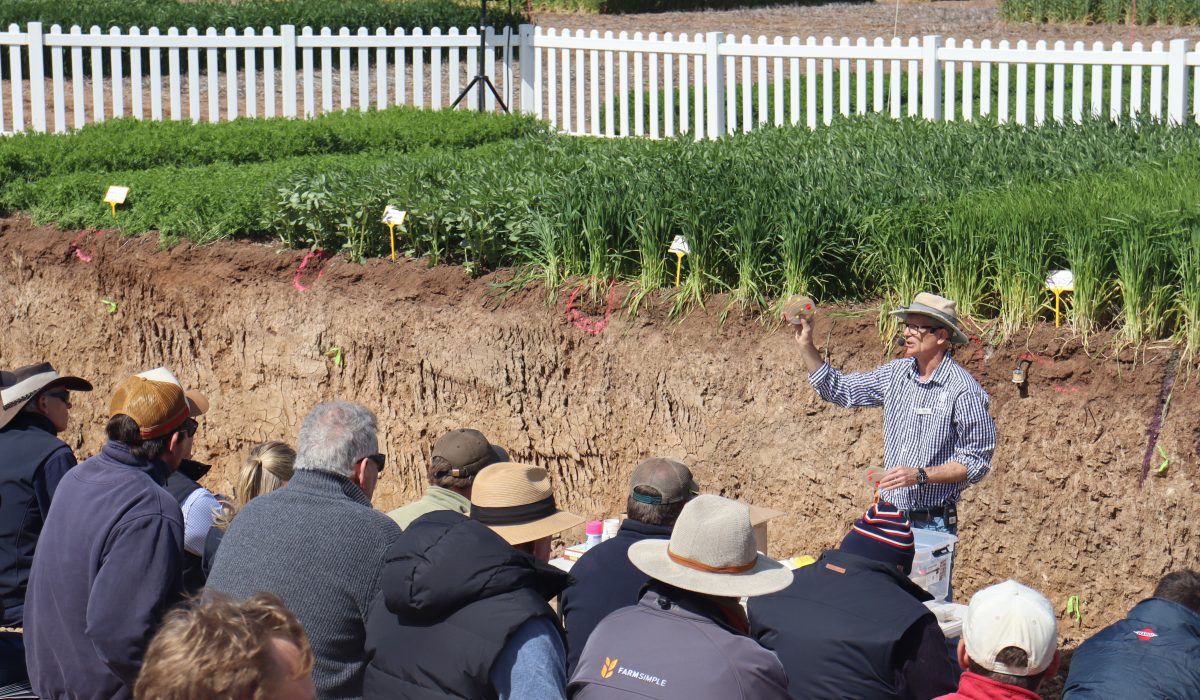
In a presentation at the BCG Main Field Day at Curyo, BCG Senior Scientist Dr James Nuttall said biomass assessments at the start of stem elongation in wheat (Zaddock’s Growth Stage 30) showed statistically significant responses to P compared to the ‘nil’ control treatment (Figure 1). “Where 50 kg P /ha was applied as mono-ammonium phosphate (MAP), there was an 81 per cent increase in early growth over the control and a 50 per cent increase over district practice (around 10 kg P/ha)” he said, adding: “For a fluid form of phosphorus treatment, phosphoric acid (PA), there was an initial significant increase in wheat growth at 15 kg P/ha compared with the control, however, for PA rates above this, the response plateaued.”
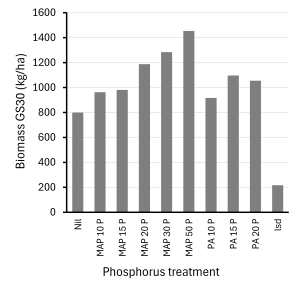
Figure 1. Wheat biomass (GS30) response to phosphorus fertiliser. MAP, mono-ammonium phosphate; PA, phosphoric acid. Rates compared were Nil, 10, 15, 20, 30 and 50 kgP/ha; lsd, least significant difference = 217 kg/ha, (P< 0.05) for treatment comparison. Treatment differences exceeding the lsd are significantly different.
He said that with adequate nitrogen and soil water currently available to the crop, it will be very interesting to see if the early responses translate to yield.
“And if we can realise the yield from this early growth, it’s going to be phenomenal” Dr Nuttall added.
Background
Phosphorus is one of the major nutrients vital for plant growth. Typically when phosphorus fertiliser (MAP) is applied to the soil it dissolves rapidly and exists as orthophosphate ions (H2PO₄⁻ and HPO₄²⁻) within the soil solution. These inorganic forms are available to plants. The orthophosphate ions also react within the soil and become less available to crops. They can be sorbed onto charged surfaces of solids, immobilised within microbial biomass or more strongly bound or precipitated with soil minerals.
For alkaline calcareous soils, such as those in the Wimmera and Mallee, the orthophosphate reacts with Ca-containing minerals and form relatively insoluble calcium phosphate compounds and so can be high P-fixing. These ‘fixing’ reactions are also reversible through desorption, mineralisation and dissolution, although the speed of release of available P is less than crop demand, particularly during the early growth period of crops. Usually such soils have a high Phosphorus Buffering Index (PBI) values in soil tests and are highly responsive to the addition of P-fertiliser.
For the current trial described above, where large early crop growth responses to P-fertiliser rate have been observed, the topsoil (0-10 cm) PBI was 127, Colwell P, 15 mg/kg and DGT-P, 37 µg/L.
BCG Research
The results Dr Nuttall shared are from one of three experiments delivered by BCG as part of “Improving phosphorus use efficiency and return on investment in high Phosphorus (P) fixing soils of the Southern and Western Regions” , funded by the GRDC and the broader project led by Agriculture Victoria, and will run for three years from 2026 to 2028.
Five different rates of P will be applied each year (0, 10, 15, 20, 30 & 50 kgP/ha) as factorial combinations to investigate multiple strategies, residual value from year-to-year in keeping P available in the system and analysing which are the most effective combinations from both an agronomic and economic perspective.
“The best outcome is to identify phosphorus fertiliser management strategies targeted to calcareous high P-fixing soils within the Wimmera and Mallee that will better match crop demand, be economic and limit the impacts of P-fixation processes within the soil” Dr Nuttall said. “The results are exciting thus far.”
Should I do some soil testing next autumn?
With high input costs, including fertiliser, the audience were keen to know about the value of soil testing. Dr Nuttall offered some considerations, particularly given the high rainfall received across the region this year:
- It’s worth doing some soil tests to depth (60cm) for soil mineral nitrogen and soil water and find out what’s being carried over for 2027, where it’s sitting in the soil profile and is it available to the crops. At very least, test as layers 0-10, 10-30, 30-60 cm to see the vertical distribution.
- Any leaching of nitrogen (N) down the profile can be potentially linked with soil acidification, particularly for lighter textured topsoils. So consider digging a shallow hole to about 40cm, a “mini pit”, and using a pH indicator kit (available from hardware stores and nurseries) to identify potential acidification issues.
- Soil structure and best management for sodic soils, by running some easy kitchen bench dispersion tests of placing soil peds in a bowl of distilled water and checking for excessive cloudiness halos after 12/24 hours. Check soil samples from 0-10 and 10-20 cm.
- For soil P status, potentially revisit soil tests to assess not only Colwell P and/or DGT-P but also PBI to get a gauge on the P-fixing potential of your soil.
- Large crops in 2026 are likely to export large amounts of key nutrients, so other than nitrogen and phosphorus, the status of soil nutrients such as sulphur, potassium, zinc and copper are also important.