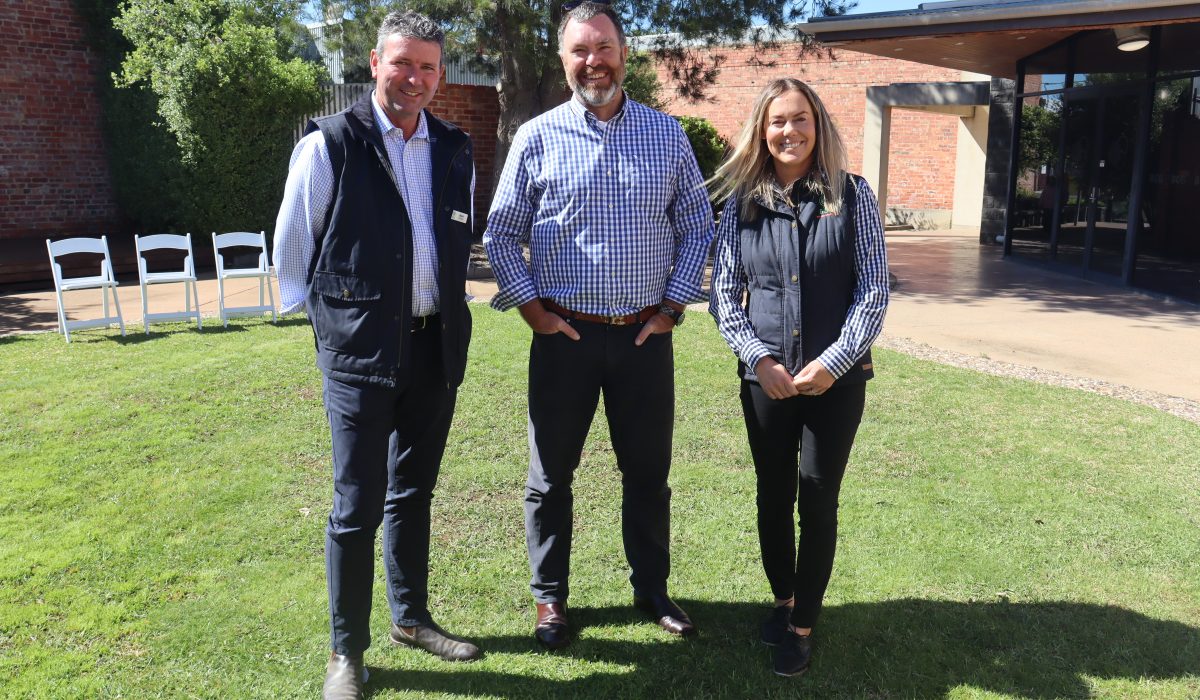
Perfect weather conditions prevailed at BCG Place on Thursday 8 October for the fifth annual BCG Chair’s breakfast, as attendees came from as far as Horsham, Swan Hill and Bendigo to hear guest speaker, Dr Andrew Watkins, share his insights about the risks and opportunities for the next generation of farmers, featuring an overview of the National Climate Risk Assessment of which Dr Watkins was a Lead Author.
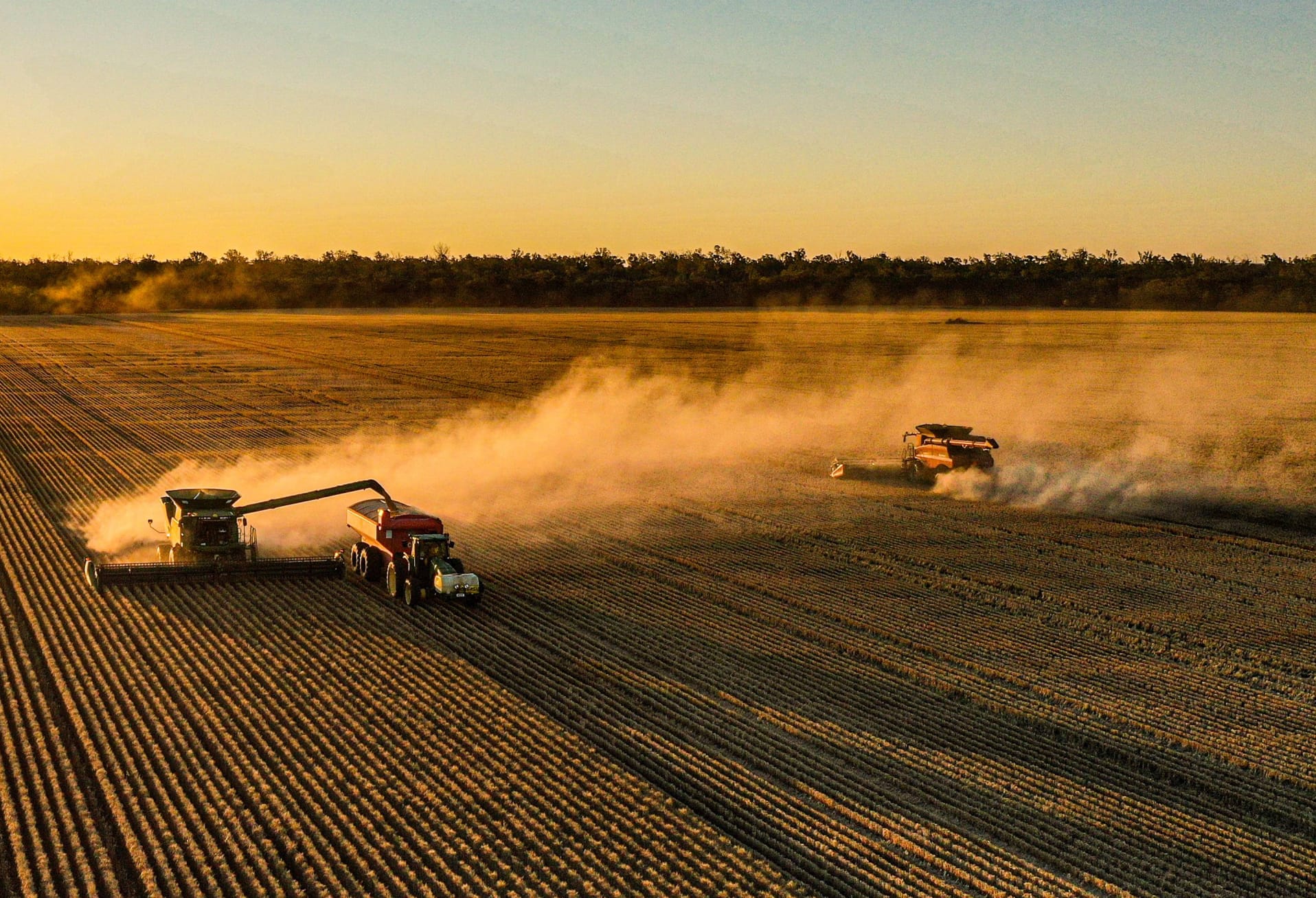
Dr Watkins is based in Melbourne, and is an Adjunct Professor at Monash University’s School of Earth, Atmosphere and Environment, a Climate Councillor with the Climate Council, and a Fellow of the Australian Meteorological and Oceanographic Society. Andrew also has a long connection with BCG, having presented climate outlooks at several BCG events and field days when he was the Head of Climate Prediction at the Bureau of Meteorology for over a decade. The connection to the region goes beyond his scientific work. In 2021, when COVID meant workers were scarce, Andrew took time away from the BoM during harvest to drive a chaser bin on the Ferrier’s Wirrabilla farm, something he very much hopes to do again.
BCG Board input
BCG CEO, Fiona Best, acknowledged BCG Chair, Brett Hosking’s, contribution to the day explaining that traditionally the event is funded by the Chair foregoing their board payment. In his welcome, Mr Hosking said the purpose of the morning was not just to enjoy a coffee and some delicious local food, but he highlighted the value of creating opportunities for connection in rural communities; “it’s a chance to look after ourselves and also, to learn” he said.
“My role on the BCG board is one that I love” Mr Hosking added “there is generosity from all BCG Board members to work towards greater outcomes, to think about how we can help farmers and communities and I am proud of BCG and what it achieves”.
In welcoming Dr Watkins, Mr Hosking said “when it comes to climate science and climate change, I think it’s important that we learn about the challenges and opportunities about the steps we can take to respond”.
From the past to the present
The presentation was wide-ranging from the definitions and history of weather, climate, greenhouse effect, climate variability and climate change, through to what’s happening in 2026 and then looking to the future, which is a particular focus of last years National Climate Risk Assessment. Attendees also reflected that Andrew’s presentation didn’t just focus on agriculture, but also those many areas that are agriculture adjacent, including considerations for local Councils, rural health care providers, financial institutions and most importantly the rural communities themselves.
Some of Dr Watkins’ reports were sobering: he pointed out there were two centuries of evidence linking CO2 with a warmer climate and that during this time, CO2 levels had risen from 280ppm to the current day 430ppm. “No-one since humans first walked on the planet 300,000 years ago has experienced CO2 above 400 ppm until now” he said.
He also reported that the last 10 years have been the globe’s hottest 10 years on record, with 2024 being the hottest of all and further 2026 was shaping up to be either the hottest or second hottest year on record. “Every single year since 2011 has been hotter than the hottest year of the 20th century.” he said.
But he highlighted the considerable achievements growers have made through advancements in technology and farming practices: “Credit to organisations like BCG who can support growers to achieve cropping success on farms with half of Melbourne’s annual rainfall”.
He talked about the weather anomalies of 2026, such as the high growing season rainfall despite El Nino being declared in June. Apart from the broader climate trend towards warmer and drier cropping seasons, Andrew talked about the current “three way battle” between activity in the Pacific Ocean (currently at near record El Nino levels; a dry signal), changes in the polar winds high in the stratosphere above Antarctica (pushing our weather systems further south; a wet signal ) and the Indian Ocean (currently very warm even near Australia, potentially a wet signal) all trying to influence weather in South Eastern Australia at once. “Every model in the world is struggling at the moment (to predict the season outcomes)” he said.
What’s next?
Dr Watkins outlined his work in the National Climate Risk Assessment, which asks the question:
“What would Australia look like if the world was 2 or 3 degrees hotter than the past?”
He said that hazards such as heatwaves, time spent in drought, bush and grass fire, large hail events are likely to increase in intensity, frequency and area impacted and are likely to be compounded where two or more hazards may occur at once.
“All aspects of Australian society are already being affected by the changing climate” Dr Watkins reported. This includes primary industries and food, health and social support, economy, trade and finance, and communities. “The risks are interconnected” he said, “for instance rain damage on roads can lead to more downtime for supply chains – something vital to us all”. He noted one significant area assessed was changes in the distribution of crop disease, pests and weed infestations, with northern crop issues shifting south.
The vulnerability of communities that rely on agriculture was also highlighted. Reflecting BCG Chair Brett Hosking opening comments, Dr Watkins highlighted the value of building local connections through organisations like BCG, local sporting and arts organisations. “Strong communities are more resilient” he said “it’s critical to have places where everyone can get together, talk, swap ideas and pitch in”
He concluded that the National Adaptation Plan, an outcome of the National Climate Risk Assessment, was about outlining how governments can support every community to adapt to the challenges of their climate.
“Birchip is as important as Bondi” he said.
Tools
To learn more about the National Climate Risk Assessment visit: https://www.dcceew.gov.au/climate-change/policy/adaptation/ncra
National Adaptation Plan: https://www.dcceew.gov.au/climate-change/policy/adaptation/ncra
What to expect from climate at your place: https://myclimateview.com.au/climate-data