

Background: Vetch is a versatile crop option for farming systems in the Mallee, Wimmera and North Central regions. The advantages of this enterprise include:
- versatility as a brown manure crop,
- dry sowing options,
- drought tolerance and
- can be grown for grazing, seed or hay production, unlike other break crops.
As a fodder option, vetch is an annual plant offering more flexibility for grain growing businesses compared to lucerne which is perennial.
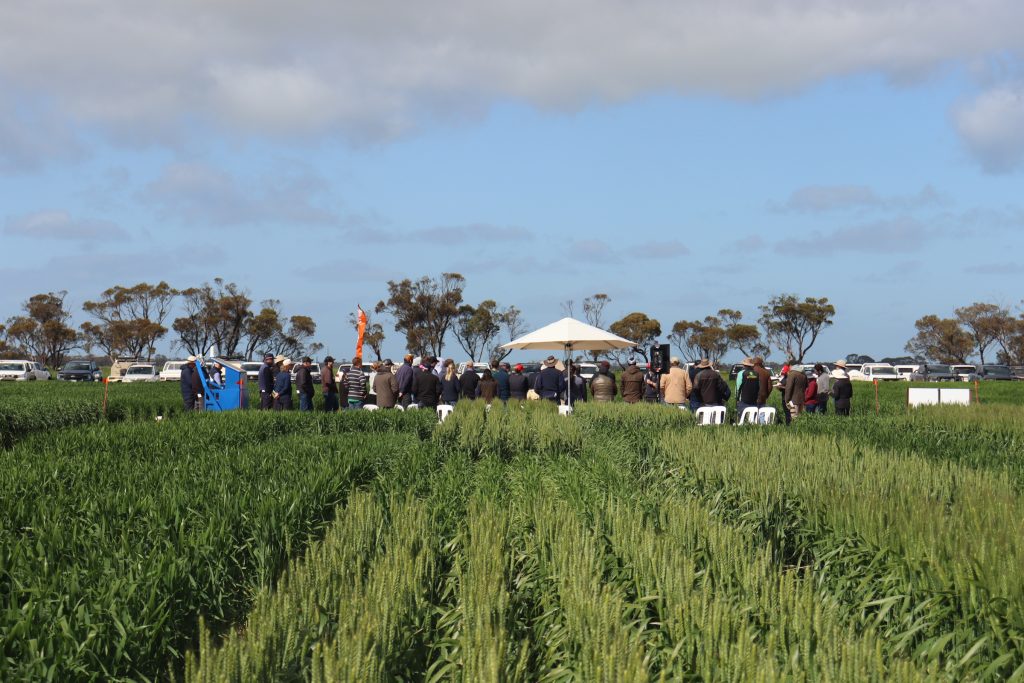
At GRDC’s National Grower Network (NGN) meeting held in Birchip in June 2023, growers identified the potential of the vetch hay enterprise for delivery of vetch hay to nearby dairy fodder markets at locations to the north along the Murray River or south into the Western District.
This fact sheet outlines some of the factors affecting vetch hay markets in the local dairy industry.
A profitable enterprise
A partial gross margin sensitivity analysis of price and yield (Table 1) demonstrates the profitability of vetch hay production in a range of prices and yields. The analysis indicates it is a profitable enterprise where only the lowest price ($100/t) and lowest yield (1t/ha) produced a negative gross margin.
Table 1. Vetch hay yield and price sensitivity analysis ($/t partial gross margin)

Current vetch hay prices average $410/t, and yields in 2024 were 3.8 – 4.5t/ha (Bennett and Butterfield, 2024) and averaged 6.0t/ha in 2023 (Bennett, 2023).
Quality parameters dairy farmers look for
Neutral Detergent Fibre (NDF) and its digestibility are critical parameters for dairy farmers. Feeds with excessively high NDF levels, or those with low NDF digestibility or a slow rate of NDF digestion, can limit dry matter intake by reducing the total amount of feed cows are able to consume each day. Ideally NDF is between 40-55.
As vetch is usually sourced as a protein feed, the Crude Protein (CP) parameter is important.
Another parameter to keep in mind is Ash, which is usually an indicator of dirt contamination. Dairy farmers will tend to avoid forage if the Ash analysis is around 10% or more.
A feed test analysis will indicate the quality of hay and how much NDF, CP and Metabolisable Energy (ME) is available.
Vetch alternatives
Dairy farmers consider both price and protein content when purchasing feed.
Supply and demand are the main price drivers for vetch hay. Vetch is a popular choice due to its local availability and balanced nutritional profile, but it would typically need to be priced around $285/t or less to match canola meal based on protein value.
Alternatives to vetch hay include lucerne and canola meal if vetch hay prices are too high. Canola meal offers high protein density at good value, with a protein cost of ~$13.90 per unit of protein. Lucerne remains a valuable multi-purpose option but is a more expensive source of protein on a per unit basis.
Figure 1 compares the current average market price of vetch, lucerne and canola meal to the break-even price at which each becomes competitive based on crude protein cost.

*Vetch hay $405/t, Lucerne hay $435/t, Canola meal $500/t
Figure 1. Current vs break-even comparison of vetch, lucerne and canola meal based on crude protein cost
Some dairy farmers have established relationships with vetch hay growers. While producing vetch for hay may present an opportunity depending on the season or weather events, supply into the dairy market isn’t guaranteed and growers are encouraged to find a market for their hay early in the season.
References
Bennett B. and Butterfield A., 2025, 2024 BCG Season Research Results, ‘Vetch end-use and its legacy effect on wheat’, pp 240-246, https://www.bcg.org.au/research-article/vetch-end-use-and-its-legacy-effect-on-wheat/.
Bennett B., 2024, 2023 BCG Season Research Results, ‘Vetch end use and how it affects the cropping rotation’, pp 171-178, https://www.bcg.org.au/research-article/vetch-end-use-and-how-it-affects-the-cropping-rotation-2024/.
CSIRO nutrient requirements of Dairy Cows SA0501051
Beef Cattle Drought Feeding Book | Agriculture Victoria
Acknowledgements
With thanks to Yvette Williams and Natalie Schlitz, Dairy Australia and Vanessa Curtis, Australian Fodder Industry Association (AFIA) for providing industry insights and expertise.
This research was funded by the GRDC as part of the ‘NGN – Vetch agronomy for the lower Vic Mallee’ project (BWD2304-001SAX).