

AgFACE research presented to the world
DPI Horsham’s Australian Grains Free Air CO2 Enrichment (AGFACE) project was recently presented to an international audience who welcomed the contribution the Australian project is making to FACE research around the world.
With atmospheric carbon dioxide (CO2) levels predicted to rise by almost 50 per cent by 2050, the DPI and University of Melbourne AGFACE project is seeking to understand what impact this is likely to have on future grain production.
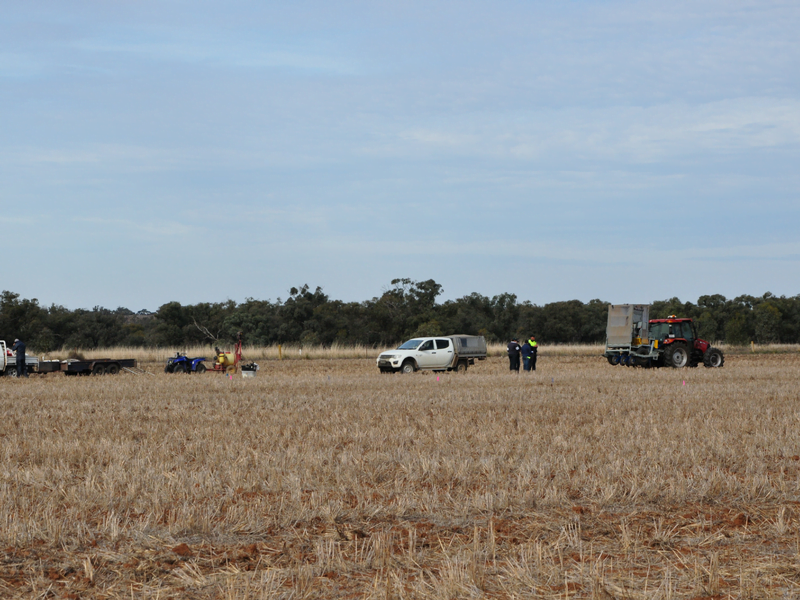
The Wimmera experiment, which sees crops circled by pipes that release higher levels of carbon dioxide, is one of a seven FACE programs being conducted across the globe but it is the only one representing low rainfall, rain-fed grain production.
AGFACE program coordinator Glenn Fitzgerald and senior scientist Garry O’Leary, travelled to Asia earlier this year to see the RiceFACE (Japan) and ChinaFACE projects and to take part in an international workshop attended by representatives from every agricultural production FACE experiment site in the world.
The aim of the trip was to share knowledge with overseas FACE researchers and to see how the AGFACE project compared.
Dr Fitzgerald said while there were slight methodological differences between the Australian FACE project and its overseas counterparts, the AGFACE program was well regarded abroad, particularly for the efforts being made to incorporate simulation modelling into the project.
During the trip, Drs Fitzgerald and O’Leary learned that not all FACE projects were using validated simulation models and hence, findings couldn’t be applied to other regions.
Dr O’Leary, who is the FACE modelling project leader at Horsham, said validation of crop simulation models is important for increasing confidence in predicted future climate change scenarios.
“The primary question for modellers is how can the observed response from an experiment be properly extrapolated to another location (soil, climate, management),” he said.
“Models provide a mechanism to communicate future effects of elevated CO2 on crop production across the Australian landscape through international and Australian networks.”
Dr Fitzgerald said the overseas FACE researchers were very interested in the modelling work attached to the AGFACE program and one of the outcomes of the trip was a commitment to build linkages between international experts in elevated CO2 research.
While at Tsukuba in Japan, Drs O’Leary and Fitzgerald took part in a workshop hosted by the National Institute for Agro-Environmental Sciences at which the director, Dr Kiyotaka Miyashita, challenged the gathering to critique the research and clearly identify its strengths and failings.
The conversation and ideas exchange continued in both formal and informal settings as the duo toured Japanese and Chinese FACE trials and met with researchers, technicians and scientists working on the projects.
It was concluded that more FACE experiments are needed in marginal areas of the world to provide scientific knowledge to address the present “rapid climate change threatening the globe”.
“One of the lessons we learned from Japan and China is that they take climate change very seriously,” Dr O’Leary said.
“They described what we’re experiencing now as ‘rapid climate change’ and emphasised a need to use technology to the maximum to minimise the deleterious effects.
“The present FACE metadata are insufficient because they do not contain critical data on crop response in marginal cropping areas.”
In addition, Dr O’Leary said primary data was being overlooked (such as grain quality).
“More new data on grain and food quality in general is needed,” he said.
Indeed, AGFACE research has already revealed that while there is the potential for grain yields in some regions to increase under elevated CO2, it is likely that grain quality will be adversely affected.
The trip provided an opportunity to identify problems with current FACE research, but the good news, according to Dr O’Leary, was that progress is most certainly being made.
“We are getting consistent results in terms of crop response to elevated CO2 from all FACE facilities around the world,” he said.
“A shifting emphasis on nutritional aspects of food is now evident and is expected to shape future experimental work.”
Dr Fitzgerald said much was learned from the trip to China and Japan, but more importantly relationships with researchers in other parts of the world were forged which would provide DPI with access to international expertise.
Looking ahead, he said future FACE research would seek to deliver clearer understandings about interactions between elevated CO2, drought and temperature; the effects of extreme climatic effects (such as heat shock); cultivar response and design; and the impact of pests and disease.
For more information on the AGFACE program visit the Primary Industries Climate Challenges Centre website at: www.piccc.org.au/AGFACE