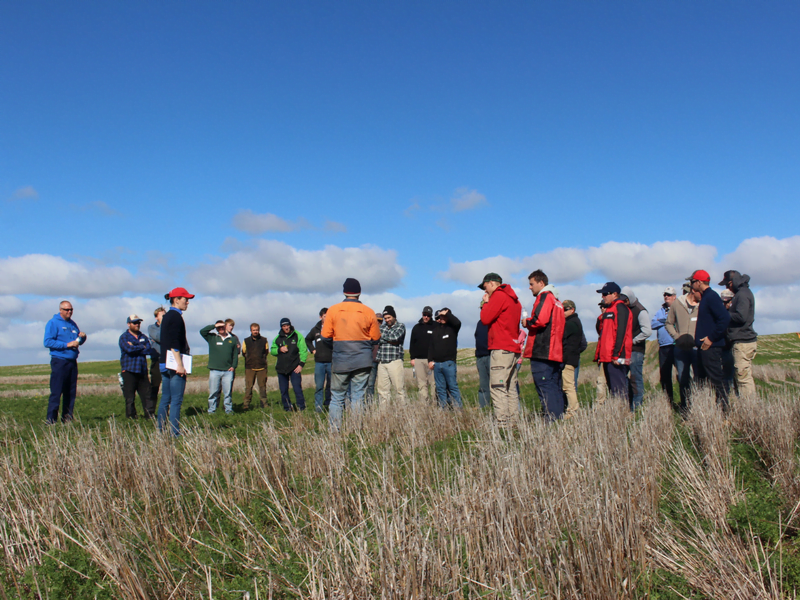


The grower discussion group returned to BCG in 2015, but this time with something extra. The first meetings for the GAPP program (Growth, Adoption, Productivity and Profit) were held in March for young (and young at heart) farmers. The objective of the initiative, which is run by BCG in partnership with the State Government, is to increase on-farm production in ways that maintain or increase profitability for farmers in the grains sector.
GAPP groups were established at Manangatang, Hopetoun, the southern Mallee, Rupanyup and Horsham along with a Women’s group based out of Birchip. Each group met three times this year and nearly 90 people in total have attended.
GAPP program co-ordinator, Linda Walters said an aim of the initiative was to see if a new model for agricultural research, development and extension could stimulate adoption.
“As the year draws to a close, it’s worth reflecting: have the participants improved their skills in growth, adoption, productivity and profit?” she said.
The workshops were facilitated by BCG but are ultimately farmer-driven, providing a platform for growers to get a better grasp on the productivity and profitability of their businesses, with input from grains industry experts, agronomists, researchers, financiers and other farmers.
Each group has a supporting local agronomist/s who provides guidance and information at each meeting and adds district knowledge to the discussion. The content was bolstered by guest speakers and industry specialists including Harm van Rees (CropFacts), Jeannette Long (Ag Consulting Co.), Phil O’Callaghan (ORM), Dale Grey (DEDJTR), Leigh Pyke (Mallee CMA) and Chris Korte (Department of Economic Development). BCG staff have also presented at various times about Yield Prophet, herbicides, weather analysis and social media. At the latest GAPP Women’s meeting, group member Julia Hausler stepped back into the lecturing shoes to give an informative presentation on grain marketing.
At the initial meeting of each group participants were asked to complete a ‘Farm business health self-assessment’ to get an idea of current knowledge levels and to identify areas for skill development. The questionnaire asked participants to rank their knowledge from 1-low to 5-high in a range of demographic, business and agronomic factors including age, ability to develop a farm business plan, enterprise analysis, labour management, crop nutrition, chemicals, risk management and decision making.
The assessment proved helpful to the farmers as well as the facilitators with one participant pointing out, “You don’t know what you don’t know”. As the program progressed, it was clear there were areas to learn and just as importantly, to share knowledge.
Southern Mallee GAPP participant Sammy Mitchell, who took part in a case study as part of the GAPP program, said “The drier years are becoming the norm and we need to work with it. Looking at our business management … should be equally as important as the agronomy because we are running businesses.
“I think it’s great to get others around you with a similar environment to discuss how they are overcoming these obstacles and their ideas and thoughts.”
Ryan O’Shannassy from Manangatang was also asked a few questions about the GAPP project, and how it has influenced his decisions on the farm. The case study highlights how GAPP makes the link from in the paddock back to the business management side, which can be beneficical to young growers like himself.
Social media has been a key feature of the GAPP program with Twitter, audio technology and a webinar being readily adopted by participants to extend the messages beyond the discussion group.
Two members from each group also volunteered one of their paddocks to undergo a Yield Prophet simulation. As a consequence, participants monitored and reviewed the yield potential of two local paddocks at each meeting. BCG Farm Business Analyst and Yield Prophet Co-ordinator Tim McClelland, also conducted a webinar for the ‘Yield Prophet champions’ to improve their knowledge.
A summary of the 2015 GAPP meetings and guest speakers is below.
Meeting 1, March:
-
Harm van Rees – Climate, nutrition, Yield Prophet and cost of production trends over the past 20 years
-
DeAnne Ferrier – Seasonal updates
-
Jeanette Long – Personality type and communication in your farm business (Women’s meeting in August)
-
Local agronomists – discussing various pre-emergent herbicide options and associated costs
Meeting 2, June:
-
Phil O’Callaghan – Cost of production discussion and exercises
-
Dale Grey – Seasonal outlook, overview of weather forecasting models and The Break newsletter
-
Tim McClelland – Yield Prophet
-
Special touring group for GAPP Women’s group at the BCG Main Field Day in Berriwillock (September)
Meeting 3, October:
-
Crop walks at Rupanyup and Managatang
-
Julia Hausler – grain marketing (Women’s meeting)
-
Cameron Taylor – Herbicide modes of action and residue management (Women’s meeting)
-
Justine Severin – Social media (Women’s meeting)
-
Leigh Pyke and Chris Korte – Salt bush grazing and land management (Women’s meeting)
The small discussion group model is not new to the grains industry with successful examples still running today. This program differs in that it is looking at the whole system and integrating business management with agronomic practices. Ultimately, we hope the improvements in knowledge are translated to changes in farming practices that close the yield potential gap needed to maintain profitability and the sustainability of the farm business.
As for ‘narrowing the yield gap in 2015’, it is too early to tell. It takes time to develop and strengthen grower discussion groups. However, with a full agenda in 2016 including presentations from Ed Hunt (Ed Hunt Ag Consultance), relevant discussion topics such as improvements in spraying technique, more on cost of production and webinar technology and crop walks planned, the program promises to provide a solid foundation for improved productivity throughout the Mallee and the Wimmera.