Take home messages
- Multiple machinery pass trafficking decreased crop yields for at least four years on a Loxton
deep sand. - Single pass machinery trafficking did not result in yield decreases at Loxton and rarely at any
of the other trafficking soil types in this project. - Most soils in the south-eastern Australian Low rainfall zone are not likely to remediate from
compaction naturally.
Background
Numerous studies nationally and internationally have demonstrated that machinery trafficking can have detrimental effects on soil structure and crop production (eg. Hamza and Anderson, 2005; Lipiec and Hatano, 2003). Although controlled traffic farming (CTF) systems date back to the early 1980s (Chamen, 2015) it is the widespread adoption of accurate GPS autosteer systems that has enabled growers to more easily implement CTF. Over the past decade adoption of CTF in Central Queensland has risen from 40 to 60 per cent (%), however, in many other mainly low rainfall zones (LRZ) of Australia (Mallee, SA Mid North and Lower EP, Central and Eastern WA) adoption of CTF is still at, or below 10% (Umbers, 2016).
There is relatively little research on the benefits of CTF in these LRZ. Therefore, in 2014 a
multi‑organisational (GRDC, DJPR, SARDI, ACTFA, SPAA) research and extension project was established in collaboration with BCG and four other farming groups (CWFS, MSF, UNFS, and EPARF) to study soil, crop, and system impacts from machinery trafficking in the south-eastern Australian LRZ. This article summarises results from one of the project’s trafficking field experiments on a deep sand near Loxton, SA.
Aim
To determine the effects of machinery trafficking on soil properties and crop performance on a deep sand in the LRZ of south-eastern Australia.
Paddock details
| Location: | Loxton |
| Soil type: | Deep sand |
Trial details

Crop details

Method
Four trafficking treatments were imposed to represent Zero, Low, Medium, and High severity
of trafficking:
- zero – nil trafficking (control)
- low trafficking – one pass when soil was dry
- medium trafficking – one pass when soil was moist
- high trafficking – three passes when soil was moist.
Each treatment was replicated four times in a randomised complete block design. At Loxton, the trafficking was carried out using a fully laden chaser bin (24t) with 50% overlapping of tyre tracks to ensure each plot had a uniformly trafficked area of 3m by 40 m.
The treatments were imposed only once, prior to seeding in 2015.
The Low trafficking treatment simulates a single pass from a heavy vehicle when the soil was dry (and therefore most rigid). This represents typical conditions for a header at harvest time.
The Medium treatment also involved only a single pass but when the soil was moist and therefore of Lower strength. This treatment is representative of sowing time.
The High treatment was under the same moisture conditions as the Medium treatment but had three passes of overlapping tyre tracks instead of one. This was intended to represent repeated trafficking that might occur after several years of a non-CTF system.
Results and interpretation
Soil properties
The impact that the treatments made on soil properties was assessed from soil bulk density
measurements taken soon after sowing in the first season. These results show that none of the treatments affected the surface bulk density, probably due to sowing cultivation and the loose sandy consistency of the site. At deeper depths High trafficking increased bulk density to levels that would be considered restrictive to root growth (Figure 1). The Medium trafficking may have marginally increased bulk density at depth, while the Low trafficking did not increase bulk density (the reduction in bulk density in the Low treatment at 15cm is currently an unexplained anomaly in the data). Field penetrometer measurements were also carried out in the second year after treatment implementation. These showed similar results to the bulk density measurements with the force required to insert the penetrometer probe at depth being greater for both High and Medium trafficking treatments compared to the Zero or Low trafficking (Figure 1).
The two treatments applied in “moist” conditions (Medium and High trafficking) were included as it is well known that greater soil compaction occurs under wet conditions. The Low and Medium trafficking treatments were identical except that the Medium treatment was imposed ‘moist’ following a 27mm rainfall event. However, this amount of rainfall did not result is a very wet profile and soil water contents after the 27mm were no Higher than at harvest in the following two seasons (Figure 2). It was therefore unexpected that the penetrometer results showed a clear difference between the Low (dry) and Medium (moist) trafficking treatments (Figure 1) which were not apparent in the bulk density measurements.

Figure 1. Left: Bulk density measured in 2015 soon after treatments were imposed (using 72mm diameter density rings). Right: Average penetrometer resistance measured September 2016.
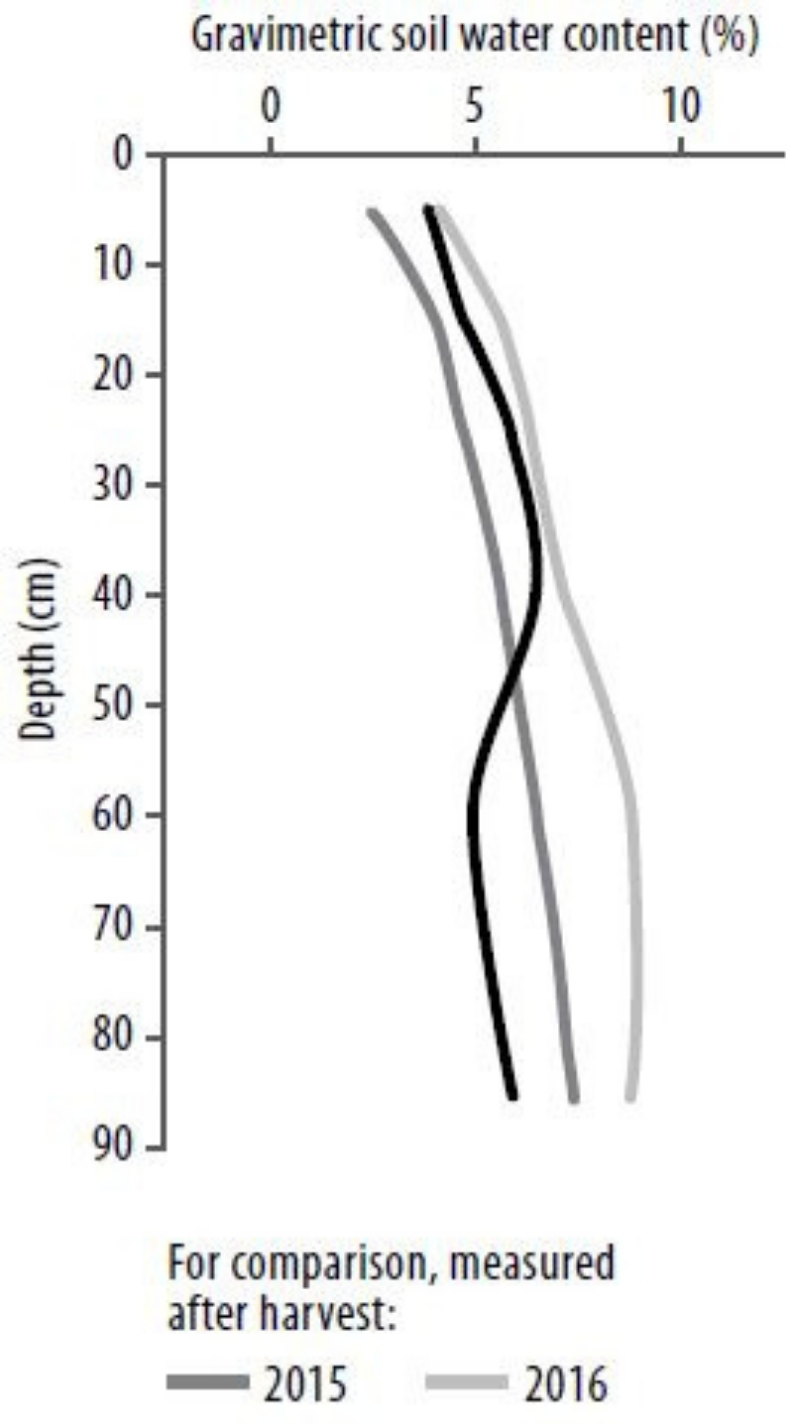
Figure 2. Gravimetric soil water content profiles measured a few days post installation of the ‘moist’ treatments (black line).
Crop performance
High trafficking resulted in significant reduction in yield compared to Zero trafficking over four years (Figure 3). These yield decreases amounted to 33% in 2015 wheat; 24% in 2016 wheat; 63% in 2017 peas; and 67% in 2018 barley. Any differences in mean yields between the Zero trafficking (control) and the Medium or Low trafficking treatments were not statistically significant (P = 5%).
Despite the similarity in penetrometer measurements for the Medium and High trafficking treatments, the yield results suggested that the Medium trafficking treatment was more like the Low and Zero trafficking treatments, which might have been expected from the bulk density measurements.
The impact of the High trafficking treatment in reducing crop yields has not been so clear cut or consistent across years at the project’s other three trial sites which are on Mallee soils, and in some cases using lighter equipment.

Figure 3. Crop yields over four years measured on control, low, medium and high trafficking on a deep sand at Loxton.
Predicting crop responses to trafficking
Modelling of soil compaction may assist farmers to know the level of soil compaction and crop responses likely to be expected from their soil type and management system. Compaction modelling is far less developed than crop modelling, however, it is possible to estimate the stress within the soil under a tyre. For example, the soil stress distribution under the chaser bin at Loxton is illustrated in Figure 4. Whether this stress will cause the soil to compact depends on the strength of the soil.
Much greater knowledge is required on understanding the strength parameters of Australian soils, but it is mainly dependent on the soil type, the existing bulk density, and soil water content. To illustrate how this understanding helps predict the type of compaction that might occur, we might assume that compaction is unlikely to occur if the soil stress is less than 150kPa. By redrawing the stress in Figure 4, just the center line under the tyre, it can be observed that the stress in the deep sand at Loxton can be expected to cause compaction to a depth of half a metre (Figure 5), as measured in our soil test results. In contrast, the stress under an 8t spray rig, used for the trafficking treatments at one of the other project sites (different soil type), only causes damaging stress levels to 20cm depth.
The project is continuing to work with international collaborators to build a decision support tool that will help growers to understand when trafficking is likely to damage soil properties. Additionally, the project is also working on how to incorporate these changes in soil properties due to machinery trafficking into Yield Prophet® crop modelling tool to simulate the change in yield response under different seasonal conditions.

Figure 4. Left: Schematic of estimated 2-D soil vertical stress pattern under a wheel of the 24t chaser bin at the Loxton trafficking experiment. Figure 5. Right: Vertical stress under the centreline of the tyre for 24t chaser bin (grey line) and 8t spray rig (black line). Grey shaded area approximates stress level below which compaction would not be expected to occur.
Commercial practice
The case study at Loxton shows that on a deep sand, despite decades of traditional farming practices and its consequent trafficking over cropped areas, repeated passes of modern heavy equipment can still further damage soil properties enough to result in important and persistent yield decreases. The number of passes, as well as the soil water content and the weight of the machinery all contribute to the extent of compaction that is likely to occur. The single trafficking pass under moist conditions appeared to have had a large effect on the penetrometer measurements at this deep sand site, but not on the bulk density nor crop measurements.
The results at Loxton suggest that for deep sands, especially if growers are moving to heavier equipment or trafficking in wet conditions, a CTF system might prevent further damage to soil structure that would otherwise reduce yields for many years to come. In contrast, single pass trafficking, especially in dry conditions, will probably not cause further damage to the soil resulting in yield reductions. Due to the lack of shrink-swell properties, these soils would not be expected to remediate from compaction naturally. If it is economically beneficial to improve soil structure, such as through a system of deep ripping and vigorous deep root growth, then it is possible that even single pass trafficking might be detrimental to soil structure and adopting a CTF system would be important.
References
Acknowledgements
This research was funded by GRDC as part of the ‘Application of CTF in the Low rainfall zone’ project (ACT00004) and DJPR, SARDI, ACTFA, and SPAA.