Take home messages
- Field peas and vetch performed best in this low rainfall year.
- While yields and profit were not great this season, the majority ‘broke even’, therefore pulses will have a fit in the farming system in this region with additional benefits achieved in the following crop.
- Always consider varietal performance over several seasons to ensure suitability.
Background
As farming systems in the North Central region have evolved, the need for a profitable break crop in the farming rotation has continued to increase. Traditionally this has existed in the form of vetch and canola, however the increased worldwide demand of pulses for human consumption has resulted in an increase in production. With this comes a shift in sowing these crops in areas they are not as well adapted. Therefore, it is important to understand the suitability of certain varieties to these newer, non-traditional areas.
Aim
Compare the performance of a range of field pea, lentil and vetch varieties and breeding lines in the North Central region of Victoria.
Paddock details
| Location: | Pyramid Hill |
| Crop year rainfall (Nov-Oct): | 317mm |
| GSR (Apr-Oct): | 122mm |
| Soil type: | Clay loam |
| Paddock history: | 2017 barley |
Trial details
| Crop type/s: | See Table 1, 2 and 3 |
| Treatments: | See Table 1, 2 and 3 |
| Seeding equipment: | Knife points, press wheels, 30cm row spacing |
| Sowing date: | 31 May 2018 |
| Replicates: | Four |
| Harvest date: | 19 November 2018 |
Trial inputs
| Fertiliser: | Granulock® Supreme Z + Impact® @ 60kg/ha at sowing |
| Herbicide: | Weeds managed as per best practice |
| Insecticide: | Insects managed as per best practice |
| Fungicide: | Disease managed as per best practice |
Method
A series of replicated field trials were established to compare the performance of a range of varieties in the North Central region of Victoria.
Results and interpretation
Overall
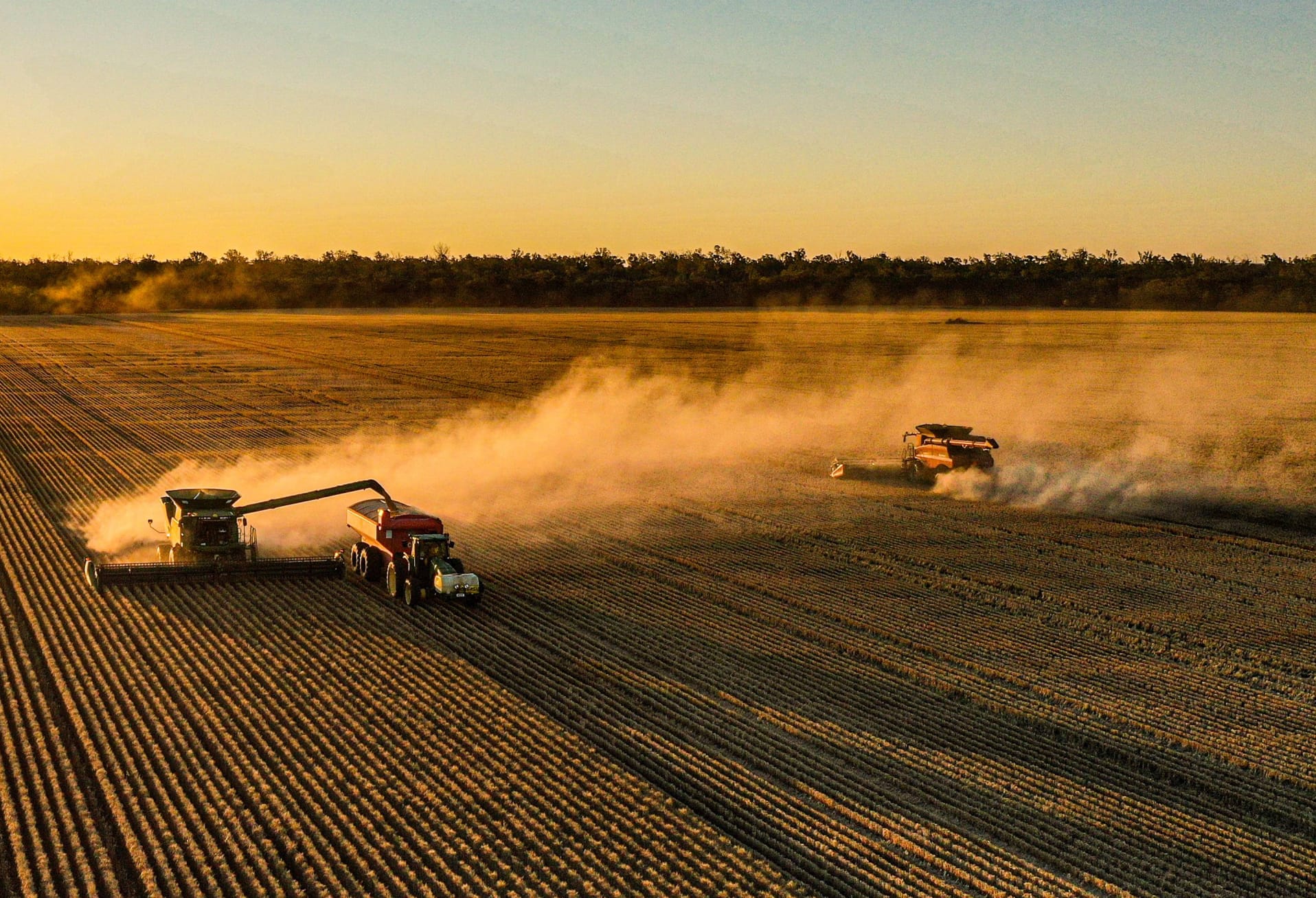
Later than ideal sowing time of these crops, combined with decile one rainfall and a dry finish resulted in relatively low yield for all crops. In previous seasons, a yield reduction of approximately 30% has been observed when sowing in late May, as opposed to the ideal timing of early-mid May (Brand and Nigussie 2017). Vetch and field peas were most profitable in these conditions, with partial gross margins of $270/ha and $180/ha respectively.
Field peas
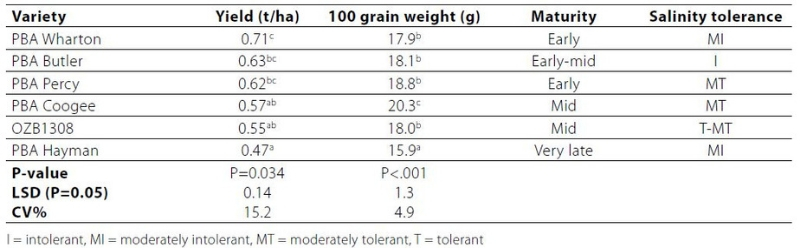
Field peas are a versatile pulse within the farming system as they can be grown for grain, hay, grazing, or a green/brown manure crop. In addition, they are suited to a wide range of soil types and environments, therefore offering flexibility within the farming system. The varieties generally performed as would be expected given the season, with the earlier to mid maturing varieties performing well, the best of which was PBA Wharton (Table 1).
Table 1. Field pea yield, quality and agronomic characteristics.
Vetch
Given the proximity to hay markets, vetch is one of the more traditional pulse crops grown in this region. The most common variety currently grown is Popany, however a quicker maturing potential replacement to this is RM4. The results suggest there is no significant difference in hay or grain yield between the two varieties (Table 2). The impact of late sowing should be noted with these yield results being below what could potentially be achieved had they be sown in a timelier manner.
Table 2. Vetch yield, quality and agronomic characteristics.

Lentils
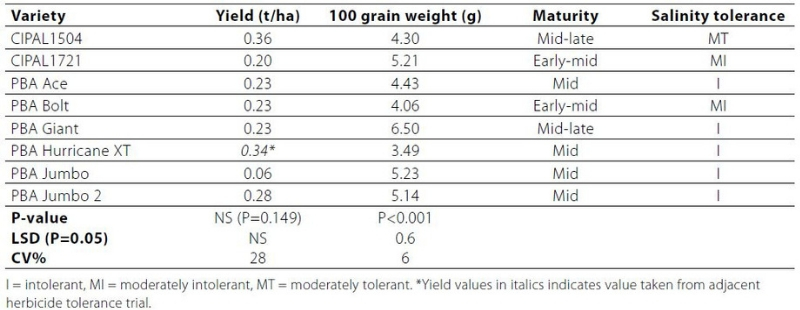
Given the potential price that could have been achieved in recent years, lentils are one of the more attractive pulse crops, in terms of direct profit. While the yields are not fantastic (Table 3), they still present an opportunity in this region given a more favorable season. The superior yield and salt tolerance of the breeding line CIPAL1504 indicates this could be a variety to consider in some of the marginal lentil growing areas in the future.
Table 3. Lentil yield, quality and agronomic characteristics.
Commercial Practice and On-farm Profitability
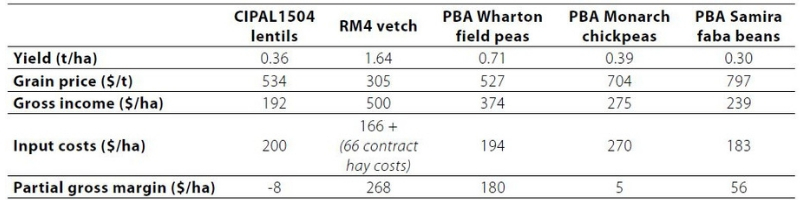
In this season, vetch hay presented the most economical approach of all crops sown. It should be noted the high prices for hay currently available made this a standout (Table 4). The capital investment in machinery should be considered with this enterprise, if you already own the equipment and are set‑up to do this, there will be greater upside. If you do not own your own machinery, the risks in this will be increased, particularly with significantly lower hay prices generally available.
The most profitable grain crop was field peas. The price sensitivity in these markets should also be considered when choosing crop types. The ability to store grain on-farm will allow flexibility in grain marketing and potentially achieve a higher price. Small areas of pulses sown in the overall farming system may allow for some risk to be spread as well as provide some flexibility in logistics. Moreover, the potential benefits from a pulse crop on the following crop, while difficult to quantify, should not be dismissed, particularly for managing weeds and diseases. In addition, the residual soil nitrogen (N) provided by these pulse crops should be considered, with faba beans, field peas and vetch generally contributing more to soil N than chickpeas and lentils (Seymour et al. 2018).
Table 4. Partial gross margin from the highest yielding varieties/treatments in these trials (n.b. chickpea and faba bean data not presented previously).
References
Brand J, Nigussie T (2017) Pulses in the Mallee 2017. 2017 BCG Season Research Results, 56-65.
Acknowledgements
This research was funded by the GRDC and Agriculture Victoria as part of the ‘Understanding the implications of new traits on the adoption, crop physiology and management of pulses in the southern region’ project (DAV00150).