Take home messages
- Frost and dry conditions in 2018 severely impacted trials and all results need to be treated
with caution. Grain yields at both Curyo and Ouyen were all less than 1t/ha, except some
chickpea varieties and breeding lines at Ouyen. - Unlike previous seasons, delayed sowing resulted in significant grain yield gains in lentils
and chickpeas at Ouyen, primarily due to the extremely frosty conditions during the
reproductive phase. Economically, lentils would have made a loss at the yields achieved in
the trials in 2018. Growing chickpeas would have been highly profitable (estimated returns
of $200-$500/ha) at most sowing dates. - When choosing new varieties or changing agronomic treatments it is important to look at
long term information rather than individual seasons. Varieties like PBA Jumbo2 and PBA Bolt lentils have performed well across a range of seasons, indicating yield stability. Potential new breeding lines like CIPAL1504, which have performed well across a range of seasons, have potential to further improve grain yields and grain yield stability in the Mallee.
Background
The Southern Pulse Agronomy (SPA) program conducts a wide range of agronomic and variety trials across all rainfall zones of Victoria and South Australia. Its primary aim is to improve yield and yield stability, ultimately leading to increased profitability and adoption of new varieties by growers. In this report, key results from selected trials conducted in the southern (Curyo) and central (Ouyen) Mallee 2018 are highlighted. Further detailed reports will be available on ‘Online Farm Trials’ by May 2018.
Sowing dates
A range of higher yielding pulse varieties have been released and are being developed, with
improvements in agronomic traits including biomass production, lodging resistance, disease
resistance, herbicide tolerance, maturity and pod retention. In addition, growers are sowing crops earlier to maximise yield potential and reduce risks of heat and terminal drought stress. However, this can also increase risk of disease and frost or poor pod set under cold conditions. Research in 2018 at Ouyen, focused understanding the opportunity for earlier sowing in lentil and chickpea varieties and breeding lines with a broad range of flowering and maturity times.
Disease management
In chickpea, the resistance to ascochyta blight recently broke down again. Therefore, management packages and novel control strategies need to be re-evaluated. In 2018, field trials at Curyo investigated current varieties and breeding lines for resistance to ascochyta blight and several recently released fungicides that can be used to control the disease and reduce grain yield loss.
Herbicide tolerance and soil type
Improvements in tolerance to Group C herbicides will have significant benefits for pulses, enhancing weed control in the farming system. Currently Group C herbicide options can cause significant crop damage, particularly on lighter sandy soils. The PBA breeding program has been incorporating a trait which improves tolerance.
In 2018, a trial at Curyo investigated the response of a new lentil breeding line with improved tolerance to Group C herbicides to a range of products. At Ouyen the relative tolerance of this line to metribuzin applied on a light sandy soil and a sandy loam was compared.
Faba bean and lentil germplasm
In the faba bean breeding program, several lines with significant improvements in yield in dry areas have been identified, including PBA Marne which was released in 2018. At Curyo the breeding line AF12025 yielded 158 per cent (%), 140% and 100% of PBA Samira from 2015-2017, respectively. Unfortunately, faba beans at Ouyen failed in 2017. Improved moisture conservation techniques mean that, beans may be considered within the farming system, particularly as they are one of the best nitrogen fixing pulses. In 2018, like previous seasons, several new breeding lines were tested to maximise yields at Curyo.
In lentils, several new lines with improved salt and boron tolerance and general adaption
were compared.
Aim
To improve yield and yield stability of pulse crops, ultimately leading to increased profitability
and adoption of new varieties by growers.
Paddock details
| Location: | Curyo and Ouyen |
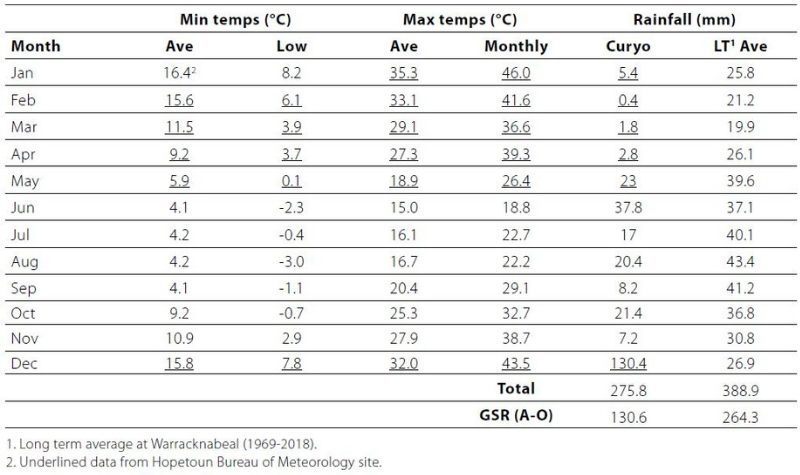
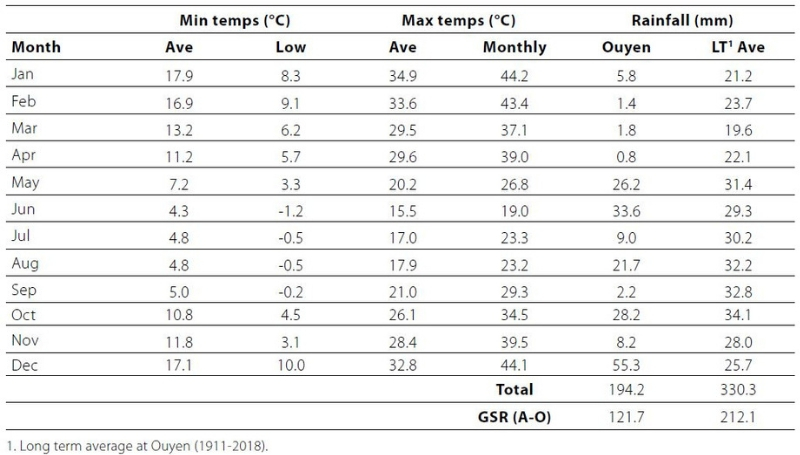
| Annual rainfall: | Curyo – 275mm, Ouyen – 194mm |
| GSR (Apr-Oct): | Curyo – 131mm, Ouyen – 122mm |
| Soil type: | Curyo – Sandy loam; Ouyen – Loamy sand and light sand |
| Crop types: | See Table 1 |
| Sowing dates: | Curyo – 8 and 9 May Ouyen – 12 April, 26 April, 10 May and 25 May |
| Sowing system: | Inter-row with narrow points and press wheels in a no-till system (row spacing: Ouyen – 28cm; Curyo – 36.5cm) |
| Harvest dates: | Curyo – Lentil and faba bean 12 and 13 November, Chickpea 26 and 27 Nov Ouyen – Lentil 26 November, Chickpea 3 December |
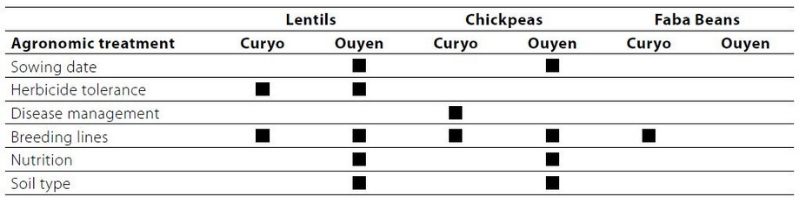
Table 1. Overview of agronomic trials (cells marked: ) at Curyo and Ouyen in 2018.
Climate
Curyo
Table 2. Temperatures and rainfall at Curyo 2018.
Ouyen
Table 3. Temperatures and rainfall at Ouyen 2018.
Results and interpretation
Sowing dates
Grain yields of lentil varieties and breeding lines at Ouyen, ranged between 0.15 and 0.55t/ha in 2018 (Table 4), which was well below the estimated potential of 0.70 to 1.50t/ha based on biomass at maturity and visual pod counts. Several frosts during the flowering and podding phase significantly impacted grain yields, particularly the earlier sown treatments which were further advanced in the reproductive phase and unable to recover. Based on visual assessment, it was estimated that 80-90% of pods were affected in the April 12 ’I’ treatment, 60-70% of pods in the April 12 ‘D’, April 26 and May 10 treatment and 20-40% of pods in the May 25 treatment. Varietal differences were not obvious. Across all varieties yields increased linearly by 7.2kg/day from 0.19t/ha sown April 12 to 0.50t/ha sown May 25.
The dry sown treatment which emerged at a similar time to May 10, had grain yields similar to the April 26 sown treatment. The trends observed in 2018 are completely opposite to long-term trial results in the Mallee for lentil, which generally indicate significant benefits from earlier sowing. Comparing the varieties, the mid/late maturing varieties CIPAL1504 and PBA Greenfield were highest yielding. CIPAL1504 has now consistently performed well in all Mallee trials across multiple seasons and sites except where Botrytis Grey Mould (BGM) was a yield limiting issue. Economically, lentil varieties and breeding lines would have made a loss at the yields achieved in the trials in 2018.
In addition to the reproductive frosts in this trial, there was a significant vegetative frost, which enabled assessment of potential varietal differences. The breeding line 10H202L showed the worst damage, followed by PBA HurricaneXT and CIPAL1522 (data not shown). All other varieties/lines showed little damage. Potential linkages to breeding families are being explored, however currently there appears to no specific link to the ‘imi’ tolerance trait, which had been suggested in industry.
Table 4. Grain yield (t/ha) of lentil (A) and chickpea (B) varieties and breeding lines sown at four sowing dates in 2018 at Ouyen. All sowing dates were irrigated ‘I’ with 10mm of water at sowing except Apr 12 ‘D’, which was sown dry and established on rainfall in early May.
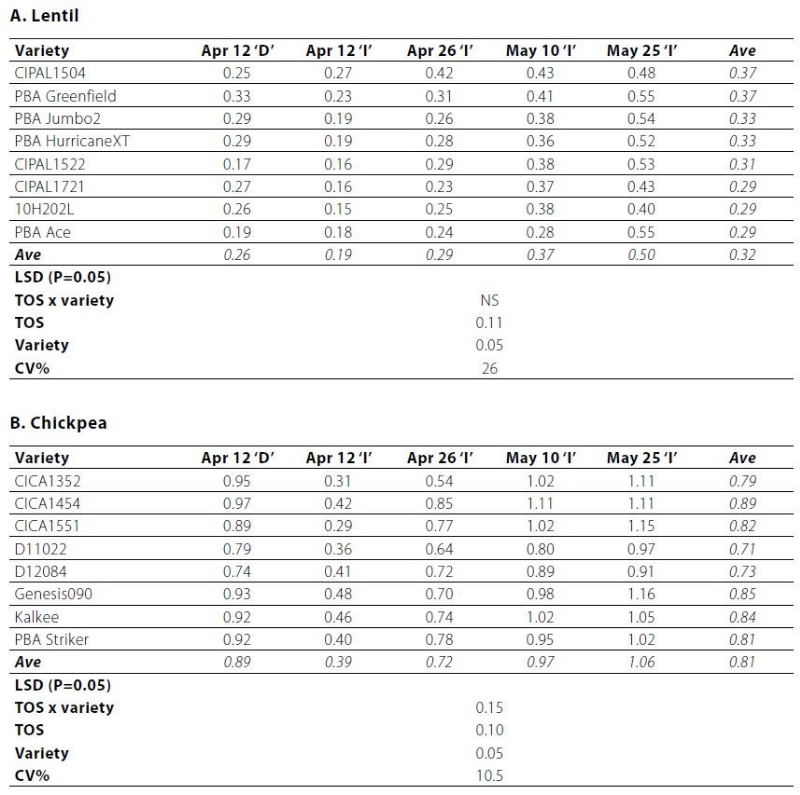
Grain yields of chickpea varieties and breeding lines at Ouyen, ranged between 0.29 and 1.16t/ha in 2018 (Table 4), which was below potential for early sown treatments, but very impressive for the later treatments, which were able to respond to later rain events. Similar to lentil, several frosts during the flowering and podding phase significantly impacted grain yields, primarily the earlier sown treatments which were further advanced in the reproductive phase. Unlike lentils, though, it was only the Apr 12 ‘I’ treatment which was unable to recover and set adequate yield. Across all varieties,yields increased from 0.39t/ha sown April 12 to 0.50t/ha sown May 25. The dry sown treatment which emerged at a similar time to May 10, had grain yields similar to the April 10 sown treatment. The trends observed in 2018 are completely opposite to long-term trial results in the Mallee for chickpea which generally indicate significant benefits from earlier sowing. Comparing the varieties, CICA1454 was
highest yielding, slightly greater than Genesis090. The earlier flowering breeding lines, which were severally impacted by frost were lowest. CICA1454, has now consistently performed well in all Mallee trials across multiple seasons and appears to have slightly improved resistance to ascochyta blight. From an economic perspective, growing chickpea would have been highly profitable (estimated returns of $200-$500/ha) at all sowing dates except Apr 12 ‘I’ which would have broken even.
Disease management
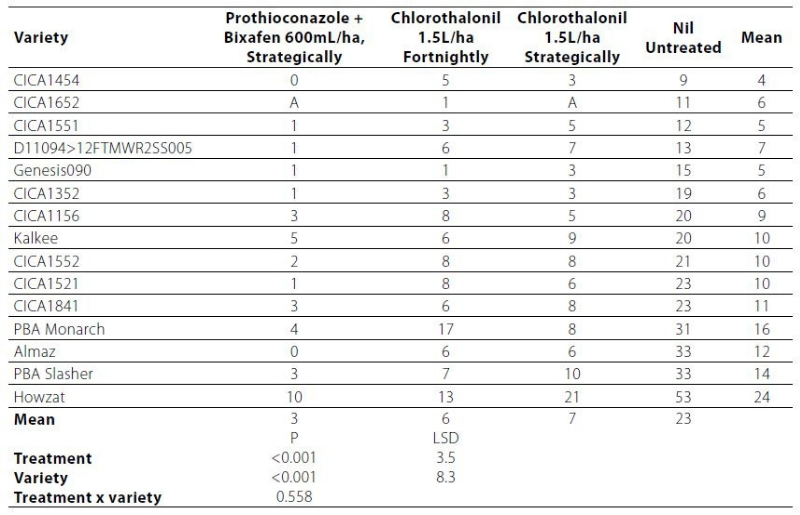
Low ascochyta blight levels were recorded during 2018, as a result of the below average rainfall, with the highest percentage plot affected being 60% in a small number of plots (Table 5). There were significant differences between fungicide treatments and the untreated plots in the percentage plot affected. Grain yields were between 0.3t/ha and 0.8t/ha in the disease management trials. Due to these low yields there were no significant differences detected in grain yield between fungicide treatments or varieties within these trials. Several breeding lines are appearing to have lower infection rates compared to varieties, similar to previous years.
Table 5. Ascochyta blight infection in 15 varieties tested under three fungicide strategies compared to untreated plots at Curyo during 2018.
Herbicide tolerance and soil type
In the trial at Curyo investigating response to Group C herbicides, the new lentil breeding line with improved tolerance, showed significantly less herbicide damage than PBA Jumbo2 to eight different Group C herbicides applied at the 4-node crop growth stage (data not shown). Maturity biomass and grain yield assessments indicated both the breeding line and PBA Jumbo2 potentially had some reduction due to herbicide application, although specific differences were difficult to assess due to the dry seasonal conditions.
In the trial at Ouyen the relative tolerance of the breeding line to metribuzin applied on a light sandy soil and a sandy loam was compared to PBA Jumbo2. 2018 was a relatively dry year and as such the uptake of Group C chemicals which is predominantly driven by root uptake was lessened, resulting in lower crop damage levels than were expected. In general, higher herbicide damage scores and lower biomass was observed on the sandhill compared with the swale, probably due to the higher leaching and lower water holding capacity of the sandhill soil (Table 6). Across both soils the post sowing pre‑emergent (PSPE) treatments generally resulted in slightly higher crop damage scores than the 4-node application. On the sandy soil the higher application rate killed PBA Jumbo2 and almost killed SP1333. Overall, SP1333 had significantly lower damage symptoms, particularly at the lower application rates.
Table 6. Herbicide damage score (0 – no damage, 100 – complete plant death; Aug 28)
and maturity biomass (t/ha) of a lentil breeding line with improved tolerance to Group C herbicides in comparison with PBA Jumbo2 in response to two application rates of
metribuzin PSPE, and at the 4 node growth stage on a sandhill (sand) compared with
a swale (sandy loam) at Ouyen in 2018.
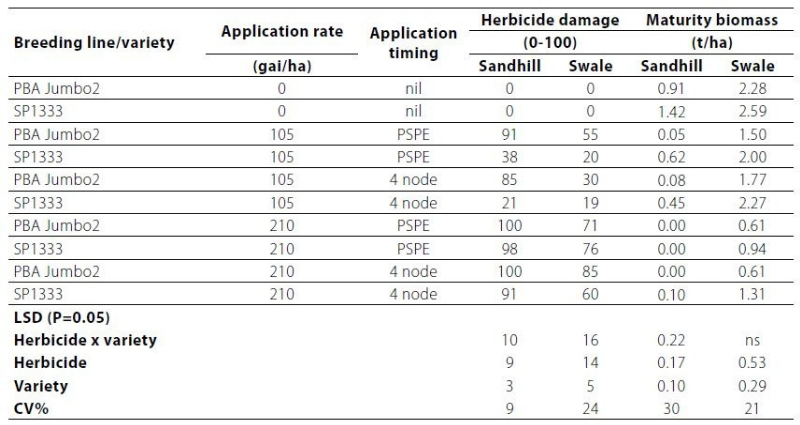
Biomass production on the sandhill was significantly lower than the swale, with PBA Jumbo2
producing no or very little biomass in all herbicide treatments, while SP1333, had no biomass at the higher application rates and a 55% and 70% reduction in biomass at the lower application rates of the PSPE and 4 node timings, respectively. On the swale, both PBA Jumbo2 and SP1333 showed significant biomass reduction from all the herbicide treatments, however the reduction was 10% less in SP1333 than PBA Jumbo2. Grain yields are not presented, due to the poor season and the high shattering rate of SP1333.
These results indicate that the level of Group C tolerance in SP1333 can reduce herbicide damage from Group C chemicals, particularly on sandy soils. This tolerance trait is being incorporated in advanced breeding lines for further assessment and has the potential to further enhance the yield stability in lentils across a range of soil types and improve weed control options.
Faba bean and lentil breeding lines
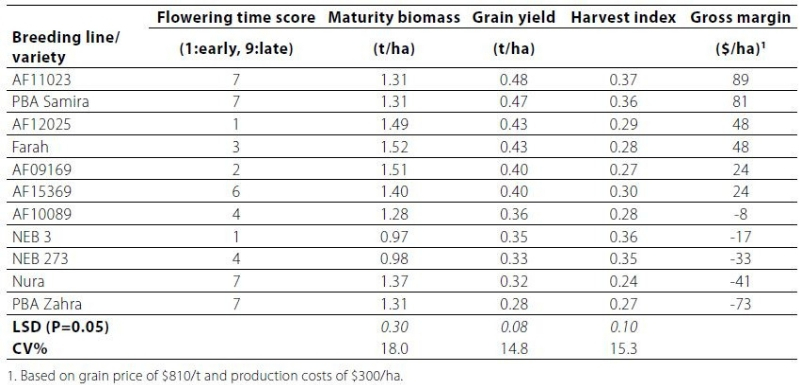
The extremely dry conditions of 2018 resulted in grain yields of less than 0.5t/ha for new faba bean lines identified for improvements in drought resistance (Table 7). These yields were less than the drought of 2015. Similar to 2018, AF12025 had grain yield equivalent to PBA Samira (0.43 and 0.47t/ha, respectively). Despite the low yields, growing faba bean would have proved profitable due to the record high grain prices. Maturity biomass generally did not significantly differ between the released cultivars and AF breeding lines, however the NEB breeding lines were significantly lower.
Table 7. Grain yield of faba bean varieties and breeding lines sown at Curyo in a trial focusing on lines with improved drought resistance in 2018.
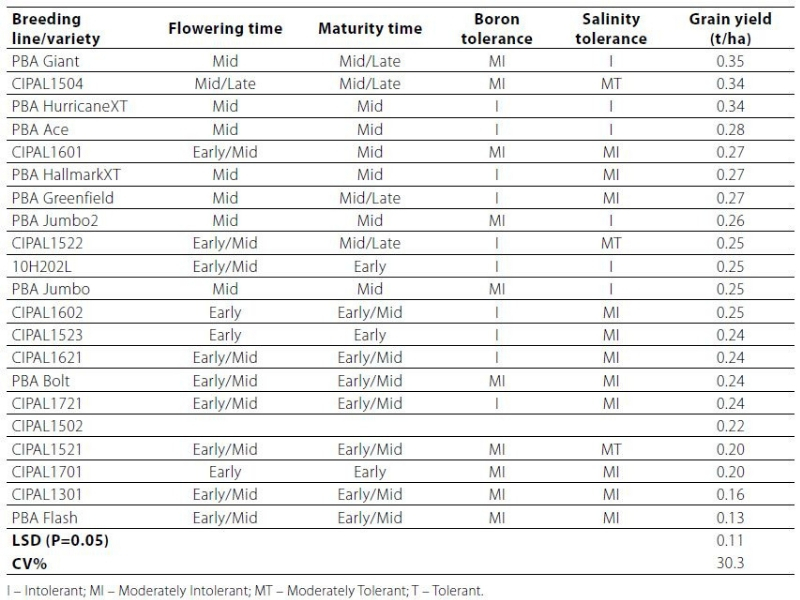
Similar to faba bean, lentil yields were very low in 2018, with highest yields of 0.35t/ha recorded (Table 8). CIPAL1504 was the highest of the new breeding lines, despite having mid/late maturity. This line has been either highest or equal highest at all sites throughout the Mallee in 2018, similar to previous seasons.
Table 8. Grain yield of lentil breeding lines and varieties sown at Curyo in a trial focusing on lines with improved drought resistance in 2018.
Commercial practice
Sowing time
- In 2019, growers are encouraged to continue sowing pulses in the optimal sowing window and avoid delayed sowing unless there is a strategic management advantage, related to disease or weed control or they are being sown in a frost prone region. In the long-term, from a Victorian perspective, early sowing has generally proved profitable as heat events and rapidly drying soil during late spring in the flowering and podding phase occur almost every year and cause significant yield loss with delayed sowing.
- Lentil can be a highly profitable crop, but the last two seasons have reminded us that there are still many challenges to ensure long-term reliability. Growers are encouraged to continue to take a long-term view being aware that the long-term price average for lentils is between $500 and $600/t.
- In chickpeas CICA1454, has now consistently performed well in all Mallee trials across multiple season and appears to have slightly improved resistance to ascochyta blight. From an economic perspective, growing chickpea would have been profitable (estimated returns of $200-$500/ha) at most sowing dates.
Disease management
- Fungicide application following label directions effectively controlled ascochyta blight in disease management trials.
- Grain yield losses due to ascochyta blight were present, but not large due to low grain yields within the trial.
- Several breeding lines performed similarly to previous years with lower ascochyta blight infection.
Herbicide tolerance and soil type
- Research here is longer term, so results are not directly applicable for growers in 2019. This
tolerance trait along with other adaptive traits are being incorporated in advanced breeding lines for further assessment and has the potential to further enhance the yield stability in lentil across a range of soil types and improve in weed control options.
Faba bean and lentil germplasm
- New faba bean lines will offer opportunities for growers in the Mallee, with profitable yields,
potentially significantly higher than commercial varieties. - Despite having mid/late maturity, CIPAL1504 has been either highest or equal highest at all
sites throughout the Mallee in 2018, similar to previous seasons. It has improved boron and
salt tolerance, which could account for its improved yield stability. These traits combined with
improved herbicide tolerance could further improve yield and yield stability of lentils in the Mallee.
Acknowledgements
This research was funded by GRDC, AgVic and SARDI (DAV00150). Thanks to the technical staff, Jason Ellifson, and Moodie Agronomy (at Ouyen) for maintaining trials and collecting data. Thanks to our grower collaborators at Curyo and Ouyen for the use of land.