

Limited rainfall across the majority of the Mallee and parts of the Wimmera have left some break crops with low yield potential. As harvest edges closer, decisions around the merits of following through to harvest versus cutting for hay or terminating the crop are a reality for many growers.
BCG research leader, Claire Browne says it’s not all doom and gloom with research suggesting even if your current crop doesn’t go to grain in 2018, there could be benefits to subsequent crops, even up to two years later.
Water-use efficiency and legume termination research conducted by BCG and funded through the Grains Research and Development Corporation (GRDC) suggests providing a break in the system through canola, lentil, vetch or fallow still offers significant benefits on a range of soil types.
This arises from factors including grass weed control, disease break, grazing or grain production value, fixation of soil nitrogen and improved stored soil moisture.
Ms Browne, who conducted much of the research at Hopetoun from 2008 to 2013, said the previous research found vetch and fallow in a dry season still resulted in an increase in wheat grain yield in the following season.
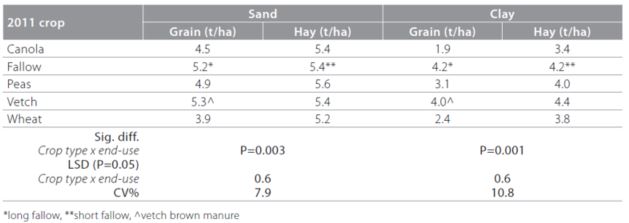
Table 1 summarises some of the results where break crop type and end-use had an effect on wheat grain yield in 2012.
“On a sandy soil type wheat yielded more when grown following canola, fallow, pea and wheat hay or vetch hay,” she said.
“On a clay soil, fallow (long or short), pea hay and vetch hay all had positive effects on wheat yield in the following season.”
Table 1. Mean 2012 wheat yield when grown following various crops and end-uses in 2011.
In the same year, wheat also yielded more following canola, wheat and pea hay at both the sand and clay sites, which was probably due to extra plant available water (PAW) at sowing in the following season, from earlier termination of these crops (hay 109mm, grain 100mm, P=0.016).
Research at Karoonda (SA) and Hopetoun in 2009 also showed increased nitrogen supply could be measured up to two years following the break. At Karoonda, there were carryover benefits into the second year after a pasture break of 16-23kg N/ha/season.
The potential benefit to crops may vary also from paddock to paddock, so it is important to consider each crop individually. Just remember, the true benefit of the break may not be realised until next year.
This research was funded by GRDC through BWD00012 ‘Yielding benefits through partnerships’ and CPS00111 ‘Identifying farm scale opportunities to improve WUE: A nationally coordinated systems approach’.