

With waterlogged paddocks still present across the region and farmers eager to get into spraying and sowing as soon as conditions allow, BCG saw it as a timely opportunity to revisit key messages from the well attended event Safely Recovering Machinery in 2022.
First things first: Safety. Use the right gear, the right way, and always take your time. Not using proper safety precautions to recover machinery can cause serious injury or fatality. Chains, cables, shackles or attachment points may break and whip back. This can shatter machinery cabin windows, striking operators or bystanders.1
Planning
In wet conditions, a well-planned and communicated approach to spraying and sowing will minimise risk. When planning, consider the following:
- Inspect paddocks by ground or air (drone) for wet areas and create a map of problem areas.
- Identify best passage for paddock access (if some roads are still closed or underwater) and the areas of the paddock to avoid
- Identify ‘safe’ areas of the farm to undertake activities such as (filling the seeder, moving trucks) choosing to do more travelling with lighter gear will save time in the long term as you avoid recovering heavier equipment in peak times. Efficiency comes second to staying out of trouble – full sprayer tanks or seeders may not be good practice in wet paddocks.
- Communication with your team is key. Have a team meeting to: Identify roles and responsibilities, communicate problem areas to all staff, ensure your team members are aware of the recovery gear, connection points, setup, job roles and safety.
Prepare
Equipment
Make sure the equipment you are using is rated to expected loads.
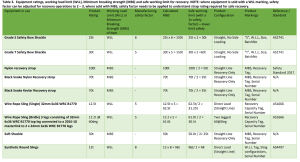
- Understand the difference between working load limit (WLL) and minimum breaking strength (MBS).Recovery gear is sold with MBS rating (straps/strops) – no safety factor included, lifting gear is sold with WLL limit – high safety factor built in for lifting operations.
- Avoid using chains. They are often not rated adequately or maintained for safe recovery use.
- Straps are safer than cables. Cables are safer than chains. Use the safest gear you can.
- Recovery equipment should have a rating 2-3 times the gross vehicle mass (GVM).
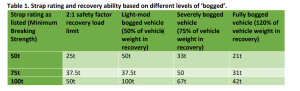
- Severely bogged equipment needs to factor in higher loads (Table 1.)
Inspect recovery equipment for damage, ask yourself:
- Is the stitching sound and intact on straps?
- Has it been cut or damaged? Even little cuts weaken the strap/strop.
- Are cables rusted, brittle, or frayed?
- Are shackles in good condition, not out of shape, or otherwise compromised?
Store equipment well
- Have a designated toolbox with recovery gear.
- Keep equipment out of the elementsincludingrain, excessive sunlight, excessive heat, dirt, dust, oil, solvents, rust. These can impact integrity of recovery gear or equipment ratings.
Safety
Weight
- Recovery equipment can be heavy, straps are lightest, chainsheaviest, use safe work practices in handling recovery. For example, a 9m long 100t snatch strap is about the same weight as 1m of 100t rated chain.
Recovery points
- Identify and only use recommended recovery points. If unsure, consult the owner’s manual to identify recovery points and guidelines.
- DO NOT use tow balls as a quick throw over recovery point. Tow balls are not rated for this purpose and have been the cause of fatalities
- If needing to use a tow hitch of a ute or quad/side by side, look to get a rated recovery hitch (figure 1).
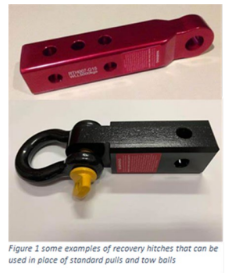
- The alternative is to remove the tow ball and use the tow hitch pin to hold strap in place (rated pin required).
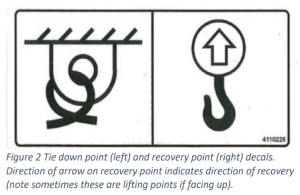
- Recovery points should have a symbol like in figure 2 (right), if they have the symbol in figure 2 (left) this is a tie down point for float travel, not recovery.
- A range of solutions are available including axle strap kits, fitted cable undercarriage setups, and mounted recovery brackets. It is important to know that the gear meets the requirements of recovery and is suitably rated. One such approach is using axle straps as demonstrated below by grain growers, but this may not be a one size fits all approach. Grain Growers’ recovery video and safety guide
Act
So you’re bogged… what should you do:
- Stop –don’t make matters worse by trying to get yourself out – if it looks like it isn’t working, it’s time for plan B.
- Unload – reduce as much weight as possible through offloading. For sprayers, can you offload to another tank, shuttles, boom?
- Clear soil – you may need to make a shovel your best friend. Remove soil from near the tyres in the direction of recovery can help reduce the recovery effort required.
- Keep bystanders and spectators out of the way. Only those involved in the operation should be there. Bystanders should be 90 degrees to the angle of recovery and at a minimum 1.5 times the length of the recovery away.
- Ensure an effective communication method is established between operators – voice, radio and hand signals.
Use the right gear, the right way and take your time.
- Don’t use snatch straps in the same way as 4WD shows.
- Drive very slowly. Don’t take off at 15km/hr – things break and it can be dangerous.
- Take up the slack, then recover at 3-5km/hr watching what is happening.
- Avoid using hard shackles to join straps, if one strap lets go, they can become a significant hazard.
- Dampeners should be used to ensure if something breaks it goes to ground. Anything that provides weight to take the momentum out of a retracting strap or cable helps, old tyre, bags filled with sand or dirt draped over the strap or specifically made dampeners.
- Allow straps time to recover. Friction from stretching means heat can build up. Straps need time to ‘recover’ to return to original length and be ready for use again.
Other vehicle preparations
Other sources have suggested that some of the following may be helpful in vehicle recovery
- Lower tyre pressures to the lowest end of manufacturer recommendations to increase recovery effectiveness, remember to re-inflate, particularly for road travel.
- Consider turning tyres around to improve recovery – tread pattern can help pull you out.
Pack up and Review
After a recovery effort, complete the process by doing the following:
Inspect gear for damage
- Check stitching, eyes and loops
- The strap/strop when it may have come in contact with sharp edges
- Cables for signs of damage to wire strands and eyelets
- Shackles for signs of wear/fatigue/bowing that is unusual
- Attachment points on machinery
Clean and pack away
- If straps need cleaning use water with mild detergent
- Store all recovery gear together for if it is needed again
Debrief
- Communication with your team around the recovery process – what worked, didn’t, what could/should be done instead.
Q & A from Member’s Technical Bulletin in 2022:
Should I use bow shackles or D shackles?
While both offer a fit, D shackles are ONLY suited to 100% straight line recovery. As soon as you put side load on the shackle it is at risk of failure and therefore is not as flexible for use. Bow shackles allow a greater range of movement without losing integrity. This can be helpful when things need to move or shift during the recovery process.
Safety factor. What does it mean and what do I need to know?
Safety factor is the ratio of minimum breaking strength to working load limit and varies depending on the consequence of failure. A lot of the equipment we use for recovery can also have a fit in lifting (shackles, cables, chains and slings) and as such have quite a high safety factor to represent the risk they pose – however there is variation. An S rated shackle has a required safety factor of 6 which means that the minimum breaking strength (MBS) is 6 times the working load limit (WLL which is printed on the shackle). i.e. 10t WLL = 60t MBS. Should we use it for 60t? – NO. We don’t want to test that outcome so closely, but we can recognise that the consequences of failure in recovery (if we do everything else right) is a lot lower than lifting and holding a dead weight over something vulnerable underneath.
Rule of thumb for recovery operations is the WLL can be utilised in the area of 2 – 3 times the value on the shackle (if it is S rated), this applies a safety factor of 2 – 3 as recommended. Some guidelines on equipment, MBS, WLL and application to recovery can be found in Tables 2 and 3.
What are soft shackles?
These can be used in place of hard shackles like bow shackles, as a safer option particularly when straps or cables break. They do have some limitations. Make sure you understand their fit. They are generally more costly, can be prone to bruising if used a lot and need a more attention to their condition between uses. But they are safer, particularly if joining straps to get extra length.

References
1 Resource from Worksafe Victoria about getting bogged: Managing the risks of bogged farm machinery | WorkSafe Victoria
BCG Special Technical Bulletin, 2022