Varieties have different characteristics that can influence responses to inputs such as nitrogen and, in the case of this trial, fungicide and plant growth regulators (PGRs). Over many years the GRDC-funded ‘Barley Agronomy for the Southern Region’ project has compared new barley varieties with current ones to determine whether specific management packages are necessary for each. Increasingly, variety specific management is an important consideration when deciding whether new varieties fit into particular farming systems.
In seasons with high yield potential, the risk of barley yield loss increases due to the development of heavy heads relative to plant height and stem strength. The growth habit of barley can have a significant impact on a variety’s risk of lodging, brackling (breaking at the top node) and head loss. One method being adopted by growers over recent years is to reduce the risk of yield loss through the application of plant growth regulators (PGRs).
The PGR used in this trial was made up of a chemical compound that inhibits the plant’s synthesis of gibberellin. Gibberellin is a plant hormone that regulates growth and influences stem elongation. When gibberellin production is limited, stem growth is retarded and the stem wall thickness increased.
Proponents of the product state the following benefits:
- thicker stem walls that improve the plant’s ability to withstand the forces from the weight of the head
- better root development allowing for increased root anchorage to reduce lodging and provide
greater opportunity for water and nutrient uptake - faster harvest speeds due to crops being more upright
- improved grain quality
- lower grain loss
- increased Harvest Index
The application of PGR can also be beneficial when sowing the following season’s crop. If the straw remains upright, problems associated with poor trash flow during sowing may be reduced.
The other aspect incorporated into this trial was the addition of a fungicide to the treatments.
Proponents of PGRs state that an increased effect (from the PGR) may occur if applied in a mixture with fungicides under conditions of rapid vegetative growth.
TAKE HOME MESSAGES
- PGR applied to barley in this trial suppressed plant height, generated a yield benefit and
improved crop gross margin. - No single variety responded differently to the addition of PGR or fungicide in this trial.
- Fungicide extended the green leaf duration of the crop.
AIM
To assess the effect of PGRs and fungicides on variety-specific barley yields.
METHOD
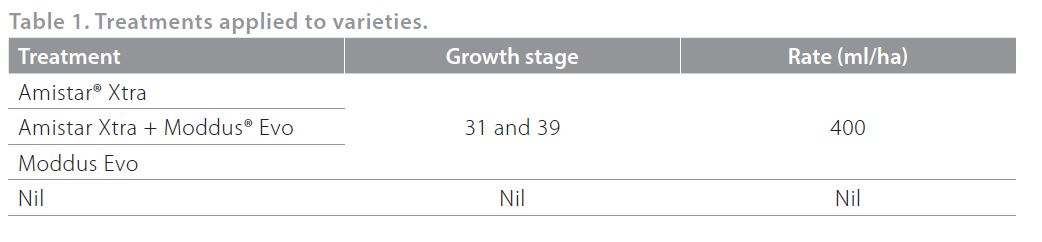
The field trial was established at the BCG and Agritech Rural site at Horsham. The trial compared a range of treatments containing variations in PGR and fungicide products in order to assess the effect on variety-specific barley yields. Treatments were applied using a hand-held 1.5m boom. All treatments received identical agronomic management, the only difference being in-treatment applications. Assessments included emergence scores, a measure of greenness (NDVI) at GS31 and GS87, plant height and grain yield and quality parameters.
Location: Horsham
Replicates: Four
Sowing date: 9 May
Target plant density: 130 plants/m²
Barley varieties: Scope, Commander, Skipper, GrangeR and La Trobe
Fertiliser:
9 May – MAP + Zn (55kg/ha)
2 July – Urea (90kg/ha)
13 August – Urea (90kg/ha)
Herbicide:
15 May – TriflurX® (2L/ha) + Avadex® Xtra (2L/ha)
9 July – Velocity® (670ml/ha) + LVE MCPA (333ml/ha) + Lontrel™ Advanced (170ml/ha) + Hasten™ (1%)
Insecticide:
30 September – Fastac® Duo (300ml/ha)
Seeding equipment: BCG cone seeder (knife points, press wheels, 30cm row spacing)
RESULTS AND INTERPRETATION
The seasonal conditions experienced at the Horsham site in 2013 were conducive to the production of high yielding crops (pp. 12), enabling a rigorous assessment of the effect of PGRs and fungicides on variety-specific barley yields. The crop emerged well and all varieties and treatments had consistent plant densities. The NDVI assessment conducted at GS31, prior to the first treatment application, showed no difference between treatments, indicating even emergence and good early growth for all varieties.
The application of fungicide, in this trial Amistar Xtra®, is believed to delay the maturity of cereal crops, extend the green leaf duration and contribute to yield in a season with cool conditions during grain ripening. Amistar Xtra is a mix of a triazole and a strobilurin. When strobilurin is applied to a crop in the presence of other fungicides, in this case a triazol, the strobilurin is believed to extend the green leaf duration. However, for this to occur, the strobilurin must be applied to a disease free crop. Observations of the trial following the treatment applications at GS31 revealed a phytotoxic (toxic effect on plant growth) effect of the treatments with Amistar Xtra.
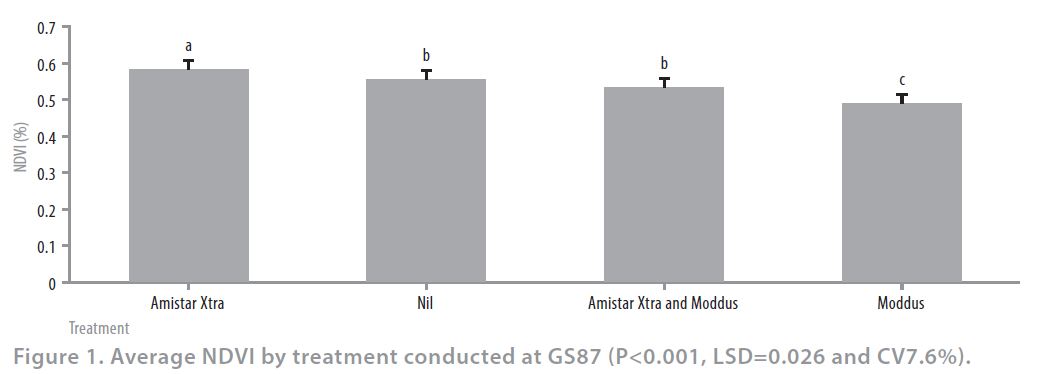
The NDVI assessment conducted at GS87 was to determine whether the green leaf duration was extended in this trial as a result of the treatments (Figure 1). The Amistar Xtra treatment was greener and the Moddus treatment less green than all other treatments in the trial. It is apparent in Figure 1 that Amistar Xtra has extended the green leaf duration and Moddus has induced ripening. Interestingly, the combined Amistar Xtra and Moddus treatment was comparable with the control. It appears as if the two products have cancelled each other to maintain normal maturation. No variety by treatment interactions were observed in the NDVI assessment at GS87.
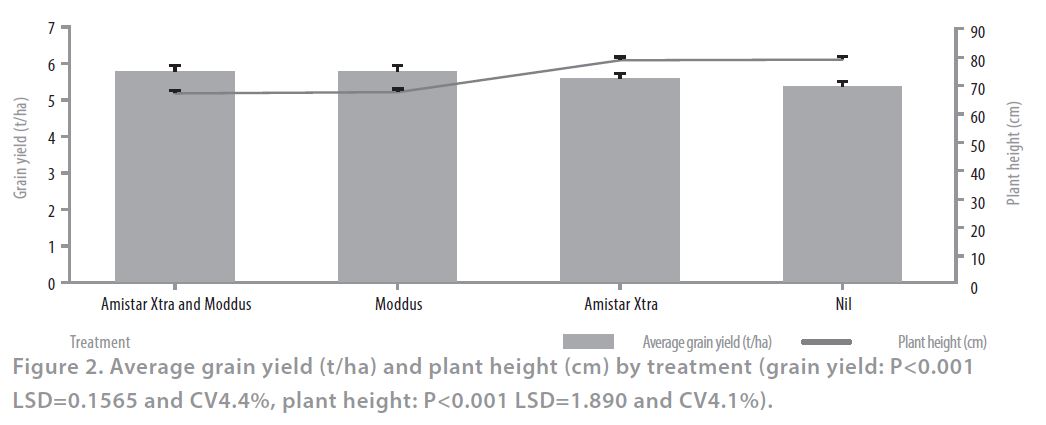
The Amistar Xtra + Moddus and Moddus only treatments yielded better than the Amistar Xtra and Nil treatments. There was an inverse relationship with plant height; the Amistar Xtra + Moddus and Moddus treatments were shorter than the Amistar Xtra and Nil treatments. These results suggest that it is the Moddus that is contributing to differences in yield and plant height. The extended green leaf duration from the Amistar Xtra did not add to crop yield or influence plant height.
No variety by treatment interactions were observed in the yield and plant height assessments. It can therefore be concluded that a specific PGR and fungicide management package according to variety is not necessary. All varieties should be managed in the same way. It should be noted, however, that this is has not been the case in demonstrations conducted in previous seasons when the application of PGR resulted in yield penalties for specific varieties. In this trial, no treatment or treatment by variety interactions were reflected in the grain quality parameters, protein, retention, screenings or test weight. Differences were observed between varieties, but the grades were not affected. The average protein in this trial was 8.6%, an indication that nitrogen was limited. All treatments and varieties achieved a feed classification. To more fully assess the quality effects of the PGR and fungicide it may be necessary to repeat the trial when more nitrogen is available to the crop.
It is apparent from this trial that Moddus has a positive effect on crop yield and no effect on grain quality. This being the case, it is necessary to conduct a partial gross margin (Table 2) analysis to see whether the cost associated with the product is covered by any increase in yield. While Moddus is not yet available in Australia, an indicative price provided by the supplier was between $25 and $30/L. For the purposes of the gross margin analysis a figure of $27.50/L ($22/ha) was used (two x 400ml applications). At the time of writing, Amistar Xtra was valued at $35.50/L which equates to $28.40/ha (two by 400ml applications). A cost of $5/ha per application was used in the partial gross margin. The feed grain price used in the analysis was a GrainCorp marketing cash price on November 27, 2013 (pp.18).
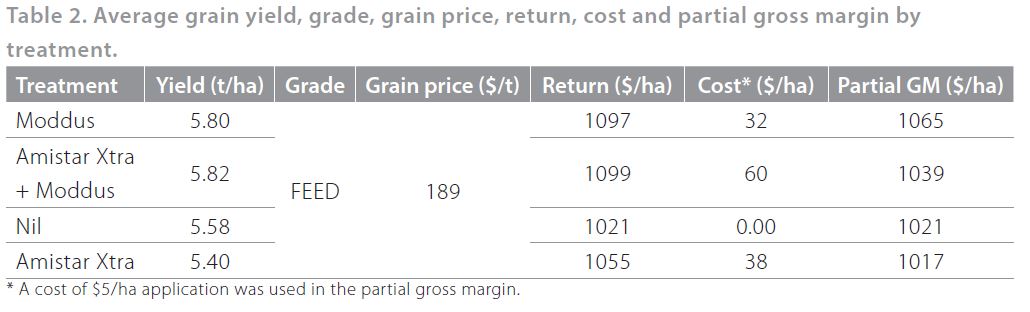
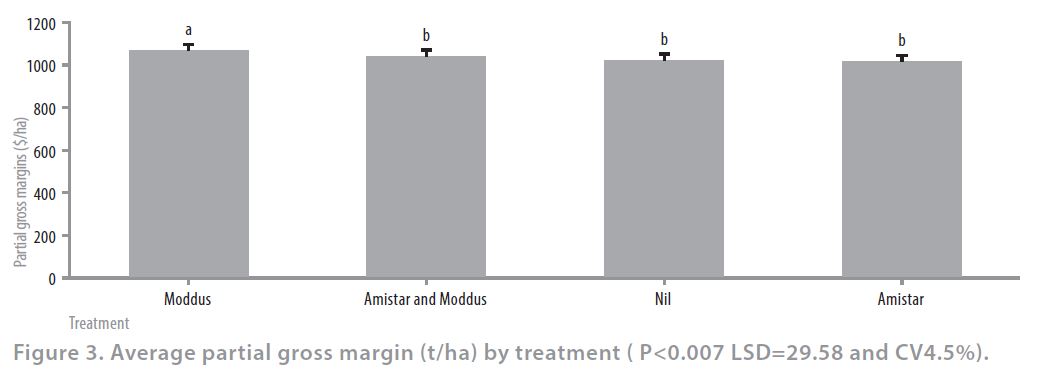
In this trial Moddus achieved a higher gross margin than the other treatments (Figure 3). However, it should be noted that the partial gross margin of Moddus was only $44.40 higher than the nil gross margin. With $32 invested in the application of Moddus, this equates to a $1.38 return for every $1 invested in the crop. Agriculture is an inherently risky business and sound risk management principles would dictate that at least a two for one return on investment should be achieved before considering the application. In hindsight, this application would not have been a good investment.
That said, the feed grain price used in the gross margin analysis could be considered low in the long-term. Further to this, the trial was nitrogen stressed which prevented the crop from achieving higher malt grades. If the grain price had been more favourable, and the trial was given an opportunity to reach higher grade classifications, the return from the application of Moddus may have been more favourable.
It is apparent that in this disease free situation, Amistar Xtra did not add to yield; its cost had a negative effect on the gross margins for those treatments that included the product.
COMMERCIAL PRACTICE
In this trial the addition of PGR to barley provided a yield benefit and improved the crop’s gross margin. The return on investment from the application of PRG was low: a return of only $1.38 for every dollar invested. Assuming sound risk management practice, this level of return would not be sufficient to warrant using a PGR. However, the barley price in 2013 and low quality achieved in this trial depressed the potential returns. In seasons where quality and the prevailing barley prices were higher, the addition of a PGR might have yielded a more useful return on investment.
It was also evident in this trial that fungicide extended the green leaf duration of the crop bit this did not increase crop yield and reduced the gross margins of treatments that included a fungicide.
There was no significant interaction between treatment and variety, with no single variety responding differently to the addition of PGR or fungicide.
ACKNOWLEDGMENTS
The trial was funded by the GRDC’s ‘Barley Agronomy for the Southern Region’ project.