It is important for growers to continue to review their varieties annually, but they should avoid placing too much emphasis on what happened in the previous year (i.e. a single year of data). For more than a decade, Yitpi reigned supreme across the Mallee, but over the past two to three years there has been a gradual change. There is now a greater spread of varieties being grown across the region, with Scout (with its recent reclassification from APW to AH in Victoria) and Mace increasingly popular choices.
Take home messages
• Scout and Mace, both Hard varieties, are now suitable Yitpi replacements for the Wimmera
and Mallee.
• Mace needs to be managed for stripe rust; there was a 0.6t/ha yield reduction due to stripe
rust at Horsham.
• New varieties Phantom and Corack also performed well across all trials.
Aim
To evaluate the performance of new and current wheat varieties in the Wimmera and Mallee.
Method
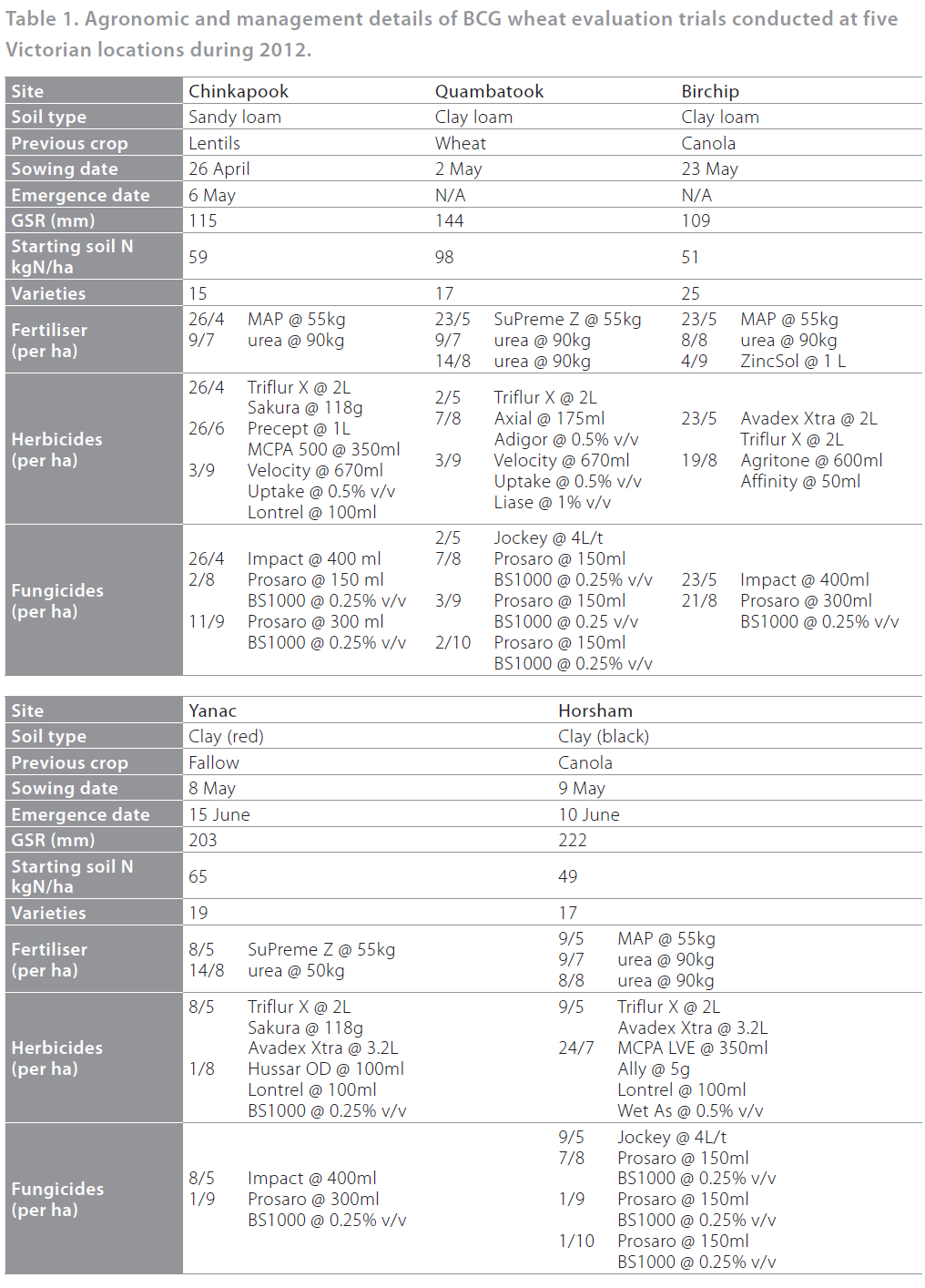
Five trials were established at BCG research sites across the Wimmera and Mallee. The trials were sown using a twin cone seeder with knife point and press wheel assemblies on 30cm row spacings. Each trial was replicated four times and managed to maximise yield (e.g. weed control and disease management). Nitrogen (N) applications were based on crop requirements determined by Yield Prophet®. Emergence date, phenology, canopy ‘greenness’ (measured as NDVI), grain yield and quality were measured. Disease scores and severity were measured by DPI pathologists, Grant Hollaway and Mark McLean. Crop details and applications for each site are listed in Table 1. The Horsham trial was baited for mice after sowing as mouse activity was high.

Results and interpretation
Chinkapook
The trial was sown into marginal moisture on a south facing mid-slope on a typical red Mallee sandy loam. Crop establishment was initially patchy, but improved within days. The effect of this variability was inconsequential, having no impact on yield and other grain parameters. Stripe rust was found in the trial in early August, prior to fungicide application. No other diseases were observed throughout the season.
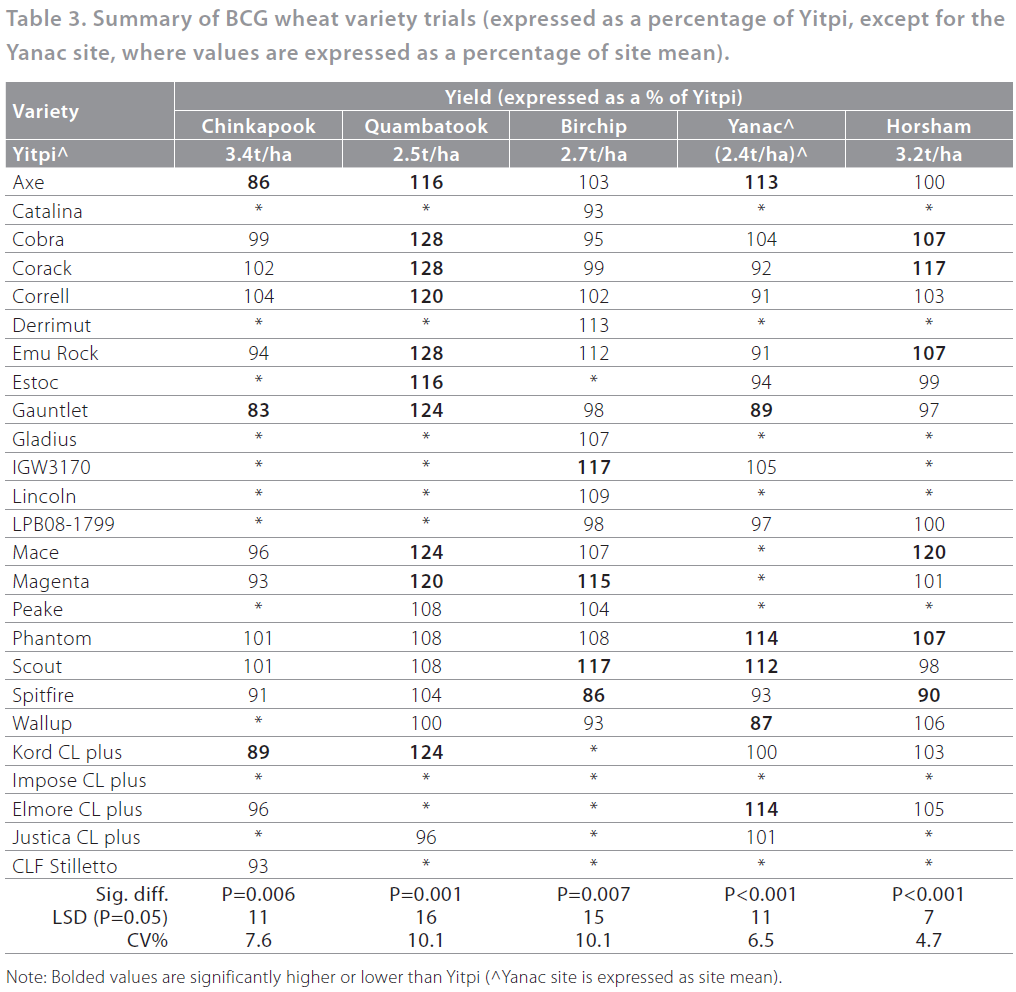
Despite below average growing season rainfall, the varieties still yielded exceptionally well, with the site mean being 3.0t/ha. Of the varieties, Correll and Corack topped the yields at 3.3t/ha. No variety was significantly better than Yitpi (3.2t/ha). Within this experiment, for a variety to be significantly better or worse than Yitpi, there needs to be more than 11% (0.3t/ha) difference between them. Kord CL plus, Axe and Gauntlet yielded significantly lower than Yitpi. The collated yields, expressed as a percentage of Yitpi, are presented in Table 3.
Grain quality was mostly APW-ASW, with protein ranging between 10-12.4%. As expected, those varieties that yielded well generally had lower protein. Correll had the lowest protein (10%), whilst Gauntlet and Spitfire were equally the highest at 12%. The high protein of Spitfire (12.4%) is consistent with its high protein accumulation ability. Spitfire’s default rating of APW in Victoria means that, despite achieving higher protein, the gross margin for Spitfire was still much lower than Correll.
Test weights were exceptional for all varieties, including Correll (83kg/hl): the site mean of the varieties was 80kg/hl. Gauntlet (73kg/hl) had the lowest test weight, falling below the standard of 74. Magenta (75), Kord (76), Phantom (75), though higher than the standard, were notably on the lower side compared with the rest. Screenings for all varieties were below 5%.
Quambatook
Following dry sowing (2 May) into a clay loam, emergence was delayed until early June after late May rain. Emergence, however, was good across all plots. Wild oats offered heavy competition across the site in late July before it was controlled in early August with Axial®. Yellow Leaf Spot (YLS) was present in all varieties at the site. Differences were observed between varieties, with Corack and Magenta having the lowest infection (<5% leaf area affected, LAA). Scout, Justica, Yitpi, Axe, Peake and Correll had the most infection >17% LAA.
Other diseases such as stripe rust, stem rust and crown rot were also observed in the trial. Stripe rust was present in moderate levels at the site, especially in susceptible varieties such as Mace, but is unlikely to have affected yield. Crown rot was present at low levels across the site and stem rust was only found in very low levels in Yitpi. The data presented in this report are based on the plots that were regularly treated with a fungicide, and were not affected by curable diseases such as stripe rust and to a lesser extent YLS.
Grain yield results from plots treated with foliar fungicides to control disease are shown in Table 3. Ten of the 17 varieties performed better than Yitpi, with the highest yielding being Cobra, Corack and Emu Rock at 3.2t/ha. The site mean yield of the trial was 2.9t/ha. The lowest yielding variety was Justica at 2.35t/ha.
Birchip
Similarly to the Quambatook trial, the crop at Birchip emerged in early June, following 10mm on 25 May. Establishment was excellent, despite the site being dry sown, achieving the target plant density of 130plants/m2. None of the varieties experienced any disease pressure during the year prior to the in-crop fungicide application. Volunteer canola from previous windrows was the only weed burden on the site during July.
The trial, having been late to emerge, was favoured by the soft ‘cool’ finish to the season. Grain yield was spread between varieties. IGW3170, Magenta and Scout performed very well, yielding significantly better than Yitpi. Derrimut and Emu Rock also yielded well, but not significantly better than Yitpi. Spitfire was the lowest yielding variety.
Grain quality was excellent, with the majority of varieties achieving H2 quality. Protein levels ranged between 11.2% (Correll) and 13.8% (Spitfire). Spitfire had significantly higher protein than all other varieties (P<0.001, LSD=0.7%, CV1.2%) which is again consistent with its high protein accumulation ability. Test weights were above the minimum receival standard of 74kg/hl; the mean of all varieties was 81kg/hl. There was no significant difference between varieties in test weight. Screenings were all below 5%. Correll, due to its lower protein, achieved only APW classification. Corack, Cobra and Magenta are APW only varieties and were defaulted to this grade, regardless of protein. The only varieties to achieve H1 were Spitfire and Wallup. However, it should be noted that these varieties also yielded the lowest. This could explain the higher protein.
Yanac
Dry sown in the second week of May, the crop did not emerge until 15 June. The site was known to have ryegrass resistance to herbicide groups A and D. While the addition of Sakura® and Avadex Xtra® with Triflur X® improved control, substantial ryegrass grew in the crop row. Hussar®, applied in-crop, suppressed the ryegrass long enough for the crop to outcompete the weeds. At flowering, the ryegrass population was low and sparse and had little impact on yield. No pests affected this trial. The trial was sprayed once with a fungicide as a preventative. No disease was found. Yitpi, Mace and Magenta were removed from the trial due to a seed packing error. Subsequently, any assessments including grain yield, will be expressed as per cent of the site mean.
Axe, Scout, Phantom and Elmore CL Plus performed the best, yielding 2.7t/ha. The site mean of the trial was 2.4t/ha. Wallup and Gauntlet were the lowest yielding varieties, significantly lower than the site mean.
Grain quality was marginal across the site. While protein levels were moderate (site mean 12.1%), Emu Rock and Kord CL Plus were the only varieties to achieve protein greater than 13%. Spitfire’s protein was equal to the site mean (12.1%). Test weights were generally low; Correll (69kg/hl), Wallup (70kg/hl), Yitpi, Justica CL Plus (72kg/hl) and Phantom (73kg/hl) all failed to meet the standard of 74kg/hl. Screenings were also higher in Correll and Wallup. It is important to note that this site had an extremely dry finish: many of the varieties may have set a higher yield potential than was possible and suffered in yield and quality as a result.
Horsham
Sown dry into canola stubble, this experiment, like most of others, did not emerge until the second week of June. This trial was established as a disease tolerance trial where each variety had eight ‘plots/replicates’. Four replicates were sprayed with fungicide and the remaining four replicates were unsprayed. Dr Grant Hollaway (DPI) assessed each variety and checked for diseases. The site was baited because of heavy mice damage prior to emergence. The trial was not affected by weeds throughout the season.
Stripe rust was the only disease of significance. As expected, the susceptible varieties had the most rust (>20% LAA). Mace (71% LAA) and Cobra (50% LAA) were most affected. Gauntlet (MR), Spitfire (MR) and Correll (MR-MS) behaved as their ratings would suggest, having the least amount of infection when unsprayed (<6% LAA). Figure 1 shows yield of each variety in the presence (‘no fungicide‘) and absence (‘disease-free‘) of stripe rust.
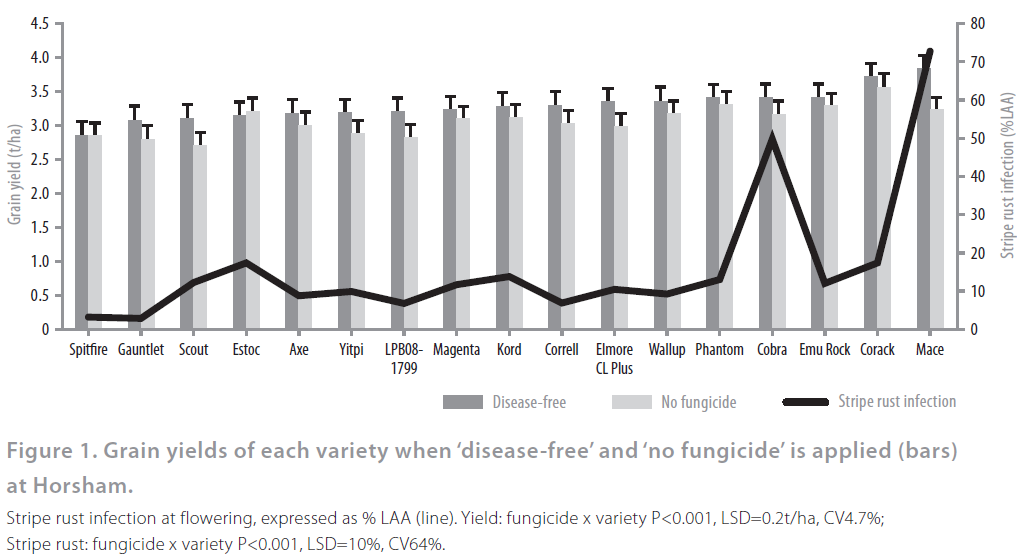
There was a strong interaction between variety and fungicide treatment (P<0.001) for both level of infection and grain yield. Mace had the highest stripe rust infection and yield loss (0.6t/ha). Cobra, despite having 50% LAA by stripe rust, did not suffer as great a yield penalty as the infection would have suggested. Estoc, however, had up to 20% LAA yet yield was not affected. There were also significant yield losses in Yitpi, Scout, Elmore CL plus, LPB08-1799 and Gauntlet, which was not related to the level of SR infection. This data would suggest there may have been an additional benefit from the fungicide that was not identified from the disease assessments.
In terms of the overall varietal performance, based on the ‘disease-free’ plots only, Mace and Corack performed exceptionally well, significantly out-yielding all the other varieties. The site mean yield was 3.2t/ha. Spitfire was the worst performing variety (2.8t/ha), yielding 10% lower than Yitpi (3.2t/ha).
Grain quality was excellent in all of the varieties except Corack, having high protein to potentially achieve H1. The relatively high amount of N applied to this trial and the dry spring resulted in higher grain protein, with the site mean achieving a protein level of 14.1%. Similarly to other trials in this report, Spitfire (15.6%) produced higher protein levels than any other variety (P<0.001), which would be expected, given its poor yield. Corack had the lowest with 12.8%. There was an obvious dilution effect in the trial: both Corack and Mace had the lowest protein, but the highest yields.
Test weight was low in Correll, Scout, Phantom and Kord and all were below the minimum standard of 74kg/hl. This meant these varieties achieved only AUH2 or AGP1. Screenings for all varieties were less than 5%, having no impact on grain quality.
Commercial practice
It is difficult to find reasons why growers should not consider growing Scout and/or Mace in place of Yitpi. Both these ‘Hard’ varieties for the last three seasons have shown superiority to Yitpi both in yield (at least 5% better) and overall adaptability. Scout, due to its susceptibility to YLS, should not be sown into wheat stubble. Mace has excellent YLS resistance and is suited to being grown into wheat stubble along with Magenta, Lincoln, Young and Corack also being suitable wheat-on-wheat varieties. Because Mace is highly susceptible to stripe rust (SVS), this disease must be proactively managed in this variety. The new variety Phantom, if it is given ‘Hard’ status, will also have a good fit in the Wimmera as it has a good disease profile and yields comparable to Scout. Like Scout, however, Phantom should not be sown into wheat stubble because of its susceptibility to YLS.
Acknowledgments
These trials were funded by BCG members through their membership.