Over the last decade, two brome grass species, Bromus diandrus (great brome) and Bromus rigidus (rigid brome) have emerged as problematic weeds in the Mallee. They have become increasingly prevalent on sandy rises, where crop growth is often poor due to low nutrition. This lack of crop competition has allowed the weed to thrive.
Traditionally B. diandrus was the most dominant brome species in the Mallee, but recently, B. rigidus, is becoming more prevalent. The principal difference between the two species is that B. diandrus germinates early, whereas B. rigidus favours dark conditions typical of no-till systems. Recent research has also shown that B. diandrus and, to a greater extent B. rigidus, have developed a cold requirement, conducive to late (post-sowing) germinations.
Understanding brome grass phenology is vital for farm management planning. Research by Gill and Kleeman (2004) observed B. diandrus in the Victorian Mallee to have increased dormancy. Evidence suggests B. diandrus can now germinate later under cooler conditions, after the crop has emerged.
Brome grass has a shorter growing season than most cereal crops. This makes it difficult to crop-top successfully, as the brome grass commonly sets seed before the crop is ready to be sprayed. Options that make crop-topping a more viable practice include sowing earlier at higher seeding rates and choosing short-season varieties.
Legally, wheat can be crop-topped when it is at the late dough stage (28% moisture in the grain) with either glyphosate or diquat. Barley can only be crop-topped with diquat as soon the crop is mature and ready for harvesting. Glyphosate is not registered for late season application in barley and the malting barley industry has concerns about the residual effects of chemical on the grain. Paraquat is not registered in either wheat or barley (GRDC 2010).
Take home messages
• Sowing early gave best crop competition with brome grass.
• Select a variety with high early vigour to suppress brome grass seed set.
• Select a variety with a short growing season when crop-topping brome.
Aim
To determine the effectiveness of controlling brome grass seed set with crop-topping short-season cereals sown at different times.
Method
The experiment was established 20km east of Chinkapook on a Mallee sandy loam soil, which has a history of high great brome (B. diandrus) levels.
Location: Chinkapook
Replicates: 3
Sowing date: 26 April and 19 May
Target crop plant density: 150 plants/m²
Crop types: Axe wheat and Hindmarsh barley
Fertiliser: 26 April TOS 1 MAP (50kg/ha)
19 May TOS 2 MAP (50kg/ha)
9 July TOS 1 & 2 urea (90kg/ha) (46% N)
Herbicide: 26 April TOS 1 Triflur X® (1.5L/ha) all plots
Roundup PowerMax® (1L/ha)
Goal® (100ml/ha)
19 May TOS 2 Triflur X® (1.5L/ha) all plots
Roundup PowerMax® (1L/ha)
22 July Velocity® (670ml/ha)
MCPA LVE® (350ml/ha)
Crop-topping: Axe Roundup PowerMax® (1.2L/ha)
Hindmarsh Diquat (2L/ha)
Fungicide: 26 August Prosaro® (300ml/ha)
Spread Wet® (0.25%)
Seeding equipment: BCG cone seeder (knife points, press wheels, 30cm row
spacing)
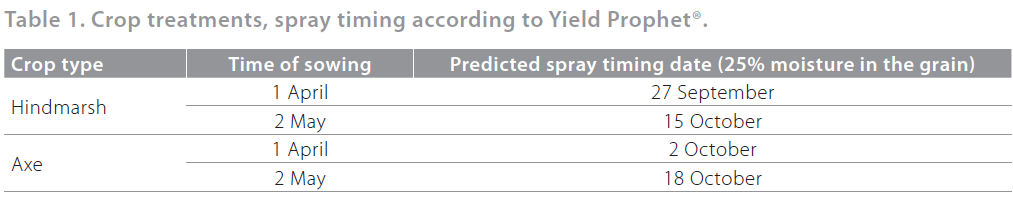
The trial was designed with four treatments replicated three times. Two crop types (Axe wheat and Hindmarsh barley) were sown at two sowing times (April 26 and May 19). Both of the treatments were crop-topped at 25% moisture in the grain (Table 1). To determine the grain moisture, the heads were threshed out, weighed and dried at 70°C for 24 hours. The different crop types were selected for their short-season growth habit, which would give the best opportunity for a successful crop-top.
Three brome grass counts per plot (with a 50 x 50cm quadrat covering two crop rows) were completed. Counts were done on the plots that were ready to be crop-topped to give an accurate account of seed set which could be potentially controlled.
Brome grass was collected from the same position as the initial panicle counts immediately prior to harvest, and sorted into brome with large and small panicles. The seeds were counted from the different size panicles to estimate the amount of seed set. Seed viability will be tested in the 2013 growing season, with germination tests carried out on the seeds collected. Growth stage assessments were also completed throughout the trial.
Results and interpretation
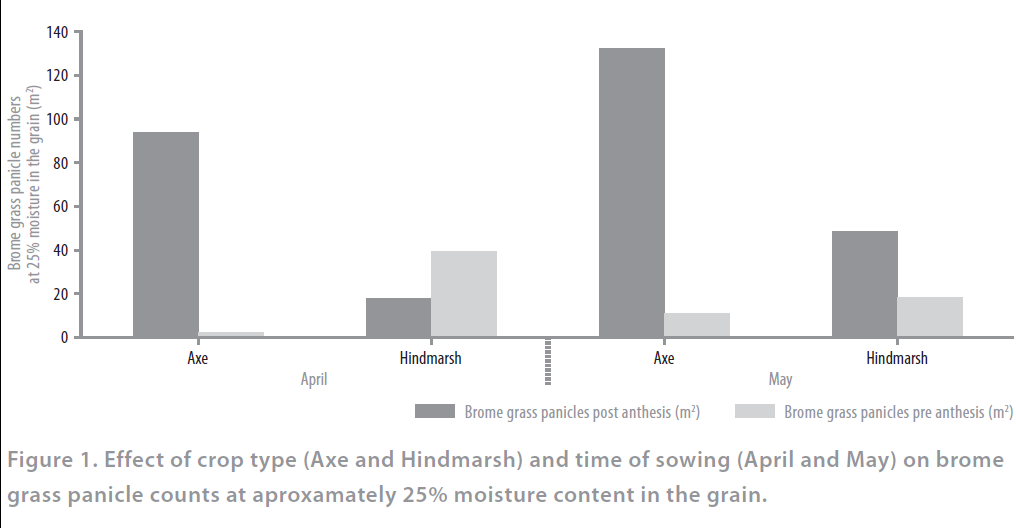
There was a trend in the data for fewer panicles in the early-sown crops compared with the late sown crops (Figure 1). Experience would suggest that early competition helps suppress brome grass. Early competition from Hindmarsh barley should have delayed maturity of the brome grass. Effectively, at the time of the crop-topping spray, only the brome grass past anthesis would have a chance of setting seed. Hindmarsh sown in April drastically reduced brome grass seed set because of the low number of panicles post anthesis.
The stastical analysis of brome grass panicle numbers pre-anthesis, post-anthesis and in total indicated no significant difference (due to the high CV’s: 153.3, 100.2 and 82.1% respectively). More investigation is needed because of the clear visual differences between the number of brome grass panicles seen across the different treatments.
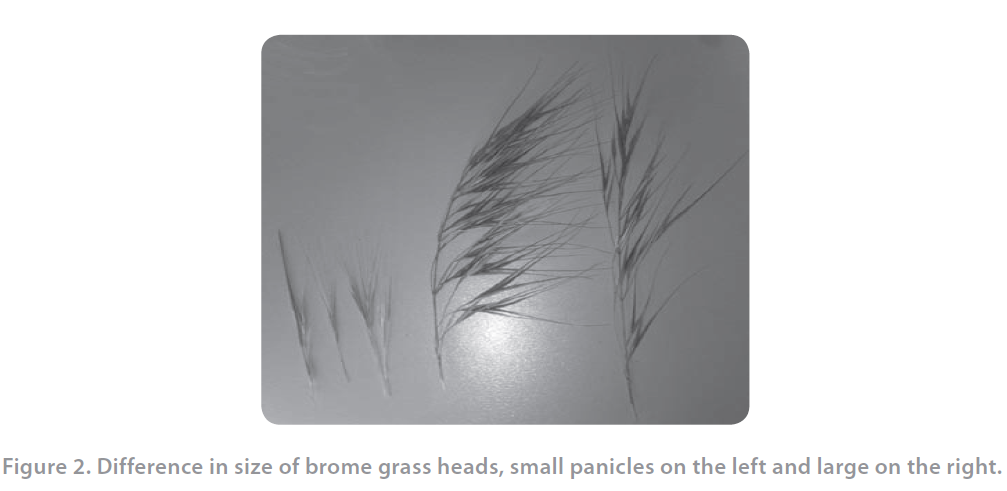
The suppression of the brome grass also led to the development of two different sized panicles, small panicles producing 1-3 seeds per head and large panicles 25-35 (Figure 2). While the early-sown Axe and Hindmash appeared to suppress brome grass emergence, in the later sown crops (May), the brome grass emerged at the same time the crop and produced a higher number of large panicles. As a result of this size difference in brome panicles between the crop seeding dates, seed counts were conducted.
The results from this trial suggest that early sowing can help reduce brome seed set. There was no significance difference between crop types, when sown early, but brome grass seed numbers were higher in the wheat (336 seeds/m2) than in the barley (61 seeds/m2).
The later sown crops were not able to establish before the brome grass emerged and did not have the same ability to compete with and suppress the weeds. If sowing later it would be advisable to select a variety that will compete more readily with brome grass. In this trial the effect of crop type/variety was clear with the late sown Hindmarsh clearly outperforming the late sown Axe in terms of its ability to limit brome grass seed set (Hindmarsh 994 seeds/m2; Axe 1948 seeds/m2).
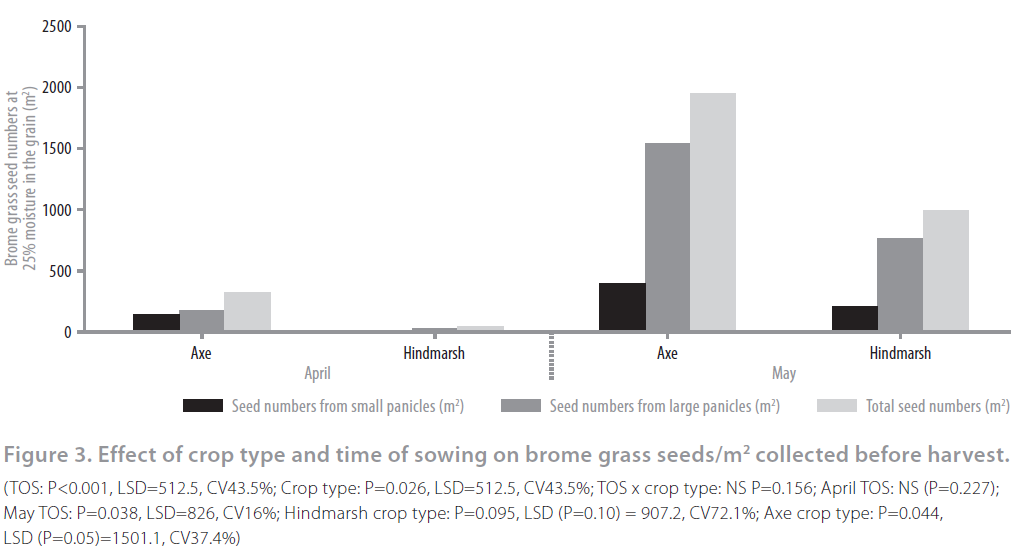
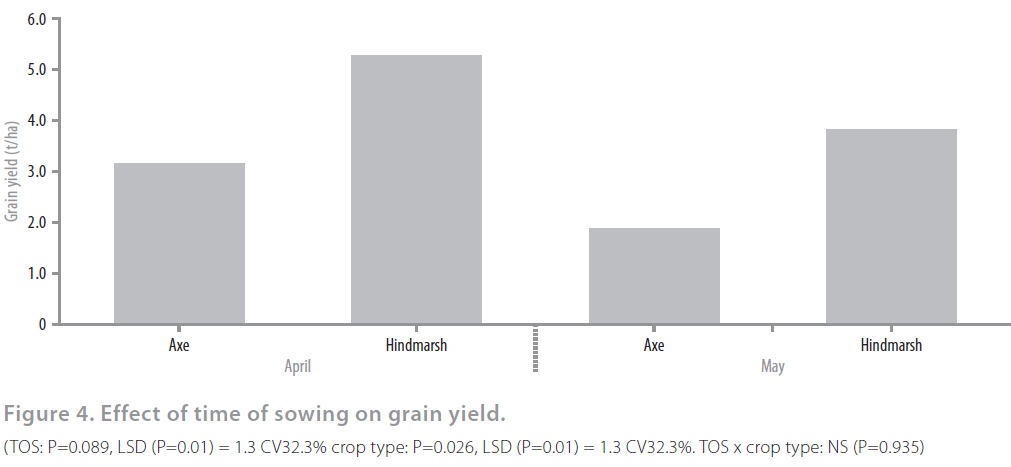
The effect of brome grass suppression was also evident at harvest time with the early time of sowing (26 April) higher yielding than later time of sowing (19 May). The early sown crop types benefited from the combined effects of greater biomass production and emergence before the brome grass. Yield correlated with the amount of brome grass present and the ability of the crop to compete with it and still produce a yield. The greater the number of brome grass panicles (Figure 1) or seeds (Figure 3), the lower the yield. From the early sowing to the late sowing, Hindmarsh yield decreased 27.4% and Axe decreased 34.6%. The Hindmarsh mean yield was higher than that of Axe.
Hindmarsh had a greater effect on lowering the seed set than Axe in the respective times of sowing (Figure 2). The differing growth behaviour of the two crop types probably played a role in this. Hindmarsh is more competitive than Axe because of its ability to produce large amounts of biomass with large numbers of tillers. This growth habit competes more vigourously for water, nutrients and space. Axe, by comparasion, produces significantly fewer tillers and grows erect, allowing the brome grass greater access to the enviromental factors necessary for good growth.
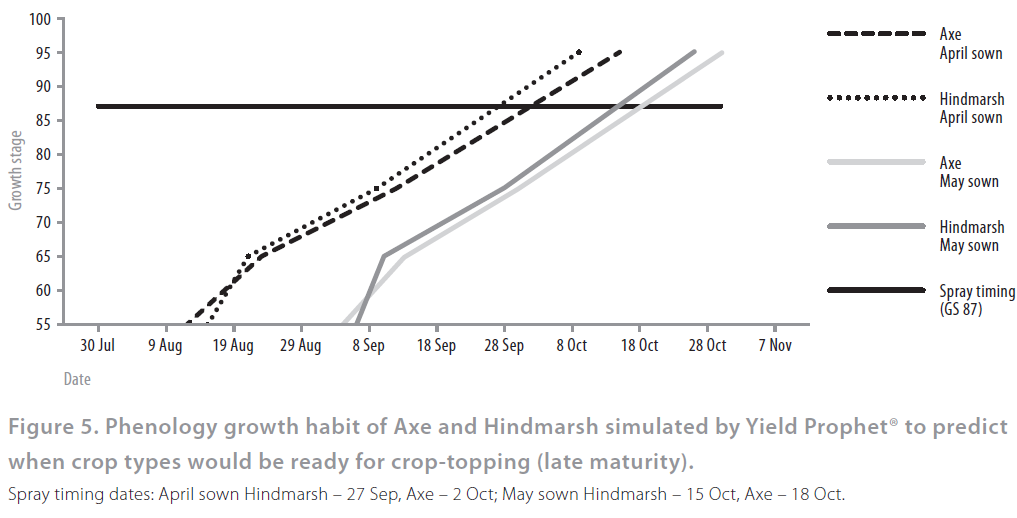
The problem with crop-topping brome grass is that it often matures earlier in the season than the crop itself and wheat can only be crop-topped once it has reached 28% moisture or at the late dough growth stage (GS87).
The crops that reached crop-topping maturity first were Hindmarsh and Axe sown early on 26 April, they reached GS87 at different times: 27 September for Hindmarsh and 2 October for Axe (Figure 5). It was evident from this trial that the faster-maturing Hindmarsh was the more appropriate choice for crop-topping. In addition to its early maturity, it competes initially with the brome (lowering the numbers) and the brome grass that does emerge is sufficiently suppressed for a good number of plants to be controlled late in the season (Figure 1 and 2).
Commercial practice
Crop-topping is becoming a more common practice in the Wimmera and Mallee, providing growers with an effective late-season weed control option.
While the findings from this trial were promising, it is vital that farmers are aware of the legalities that surround crop-topping, thus ensuring it remains a sustainable management practice. Withholding periods (WHP) will apply and must be adhered to. Remember, the late use of herbicide in-crop increases the risk of detectable residues in the grain, which could potentially lead to breaching the maximum residue limits (MRLs). The Malting and Brewing Industry Barley Technical Committee (MBIBTC) is strongly against the use of herbicides late in the season. Diquat is the only registered product for crop-topping barley however, it is important to check with the maltsters before spraying, as some impose restrictions on crop-topping.
Effective crop-topping can, however, be as good as a break or fallow for weed control, without compromising yield. To ensure a successful crop-topping, with less chance of weed escapes, it is essential to choose a crop type/variety that matures early and has a very competitive growth habit.
This trial was conducted at Chinkapook, but the data should apply to most of the state due to the phenology changes in different climate regions. To determine if this is the case on your farm, monitor brome grass growth stage late in the season. In a wheat crop, glyphosate should be sprayed when the seed heads emerge and before the dough stage, but remember glyphosate takes time to move through the plant. If the brome is past flowering diquat should be used, as it will provide better control of seeds in the dough stage (Douglas, A. and Ferris, D. 2010).
References
Douglas, A. and Ferris, D. (2010), Spray-topping pastures. Newsletter of the Department of Agriculture and Food 20 August 2010, Vol. 11, No. 6 pp. 4.
GRDC factsheet ‘Late season herbicide use’ (September 2010).
Gill and Kleeman (2004), Weed 6. Brome grass, CRC for Australian weed management.
AcknowledgmentS
This project was funded by the GRDC (project UA00113).