Over the last decade, no-till farming systems have been widely adopted across northern Victoria. There has also been a general move away from livestock. In part, farmers adopting no-till have had the perception that no-till is incompatible with livestock. There may also have been a need to simplify other aspects of their farms while adapting to a major change in the cropping enterprise (adoption of no-till). Some no-till farmers may now be interested in reintroducing livestock.
There are a variety of perceived problems with livestock in no-till farming systems, including trampling, compaction, infiltration, erosion, poor feed production, weed seed burial and transport, surface roughness and livestock tracks from water points.
Potential benefits from livestock include increased profit from utilising residual feed resources, greater flexibility in weed control, reduced risk from price variation and poor seasons, alternatives to herbicide via integrated weed management, nutrient cycling and germination stimulation. In wetter areas, recent research has also demonstrated increases in crop yield from summer grazing (see ‘Sheep and no-till: no worries!’ pp. 177).
Data from BCG sites in 2011 at Ultima and Banyena showed small, measurable effects of grazing on soil properties but no measurable impact on yield (BCG 2011 Season Research Results, pp. 199).
Take home messages
• Modest autumn grazing of no-till crop stubbles sometimes leads to small measurable increases in surface soil bulk density.
• In two seasons, on soils in the Mallee and Wimmera, modest autumn grazing of no-till crop stubbles had no measurable effect on crop yield, quality or weed seed burial.
Aim
To investigate the effects of grazing livestock in no-till paddocks on soil structure, soil compaction and soil moisture, weed seed burial and carbon/nitrogen cycling in no-till farming systems.
Method
Sites
The study used no-till paddocks which had been continuously cropped for the last four or five years. A no-till, cracking clay paddock was selected in the Wimmera (Quantong) and a sandy-loam was chosen in the Mallee (Hopetoun). The Quantong paddock had no livestock history in the previous four years. The Hopetoun paddock was sown to wheat in 2011 and last had sheep in the early 2000’s.
Location: Hopetoun
Paddock history: 5 years of direct drilled cropping (wheat in 2011).
Treatments: Plus grazing (97ha bulk of the paddock)
Control (15 x 20m fenced exclusion zones)
Replicates: 3 exclusion zones
Stocking rate: 350 cross bred lambs at 1.5DSE/hd
Stocking duration: 29 days at 5.4DSE/ha (10/2/2012 – 9/3/2012)
Sowing date: 8 May
Seeding density: 55kg/ha
Crop type: Hindmarsh barley
Seeding equipment: Flexicoil (30.5cm row spacing)
Location: Quantong
Paddock history: 4 years of no-till cropping (lentils in 2011). No sheep
during this time.
Treatments: Plus grazing (36ha bulk of the paddock)
Control (15 x 20m fenced exclusion zones)
Replicates: 3 exclusion zones
Stocking rate: 171 cross bred lambs at 1.8DSE/hd
Stocking duration: 16 days at 8.4DSE/ha (13/3/2012 – 29/3/2012), 46 days
at 2.4 DSE/ha (opened into adjacent, larger paddock
29/3-14/5)
Sowing date: 24 May
Seeding density: 60kg/ha
Crop type: Gairdner barley
Seeding equipment: Knife points (38.1cm row spacing)
Treatments
Three livestock exclusion zones were fenced off in each paddock. Treatments were described as ‘grazing’ (paddock outside exclusion zone) and ‘control’ (inside exclusion zone). More than three replicates would be desirable, but would have been expensive (each had to be fenced). The approach taken instead was to increase the accuracy of measurements by taking multiple samples, and to balance sampling across both sides of the treatment (effectively six replicates). The interpretation accordingly notes differences that are significant at a lower P-value than commonly used (P=0.1).
Grazing commenced as required by the farmers after harvest. Farmers were requested to stock paddocks at realistic rates for as long as possible, consistent with erosion and/or other management concerns, so that grazing treatments provided as much of a contrast as possible to control treatments. All weeds were controlled in grazing and control treatments to eliminate weed water use as a factor in differences between treatments.
Measurements
Stubble residue was collected pre-grazing and pre-sowing. Crop biomass samples were obtained at GS30, GS65 and GS99 (10 x 0.5m rows per treatment).
Surface soil bulk density (0-6.5cm and 5-11.5cm) and surface dry soil aggregation (0-2cm) were measured pre-grazing, pre-sowing and after harvest (where possible).
Soil surface and deep soil cores (eight per treatment) were taken pre-grazing, pre-sowing and after harvest. Composite samples at 0-10, 10-40, 40-70, 70-100 and 100-130cm depths were analysed for soil water and mineral nitrogen.
The degree of weed seed burial in grazing and control treatments was estimated using proxy weed seeds (4mm plastic beads). Two 1m2 areas in each treatment were hand ‘seeded’ at 400/m2 on the soil surface prior to sheep grazing. Immediately after sheep were removed and post sowing, areas of row and inter-row were excavated (8.5cm x 30cm) in 1cm layers to 4cm. Soil from each layer was washed away over a fine sieve and the number of beads counted.
Yield, harvest index and quality analysis were undertaken at harvest.
Results and interpretation
Grazing effects – stubble
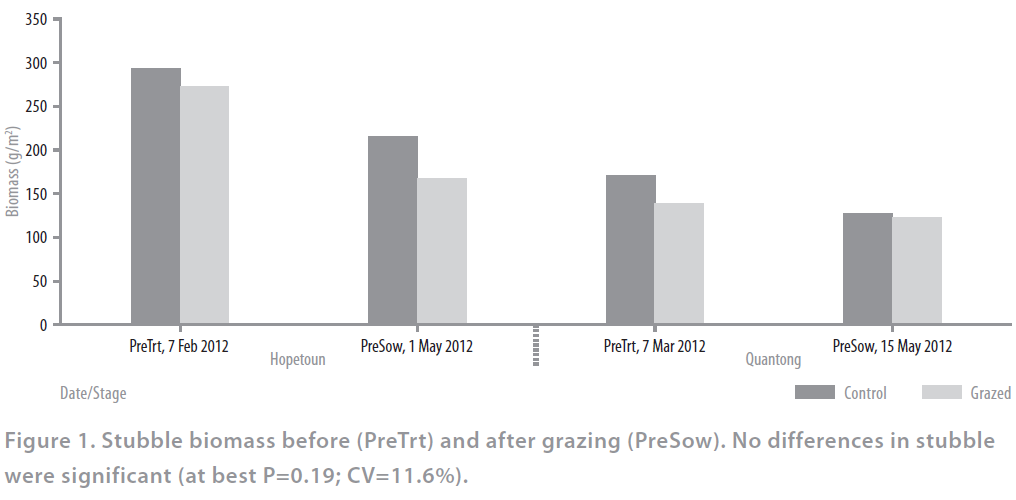
Whether grazed or not, natural breakdown had the biggest impact on stubble biomass before sowing (in the control treatment, Figure 1). Grazing led to a small additional loss of (wheat) stubble biomass at Hopetoun (about 30g/m2 or 0.3t/ha, consistent across reps but too variable to be significant, P=0.169), but there was a small additional gain at Quantong (21g/m2, P=0.032, LSD=16g/m2). This may have been because there was less (lentil) stubble to start with in control plots at Quantong, but a similar effect was observed in 2011, possibly because it was easier to separate stubble from soil after grazing than in control plots.
Grazing effects – soil
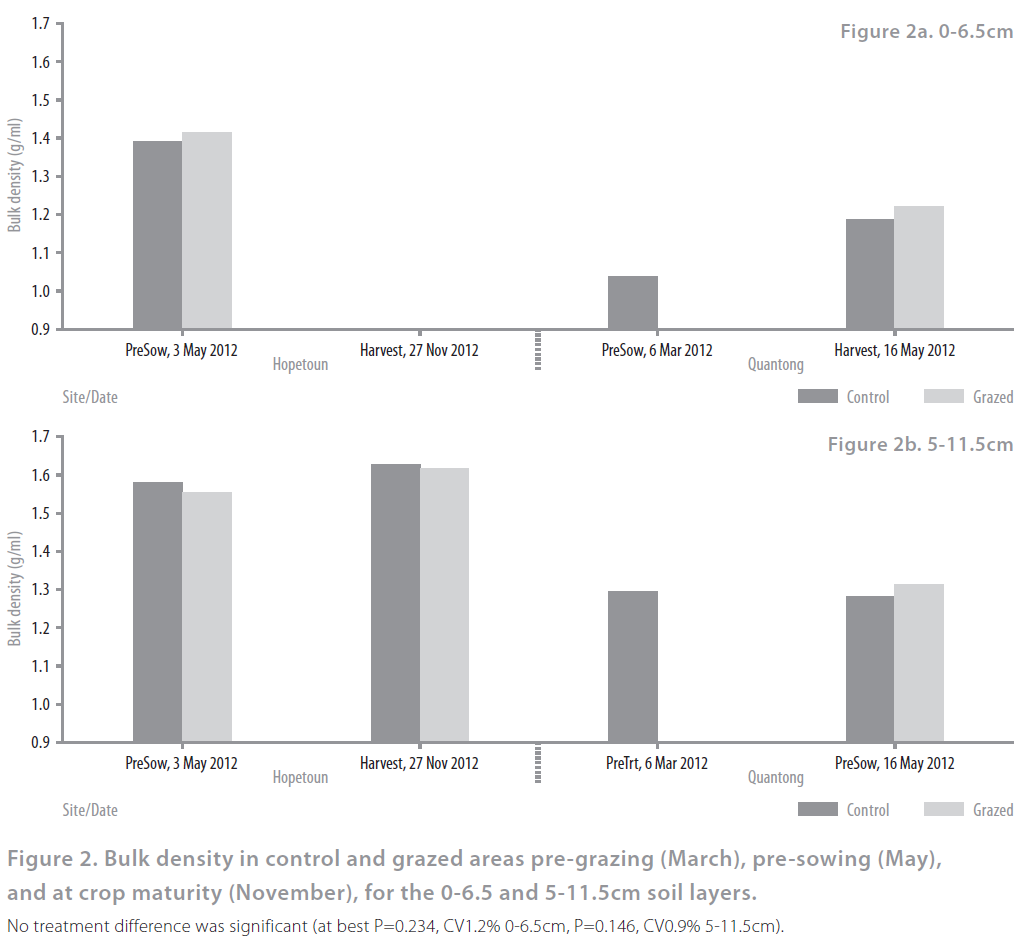
Soil effects were measured as bulk density, aggregation, soil water and nutrients. Unfortunately, bulk density measurements weren’t possible pre-grazing at Hopetoun and post-harvest at Quantong due to dry soil.
There was no strong effect of grazing on bulk density at either site or depth (Figure 2a, b).
Soil aggregation
Aggregation increased over the season at Hopetoun, and decreased at Quantong (Figure 3). There were no consistent effects of grazing on soil aggregation, and in any case effects were small compared to seasonal changes. At Hopetoun aggregation was less after grazing (P=0.197, less in each replicate but too variable to be significant), and significantly more at Quantong (P=0.087).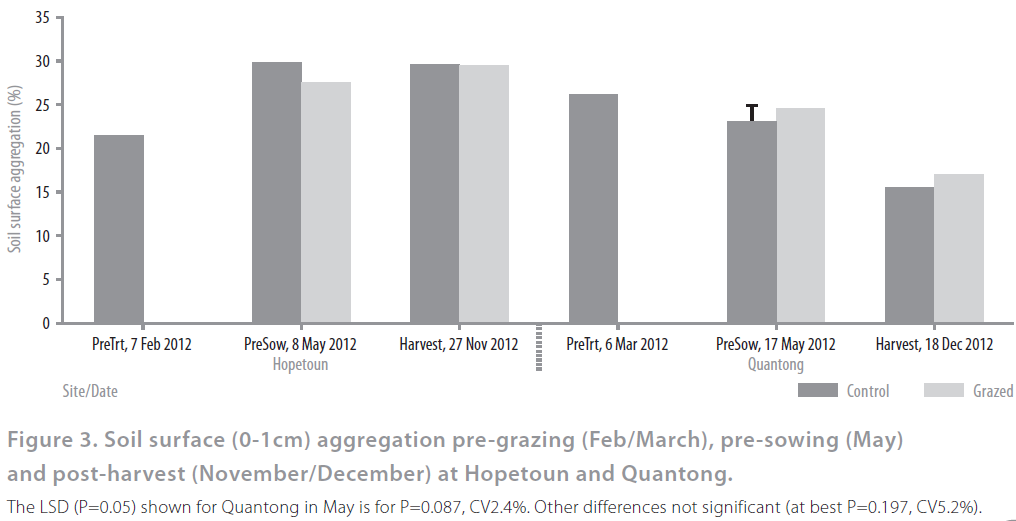
Soil water
There were no differences in soil water at topsoil or depth that could be explained by anything other than spatial variation (not shown).
Soil nutrients
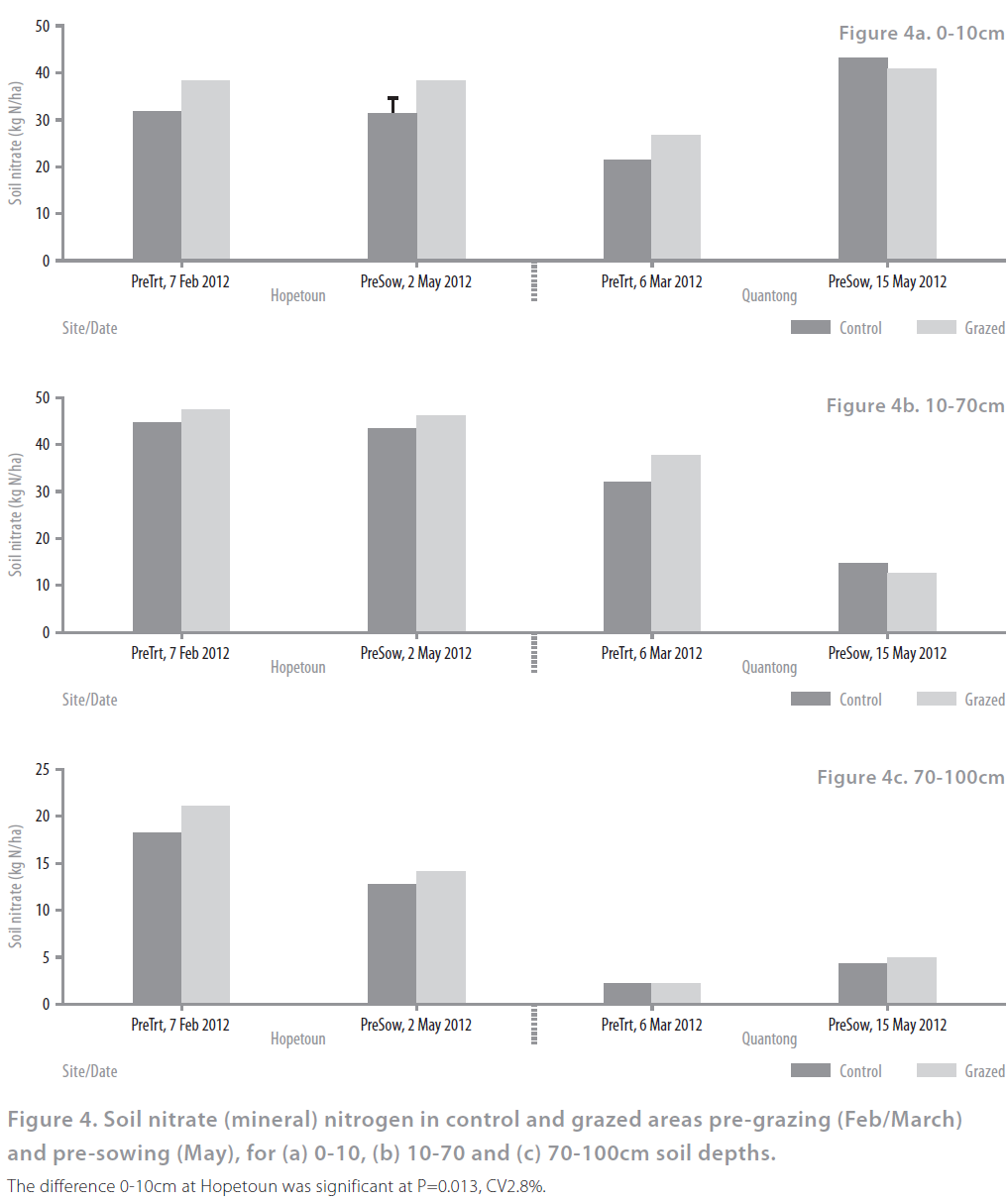
Soil nitrate nitrogen tended to be higher in the surface soil and root zone of grazed treatments before they were actually grazed (Figure 4a, 0-10cm). There may be a link to them also having less stubble (Figure 1). The grazing treatment appeared to decrease nitrogen by the pre-sowing measurement at Quantong in both surface and root zone soil, but had little effect at Hopetoun. Nitrogen was also quite stable between pre-treatment and pre-sowing samples at Hopetoun, but increased in the surface soil at Quantong and decreased in the root zone (possibly mineralisation of the lentil stubble. Nitrogen decreased only at depth in 70-100cm soil at Hopetoun (Figure 4c).
Grazing effects – weeds
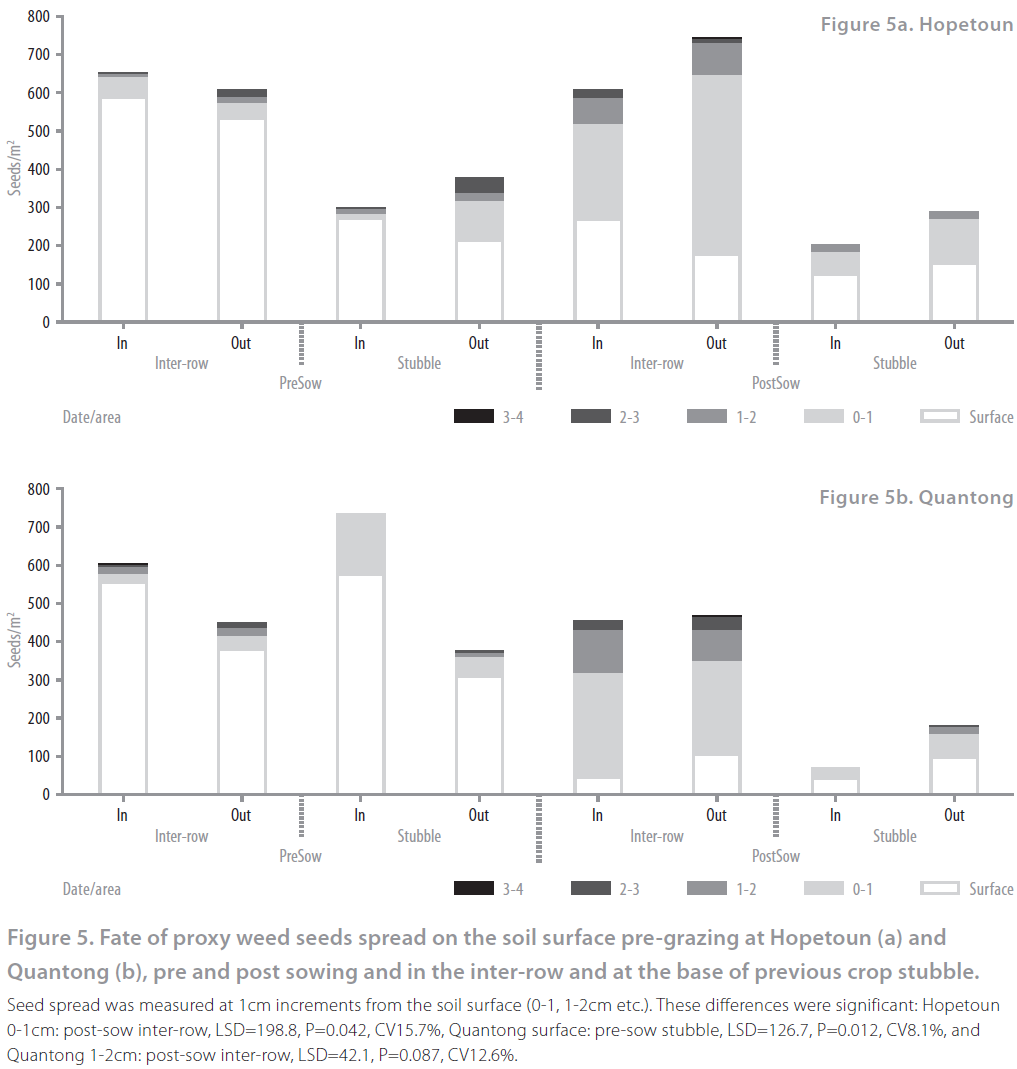
The effects of grazing on weed seed burial were monitored using small beads, which were spread on the soil surface before treatment. The main trend at both sites was for beads to be buried in the 2011 inter-row by the sowing process, and to disappear from the surface – 4cm depth sampled altogether in the stubble row (Figure 5a, b). The effect of sowing itself was much greater than any difference caused by grazing (apart from the effect on recovery of beads which may also be important).
Grazing did lead to more seeds being buried in the sowing process but only at Hopetoun (significant 0-1cm, P=0.042). At Quantong, a cracking clay, grazing had a bigger effect on recovery, with significantly fewer seeds on the surface pre-sowing, and more buried 1-2cm after sowing. It seems likely that seeds were lost down cracks at Quantong (below the 4cm excavated in this experiment) but the fate of missing seeds at Hopetoun is unknown.
Crop growth
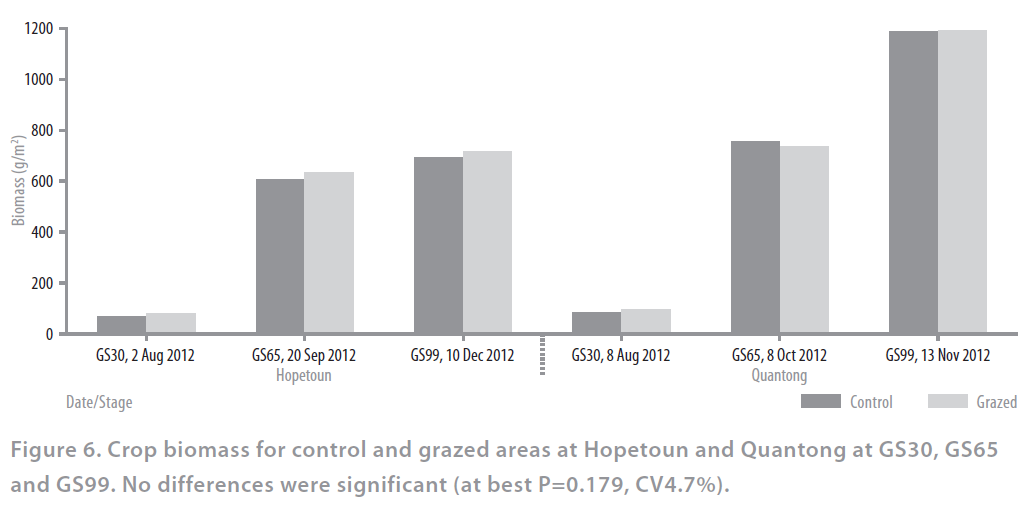
There was little difference in crop biomass between grazed and control treatments at any stage (Figure 6).
There was no consistent trend in biomass nitrogen percentage either (Figure 7).
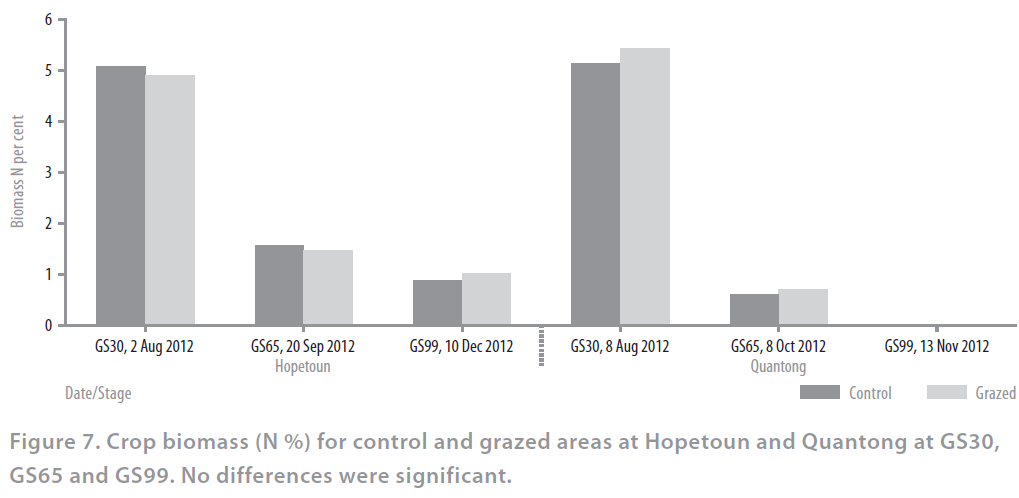
There were no significant differences between crops grown on control and grazed treatments in terms of yield, harvest index or quality (Table 1). There was a trend at both sites for higher yields to be associated with higher harvest index and grain protein, probably representing higher underlying nitrogen nutrition. This was near-significantly higher at Quantong and in keeping with biomass nitrogen (Figure 7) and soil mineral nitrogen measured before the grazing treatments occurred (Figure a-c). This is most likely a spatial effect.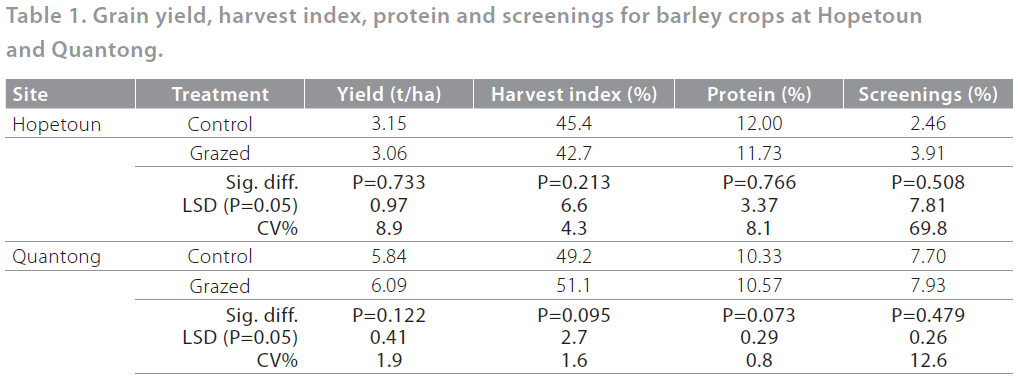
Interpretation
Light-moderate grazing pressure by sheep on no-till stubbles in a paddock in the Wimmera and Mallee in late autumn led to no measurable differences in soil surface aggregation or soil water. In 2011 there was a slight increase in surface bulk density due to grazing but no other measurable effects. There were no consistent and/or measurable effects of grazing on burial of proxy weed seeds (plastic beads), and effects were small compared to the sowing process.
Both seasons of work on grazing of no-till paddocks imply that grazing does affect soil properties. Unless grazing is particularly heavy, or conducted when the soil is very wet, it is likely to be difficult to measure the effects both on soil properties and on crop growth.
Light to moderate grazing is also likely to be far less important to crop growth than factors such as rotation and weed control. The exception may be in situations in which the risk of erosion is high.
The results are similar to those found in NSW with summer grazing (see ‘Sheep and no-till: no worries!’ pp. 177). An important difference is that no yield increases have been associated with grazing in this environment.
Commercial practice
The results after two years’ work on this project suggest that light to moderate grazing of sheep on no-till stubbles in autumn is unlikely to have detrimental impacts on crop growth in the following season. This may not apply with heavier grazing, or where the soil is excessively wet during grazing.
Farmers need to consider erosion risk, and possible detrimental effects in paddocks where there is a large weed seed bank, before deciding to graze individual paddocks.
Strategies such as use of containment areas and feeding will help to manage concerns that no-till farmers have about soil structure damage or weed seed burial from grazing during wet periods.
Acknowledgments
This study was funded by the national GRDC Grain and Graze II project.