The adoption of stubble retention, combined with the increased popularity of wheat-on-wheat plantings, has resulted in the stubble-borne disease yellow leaf spot (YLS) becoming widespread. An increase in the cultivation of susceptible wheat varieties, such as Yitpi, has also favoured this disease. YLS is most often observed in seedlings, but when conditions are suitable (continued leaf wetness), it can progress up the plant and cause heavier yield losses. Management of this disease can be difficult: registered fungicides can be ineffective and are often uneconomic. An appropriate crop rotation and the use of resistant varieties will successfully manage this disease.
Commonly grown varieties, such as Yitpi and Scout, are particularly susceptible to YLS. The past two seasons (2010 and 2011) produced substantial stubble loads that harboured significant YLS inoculum, leading to severe infection in subsequent susceptible wheat crops. Following these years, growers have moved away from sowing wheat into wheat stubble. During 2012, given the uncertainty experienced as a result of the late break, some growers opted to sow wheat where they had originally planned to sow higher risk crops such as canola or pulses. As stubble retention continues, growers will need to find strategies to combat the effect of YLS. This article reports on three BCG trials (conducted in collaboration with DPI and MSF) which investigated management options of YLS.
Please refer to ‘Using flutrialfol (Intake®) in combination with foliar fungicides for the control of yellow leaf spot and stem rust’ (BCG 2011 Season Research Results, pp. 107) for previous trial results.
Take Home Messages
• The best strategy against yellow leaf spot is to avoid sowing susceptible varieties in a
wheat-on-wheat situation.
• The effectiveness of foliar fungicides for the control of yellow leaf spot is often
variable; appropriate timing is crucial. In a low rainfall environment, it is rare to
achieve an economic response when applying fungicides to control yellow leaf spot.
• Under the right seasonal conditions, yellow leaf spot can reduce yields by between
5-10%.
Aim
The project objectives were to:
• determine what effect stubble load and type had on YLS infection
• determine whether changing cultural practices would aid in reducing YLS incidence
• investigate the effect of fungicide application timing and nutrition on YLS severity.
Method
Location: Birchip
2011 crop in paddock: Derrimut wheat (MS-S to yellow leaf spot)
Sowing date: 30 May
Target plant density: 150 plants/m²
Crop type: Correll wheat (S-VS to yellow leaf spot)
Herbicides: 30 May Roundup Attack® (2 L/ha)
+ TriflurX® (1.5 L/ha)
Fertiliser: 30 May 50kg/ha Granulock
supreme Z (N 11%, P
21.8%, S 4%, Zn 1%)
8 Aug 90 kg/ha urea (46% N)
Seeding equipment: BCG Gason parallelogram seeder (knife point,
press wheels 30cm row spacing)
The trial was sown into Derrimut wheat stubble, which provided inoculum for the following wheat crop. To a lesser extent, a neighboring paddock of wheat may have contributed to inoculum being carried by wind onto the plots. Due to the close proximity of the plots, there is also a chance that inoculum was carried from plot to plot by the wind throughout the season.
Disease severity (% LAA) within each plot was visually estimated by Dr Grant Hollaway (DPI Horsham) on 15 August.
Plots were harvested on 1 December, using a Kingaroy plot harvester. A sub-sample was retained from each plot to determine grain quality for each treatment.
Cultural practice
This experiment compared various stubble management techniques including burning, slashing, stubble left standing (retained), stubble left standing plus fungicide and stubble incorporation. It attempted to measure how each stubble management practice contributed to YLS control. The treatments were imposed on the 29 May; the crop was sown the following day.
Fungicide and nutrition
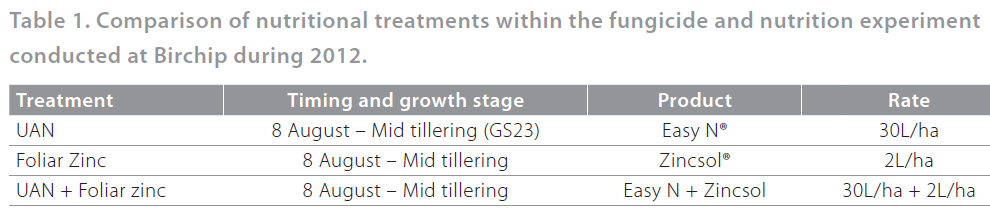
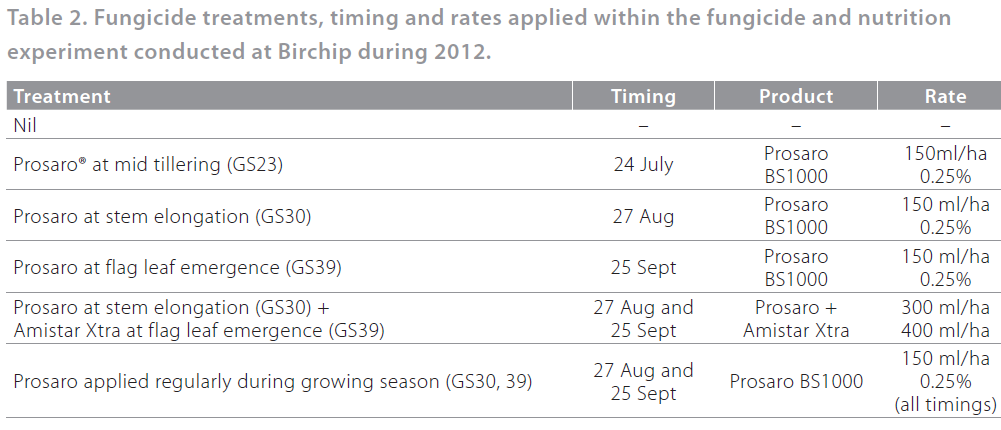
This experiment sought to understand the ways in which various fertilisers and fungicides interact when applied at different times with the aim of reducing disease severity. It attempted to pinpoint the optimum time to apply fungicide and fertiliser to reduce YLS severity. The nutritional and fungicide treatments are shown in Tables 1 and 2, respectively.
Stubble inclusion
This experiment investigated the role of infected stubble on YLS severity. In preparation, the experimental area was burnt to remove infected wheat stubble. The site was sown to Correll wheat on 3 and 4 July. Infected wheat and/or un-infected barley straw were spread onto the plots, as follows:
• non-infected barley stubble (control) applied at 2t/ha
• infected wheat stubble applied at 2t/ha
• mix of barley and wheat stubble spread over plot applied at 1t/ha each.
The plots were scored for disease severity and grain yield was recorded.
Results and interpretation
Even though the 2012 growing season started with a late break, YLS was relatively severe early in the season at the site and across many parts of the district. Initially, plant growth was slow until significant rain occurred during June, with a total of 27mm received for the month.
At times throughout the season, the crop appeared to have suffered more from moisture stress than leaf disease (see ‘Site descriptions’, pp. 9 for details of starting soil moisture, nitrogen and rainfall data).
It is likely that stressed crops are more susceptible to YLS. Yellow leaf spot kills green leaf area that converts sunlight into energy (photosynthesis) but, because lower leaves are not the main contributors to grain yield, often a plant will ’grow out’ of the disease and the effect on grain yield will be minimal.
The direction of sowing was north/south. An interesting observation throughout the year was that evidence of the disease was more often observed on the east side of the plants than the west. The leaves on the west appeared to be green; those on the east had more yellow spots. The reason for this is not known. However, it may be partly due to more conducive conditions for spore germination and infection on the east side of the plant. The east side is likely to be slightly more protected from wind and sun-light and therefore maintains leaf wetness for a longer period of time. Leaf wetness is critical for spore germination and plant infection.
Cultural practice
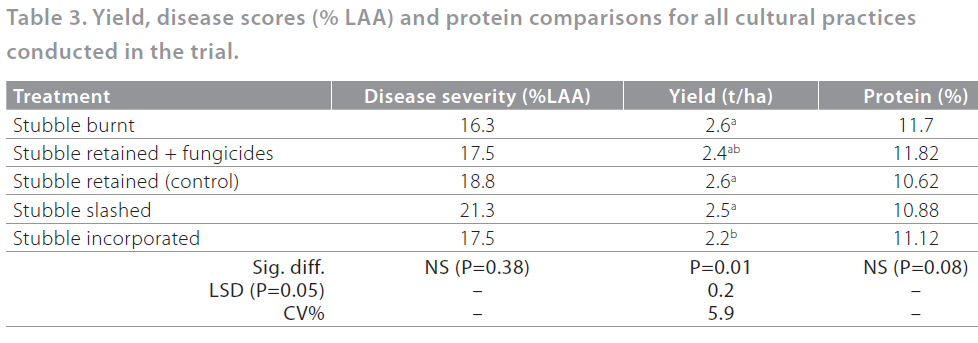
Even though Correll wheat sown into the burnt plots had slightly less YLS infection than the other plots, none of the stubble treatments had a significant effect on YLS severity (Table 3). The removal of infected stubble by burning was expected to result in much lower infection, due to removal of the inoculum source, compared with the stubble retained treatments. It is, however, likely that the wheat within the burnt plots was infected by spores blown from adjacent plots and also by incompletely burnt infected crowns. In a paddock situation, burning would be expected to have provided a better reduction in YLS severity than observed in this experiment.
The grain yield of all treatments was similar. The exception occurred when stubble was incorporated and grain yield was reduced by about 0.4t/ha compared with the standing stubble treatment (Table 3). This difference in grain yield was not likely to be due to YLS, but to a loss of soil water from the cultivation and/or the tie-up of nitrogen during the crucial early tillering phase. None of the stubble treatments had an effect on grain protein (Table 3).
Wheat plants sown into the slashed stubble had slightly higher (not significant) disease severity than the other treatments (Table 3). This may have been due to more stubble being exposed to the moisture on the soil surface, which favoured maturation of the fungus and development of fruiting bodies.
It is not possible to draw a conclusion with regard to the effects of YLS on grain yield within this study because the differences in disease levels were so small.
Fungicide and nutrition
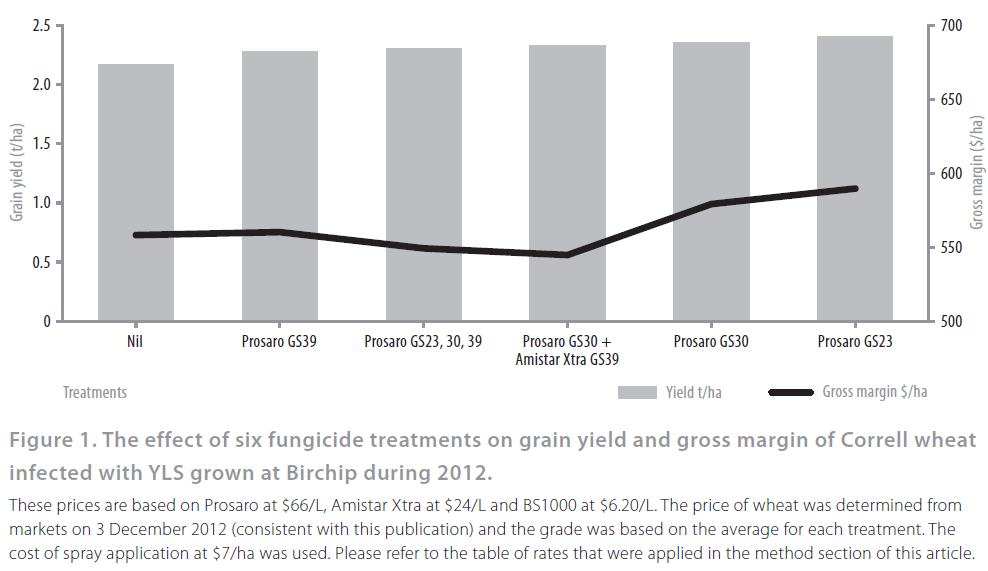
Since infection of the disease occurs during the early tillering phase, the timing of fungicide application is important for disease control. Results showed that all spray timings increased the yields significantly compared with the nil treatment. Prosaro applied at the GS23 stage (earliest spray timing) was the highest yielding of all, with a yield of 2.4t/ha (Figure 1). The gross margin, at $589/ha, showed that the best return on investment was made on the earliest application at GS23.
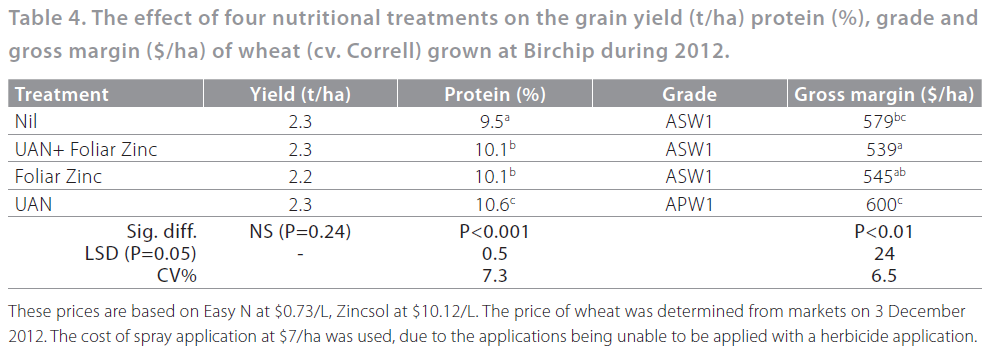
Protein levels differed between treatments (Table 4). Significantly increased protein levels were seen where UAN was applied. This resulted in a higher grade (APW1), thus increasing gross margin for this treatment. At $600/ha, the gross margin of the UAN treatment was only slightly higher (not significant) than the untreated.
The zinc application had no effect on yield or YLS severity. Zinc is a micronutrient necessary for a range of plant biochemical functions. Adequate zinc levels allow the plant to remain greener for longer. As the zinc treatments were applied only about a week prior to the assessment of YLS severity, it may not be possible to draw conclusions on the benefit or otherwise of using zinc or nitrogen to reduce disease severity.
Economic consequences
As shown in Table 5, an economic advantage was achieved from applying UAN at the mid tillering stage, as with an increase in protein from 9.5 to 10.6%, the grade improved from ASW1 to APW1, thus increasing the return on investment. Although the wheat with UAN applied had the largest gross margin, due to the cost of application and chemical, it was not significantly higher than the $579/ha gross margin of the nil treatment.
As shown in Figure 1, an economic advantage resulted from applying fungicides at various timings throughout the growing season. The nil treated plots returned a gross margin of $559/ha, compared with the treatments that received one application only of Prosaro, at GS23 and 30, returning $589/ha and $579/ha respectively. The treatments that received more than one application of a fungicide had a lower gross margin, due simply to the cost of product and the fact that the yield was not greatly increased.
Stubble inclusion
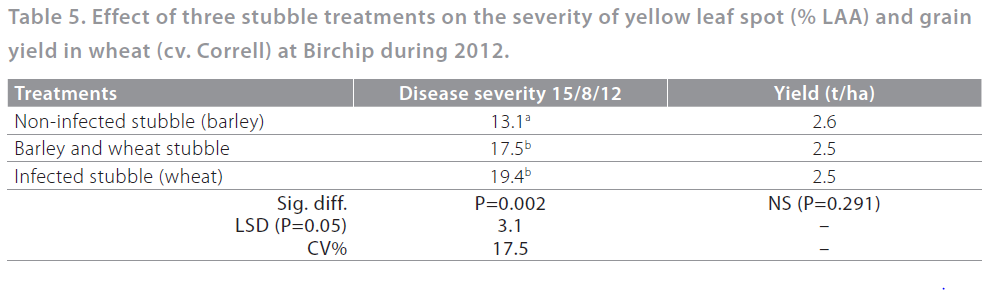
As expected, the severity of YLS was significantly greater (P=0.002) in those plots in which infected wheat stubble was present (18 and 19% LAA) and lowest in those without wheat stubble (13%) (Table 5). The higher than expected infection in the absence of infected wheat stubble (i.e. where barley stubble was applied) could be attributed to carry-over of spores on un-burnt crowns and air-borne spores from adjacent plots. In a paddock situation, a lower YLS severity in the absence of infected wheat stubble would be expected.
No significant treatment effects on grain yield were observed within this trial. Due to significant YLS developing in the non-infected treatment, it was not possible to draw conclusions on the effect of this disease on grain yield. In a paddock situation we would expect a lower level of disease to have occurred if this cultivar was sown into barley stubble.
DPI plant pathologist Dr Grant Hollaway warned that the results needed to be treated with caution. His experience suggests that this level of disease would normally have reduced yield by about five to ten per cent. The difference in disease levels achieved here would reduce that to less than five per cent, a figure for which statistical significance is not possible. Dr Hollaway further warned that growers need to be aware that they may lose five to ten per cent by growing a susceptible cultivar into infected stubble. He said there were benefits to using the more resistant cultivars in a wheat-on-wheat situation.
Commercial practice
This trial was conducted in a low rainfall region with well below average spring rainfall which would have limited disease development. Due to these dry conditions, YLS levels were relatively low in this area. However, in other areas of the Mallee, with more favourable conditions, YLS may have reduced the yield of wheat crops by approximately five to ten per cent when susceptible wheat cultivars were sown into infected wheat stubble.
Cultural practice, stubble inclusion and added nutrition at this site in 2012 had no effect on YLS. The only action shown to increase yields was the application of a fungicide. No significant economic advantage was achieved from the application of fungicides, zinc or foliar nitrogen. In a dry Mallee environment, farmers need to be aware of the potential dangers of unknown spring weather patterns and the risk of excessive expenditure involved with fungicide application. Fungicide treatments could be used, but while controlling the disease, in 2012 they provided no economic gain.
The key to the management of YLS is to (i) avoid sowing wheat into paddocks that still have one to two year old wheat stubble present and (ii) plant partially resistant cultivars if wheat must be sown into wheat stubble.
Acknowledgments
This trial was funded by Mallee CMA, and DPI conducted disease assessments.