While lamb prices have eased from record highs over the past 12 months, including a livestock component in the farm business over time offers many low rainfall farm businesses greater resilience in leaner seasons. Having a mixed farm operation provides livestock income (production and sales) and often influences investment and management decisions (such as capital tied up in machinery and cropping programs). Profitability losses are lower than those in intensive cropping systems in low grain income years.
Pasture availability during late autumn and winter is usually a challenge for mixed farms in this environment. Cereal crops (grain and forage types) are a valuable feed source for all sheep classes. With an early sowing opportunity, they are capable of producing abundant feed for grazing before legume pastures are ready in late winter and spring; allowing stocking rates to be increased without compromising the area cropped. If sown for forage use only, cereal crops can be grazed later, while a dual purpose cereal crop needs sheep removed before GS30 to avoid grain yield and quality penalties.
Specialist forage cereals have not been used extensively in low rainfall environments to date. The trial was a second year of feed evaluation for the best of the cereal grain and forage crops trialled in 2011 at Corack (BCG 2011 Season Research Results, pp. 181-186).
Take Home Messages
• Growing season lengths did not necessarily influence variety feed value; both early
and late maturing varieties performed equally well in the 2012 dry season.
• Hindmarsh barley was one of the best varieties: it consistently produced valuable
feed at both sites and had highest grain yield at Birchip (ungrazed 3.1t/ha).
• Keeping plants fresh through rotational grazing will ensure stock nutrition
requirements are being met.
Aim
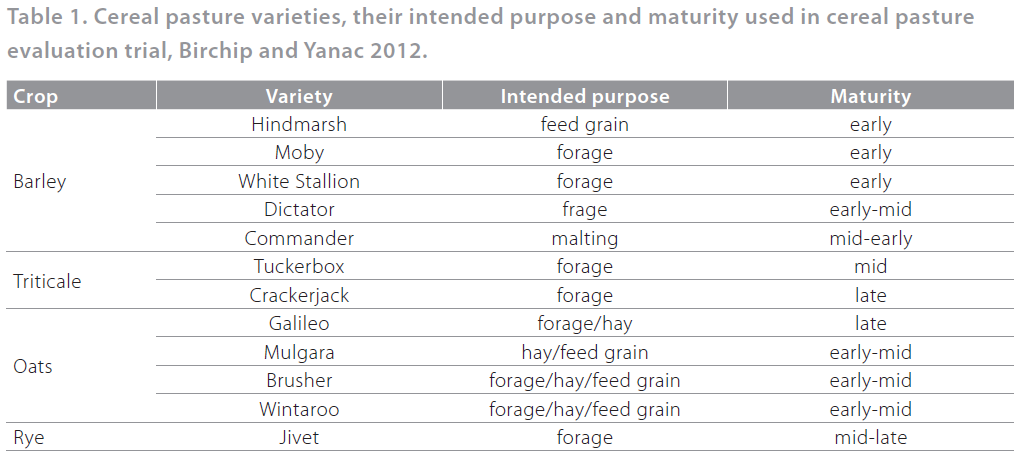
To evaluate commercially available forage cereal varieties, comparing their feed value and suitability for grazing or grain production in low rainfall Mallee and Wimmera environments.
Method
Location: Birchip and Yanac
Replicates: 4
Sowing date: Birchip: 27 April,
Yanac: 8 May
Target plant density: 160 plants/m², except ryegrass (220 plants/m² –
Birchip only)
Crop type/s: Forage wheat, triticale, barley and oat varieties
(Table 1)
Inputs/fertiliser: At sowing: MAP (55 kg/ha)
Seeding equipment: Birchip – BCG Gason parallelogram seeder (knife
points, press wheels, 30cm row spacing)
Yanac – BCG cone seeder (knife points, press
wheels, 30cm row spacing)
In 2012, the better performing forage wheat, triticale, barley and oat varieties from a similar trial conducted at Corack in 2011 were re-evaluated, using a replicated plot trial at Birchip and Yanac (NW of Nhill). The trial at Birchip was sown into wheat stubble, while at Yanac the trial was established on a cultivated fallow.
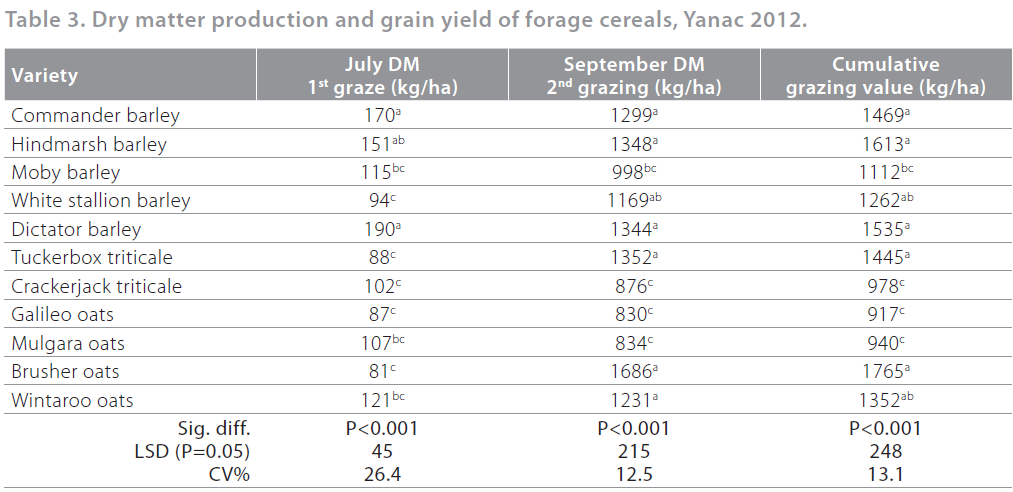
Dry matter (DM) production was measured by taking two cuts in the season when the crops were at least 15cm tall. At Birchip, DM cuts were taken on 20 August, and a separate anthesis cut on 10 October. At Yanac, DM cuts were conducted on 8 July, and a regrowth cut on the same sample areas on 11 September. The July and September cuts were totalled to give a measure of the cumulative grazing value. The nutritional value was assessed by analysing tissue samples taken from the DM cuts.
Dry sheep equivalent (DSE) grazing days were estimated for two varieties at Birchip using:
DSE grazing days = DM (kg/ha) – 30 (kg/ha; physically unavailable DM) x feed test metabolisable energy (ME) / 8 MJ, which assumes that each DSE requires 8 MJ/day.
The Yanac site was badly affected by resistant ryegrass, to the extent that the trial had to be terminated on 11 September to avoid seed set of resistant ryegrass. Due to the range of crop types randomised through the trial, no herbicide options were available to control the ryegrass at the site.
At Birchip, plots were grown through to harvest and assessed for grain yield on 2 December using a small plot harvester. Grain samples were collected and analysed for quality.
Results and interpretation
Both sites experienced below average (April-October) rainfall seasons: Birchip received 156mm GSR rainfall (decile 2) and Yanac 149mm GSR rainfall (decile 1). At both sites, late February and early March rainfall increased subsoil moisture but April was very dry prior to sowing.
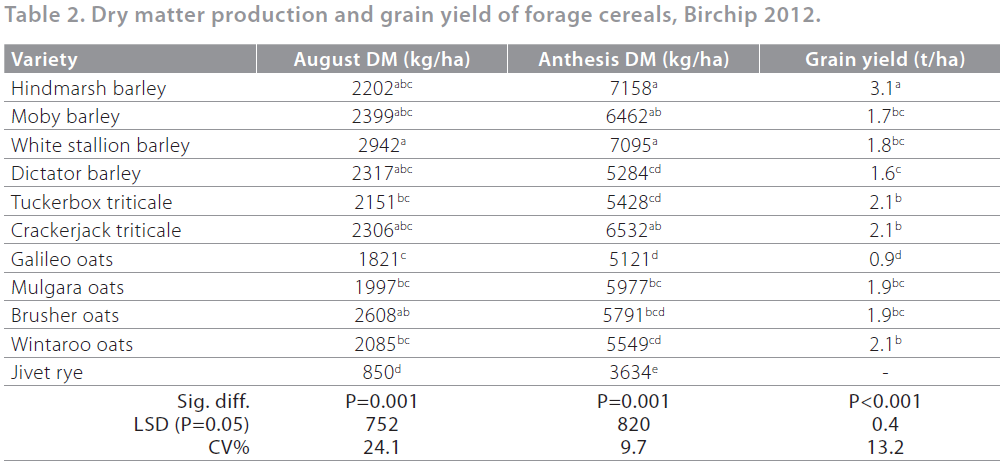
At Birchip, DM production was greatest in August and at anthesis for the early maturing varieties Hindmarsh, Moby and White Stallion barley, but also for late-maturing Crackerjack triticale (Table 2). Dictator barley and Brusher oats performed well early, but were surpassed in DM production by anthesis.
Grain yields are presented to indicate how ungrazed areas performed, assuming seed was harvested for sowing the following season or as grain intended for sheep feed. Hindmarsh barley had the highest grain yield (Table 2).
Jivet, a late maturing Tetraploid ryegrass, is intended for spring-summer growth. As expected, its early growth was sluggish compared with other cereals, but its late growth meant it was still green in mid-November, albeit moisture stressed. It is likely that the Jivet would have responded to late rains and provided green feed for animals in the spring when other varieties would have ripened.
At Yanac, Commander, Hindmarsh and Dictator barley produced the most early dry matter. White Stallion barley, Tuckerbox triticale, Brusher and Wintaroo oats started slowly, but managed by September to accumulate grazing value comparable with the other faster growing varieties. Moby barley and Crackerjack triticale did not do as well at this site as at the Birchip site (Table 3). Galileo again was one of the lowest DM producing varieties.
There were different responses in pasture production to the low rainfall season between varieties at the two sites. At both sites, the better performing cereal pasture varieties were a combination of early and later maturing varieties. It is likely that the variation in response was due to subsoil moisture reserves, rainfall events at critical stages through plant development, and traits that cope with subsoil conditions.
All varieties provided the minimum requirements for lactating ewes and lambs when grazed in July and August, ie. crude protein >16%, metabolisable energy >11 MJ/kg DM and digestibility >75%. Table 4 demonstrates the decline in nutritional value of two cereal pastures as the season progressed and how this, combined with dry matter production, affects the grazing value (DSE grazing days) between the varieties.
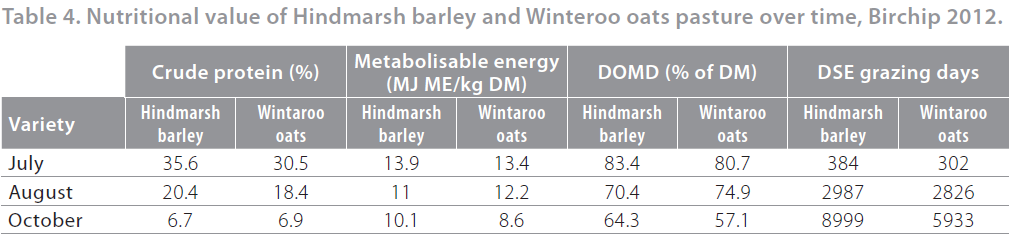
Keeping pasture growth fresh is important for the maintenance of nutrient value. In August, at the Nullawil Best Wool Best Lamb/MLA 2012 producer demonstration site (also supported by Northern Victoria Grain & Graze), a Moby barley pasture which had been grazed twice was sampled and compared with Moby that had only been grazed once. Moby grazed twice had higher crude protein (16.8%) and metabolisable energy (13MJ ME/kg DM) than Moby grazed only once which had 9.4% crude protein and 11.5MJ ME/kg DM.
Commercial practice
When choosing a cereal forage variety, there are a number of factors that need to be considered:
• the total feed value
• time requirements (When will the feed be needed? Will other pastures be available at
the same time?)
• ability to recover after grazing, giving a second use for the crop e.g. grain, secondary
grazing or hay.
• the rotational needs of the paddock.
In poorer seasons, grain specific varieties are producing similar amounts of feed to the forage and hay types. However, it is likely that in better seasons, forage varieties such as Moby barley will capitalise on the extra moisture and produce extra DM. Growers’ attitude to risk, the timing of the break, seasonal forecasts and access to seed (what’s on hand, what must be bought) will all influence the varieties chosen for grazing.
All the cereal pasture varieties included in these trials had excellent feed value for sheep which have a high nutrient demand (lambs and pregnant/lactating ewes). However, the nutrition value declined substantially as the pastures approached maturity. This decline can be overcome by means of rotational grazing to ensure that pastures stay fresh, and later by feed supplementation.
Acknowledgments
This project is supported by Northern Victoria Grain and Graze 2 (GRDC project BWD00018; funded by GRDC and Caring for Our Country).