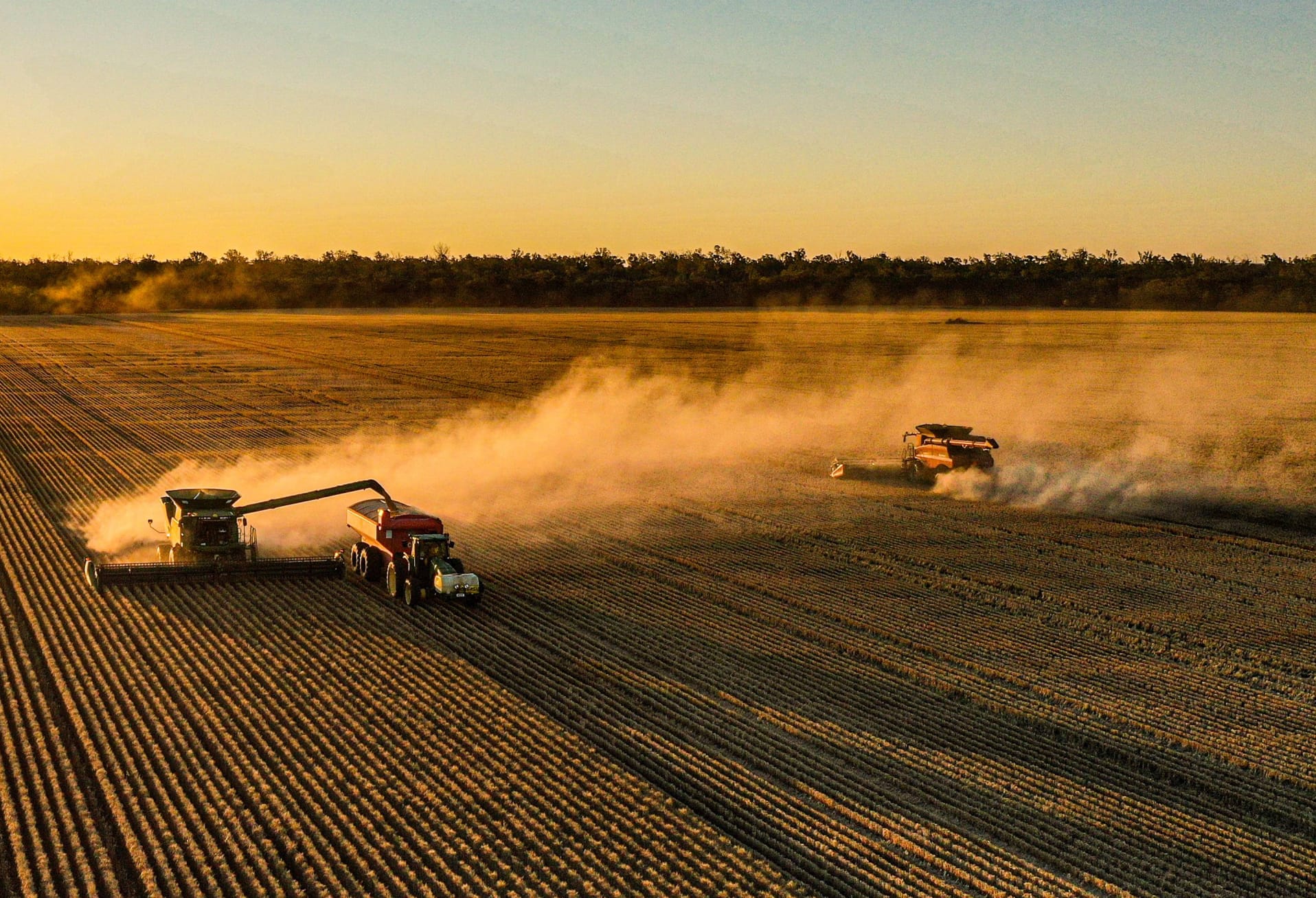
Over the past 10 years, no-till farming systems have been increasingly adopted while the numbers of farm businesses with a sheep enterprise have declined. Research has shown that mixed farming systems are more resilient in variable climates (GRDC: Low Rainfall Collaboration Project) and recently, interest in mixed farming has revived. It is becoming more common for southern Mallee farmers to graze their out-of-season stubbles for the production of prime lambs. However, while the advantages of this are clear, growers who follow this practice must be aware of the potential for wind erosion occurring as a result of over grazing.
Between 2008 and 2013, BCG has been participating in a GRDC project assessing the impacts of farming systems’ attributes on storage and subsequent crop use of ‘out-of-season’ rainfall.
This has been addressed by conducting plot-based field experiments which feature several soil surface treatments (standing stubble, slashed stubble, bare earth, cultivated earth and summer weeds) and measure differences in entry and persistence of out-of-season rain under each treatment. Results are showing improvements in conserved moisture through weed control. It is now accepted within the broadacre grains industry that controlling out-of-season weeds increases stored soil moisture. Less certain is the contribution of the presence of stubble cover to stored soil moisture. The GRDC project has looked at presence/absence of stubble cover and its effect on moisture conservation. It does not address the quantity of stubble necessary for maximised conservation.
Take home messages
• Crop stubbles provide a valuable feed source for stock over the summer period. The results from this trial indicate that grazing stubbles does not reduce either the amount of soil water stored during the summer fallow period or subsequent crop yield.
• In low rainfall environments, it is rarely possible to grow sufficient stubble to improve summer fallow efficiency by reducing evaporation (>5t/ha): growers should make use of this valuable feed source.
• Growers should maintain at least 70 per cent stubble cover (about 2t/ha of cereal stubble) to minimise the risk of wind erosion.
Aim
To determine whether maintaining stubble cover in low rainfall environments increases summer moisture conservation, and, to establish the minimum stubble quantity or threshold necessary to ensure maximum moisture conservation over the summer.
Method
The experiment was established on wheat stubble 28km north of Birchip and repeated on two distinct soil types (sand and clay) from the one paddock. The sand site lay on the mid slope of a rise with sandy loam topsoil and the clay site on a low-lying flat with clay loam topsoil and moderate subsoil constraints.
Location: Jil Jil
Replicates: 4
Trial design: 2 complete randomised blocks (sand and clay)
Crop type/s: wheat stubble sown to Wintaroo oats
Sowing date: 9 May
Seeding density: 150 plants/m²
Inputs/fertiliser: 75kg/ha 27:12
Seeding equipment: Horwood Bagshaw seeder (knife points, press wheels,
17cm row spacing)
The replicated trials were established with four treatments of different quantities of stubble – nil stubble (bare earth), 50% cover (1t/ha), 75% cover (2t/ha) and ungrazed (4t/ha). To maintain consistency with farmer practice, the plots (10m x 10m) were fenced and stubble treatments established by altering the number of days’ grazing by lambs in the relevant plots. Upon the completion of grazing, photos were taken in each plot to assess remaining ground cover. These photos were then analysed, using the Ground Cover Assessment Tool (GCAT), which gives a percentage of ground cover.
Prior to grazing, two soil cores per plot (segmented in 10cm layers to a depth of 1m) were taken on 16 December 2011.
At the start of the summer period, to ensure full moisture conservation, the sites were sprayed with knockdown herbicide and sprayed on a needs basis over the season to ensure no weeds were present. At the end of the summer period, on 8 May 2012, the initial soil sampling process was repeated, so that any change in soil water could be assessed for each plot and treatment.
As a validation for the findings from the soil analysis, an oat crop was grown on top of the plots and assessed for biomass production and yield.
Results and interpretation
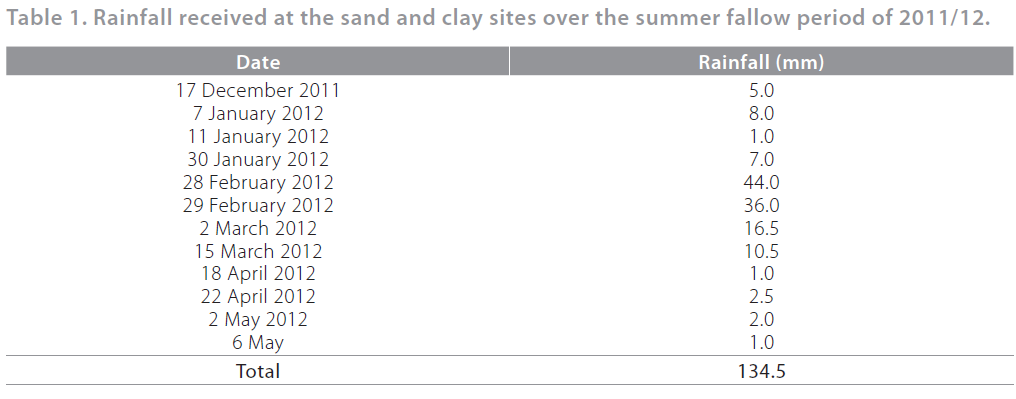
A total of 134mm of rain fell over the summer period (December to April); this represents decile seven for the area (Table 1). However, of greater importance is that most of the rain fell in four events over a 16 day period during late February and March. Having the rain fall in what was essentially one event ensured deeper infiltration and lower evaporative losses, allowing for greater summer fallow efficiency. The rainfall at the site created conditions highly suited to testing the effect of stubble cover on moisture conservation.
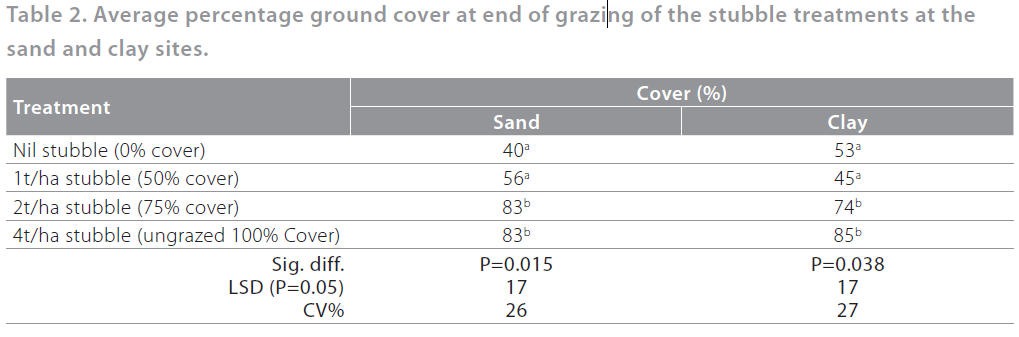
At both sites the percentage of ground cover measured on the nil and 1t/ha hectare stubble treatments were significantly different from the heavier stubble treatments of 2t/ha and 4t/ha (Table 2). It should be understood that the GCAT gives an indication of ground cover: it does not exactly reflect the actual situation in the plots. Visually, the plots had very different quantities of stubble; in the grazed plots, much of it was lying flat on the ground. This had the effect of increasing the percentage of ground cover measurements returned by GCAT. The larger stubble treatments visually had a greater amount of stubble and a greater percentage of standing stubble.
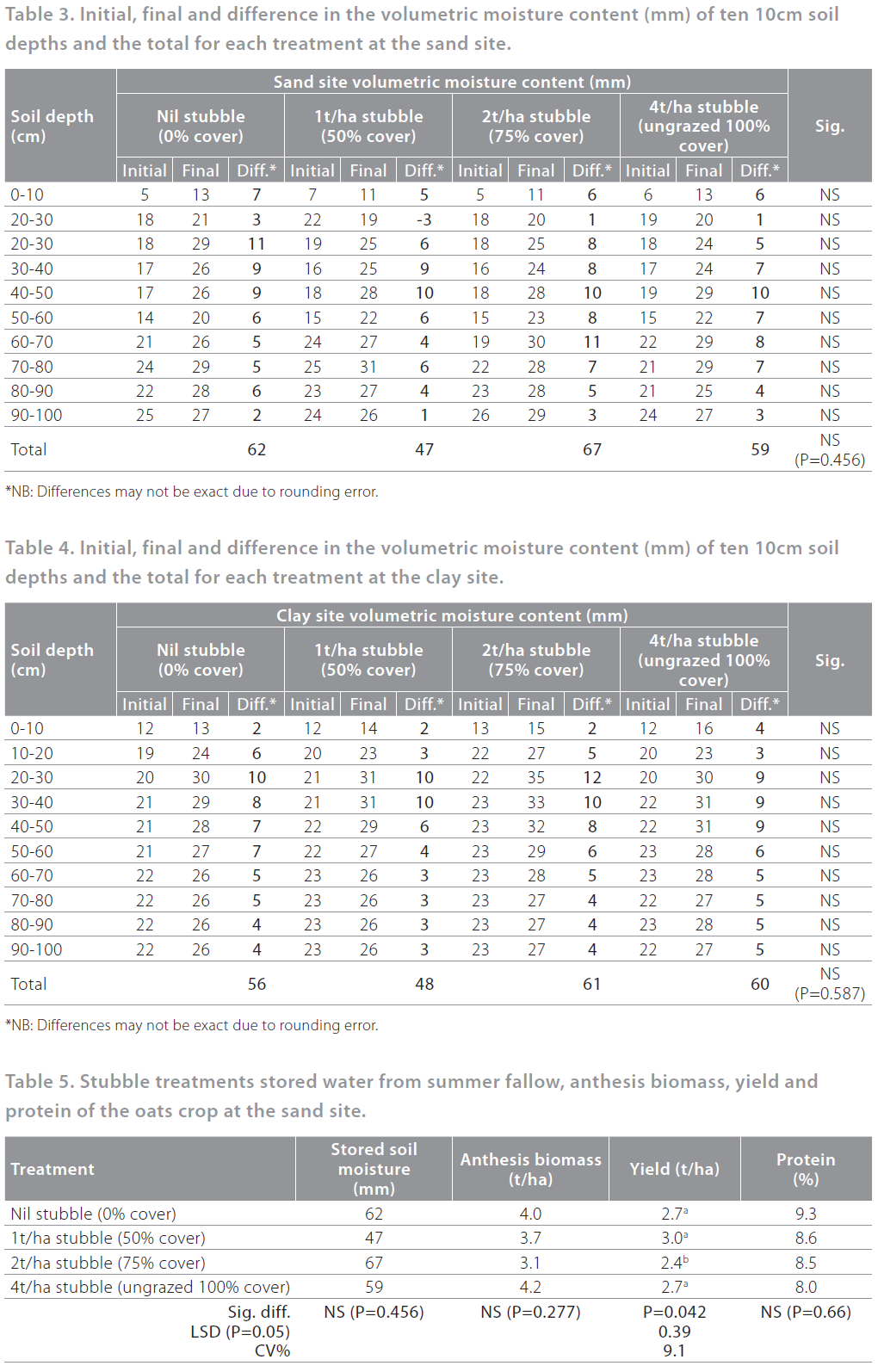
The soil analyses at the sand and clay sites showed no difference between treatments in starting soil water, end of summer soil water and total stored soil water resulting from the summer fallow (Table 3 and Table 4). This indicates that the stubble treatments had no effect on stored summer soil water. It should be noted, however, that analysis of this kind is notoriously fickle. It was necessary to validate these findings by producing a crop on top of the treatments as a more accurate approach to determining the effect that stubble was having on stored soil water.
The mean stored soil water measured for all treatments at the sand and clay sites were 59mm and 55mm respectively. This resulted in a very impressive fallow efficiency of 44% and 41% respectively.
In north west Victoria, fallow efficiency averages between 20 and 25%. The high fallow efficiency is reflective of the rainfall pattern over the summer, with large events over a short period of time.
The anthesis biomass, crop yield and protein produced by the oat crop following the summer stubble treatments on the sand and clay sites was also analysed (Table 5 and Table 6). At the sand site, no difference between treatments in anthesis biomass or protein was recorded. There was a difference in yield between the 1t/ha stubble treatment and the 2t/ha stubble treatment.
At the clay site, no difference between treatments in yield or protein was measured. There was a difference in anthesis biomass between the nil, 1t/ha and 2t/ha stubble treatments and the 4t/ha treatment.
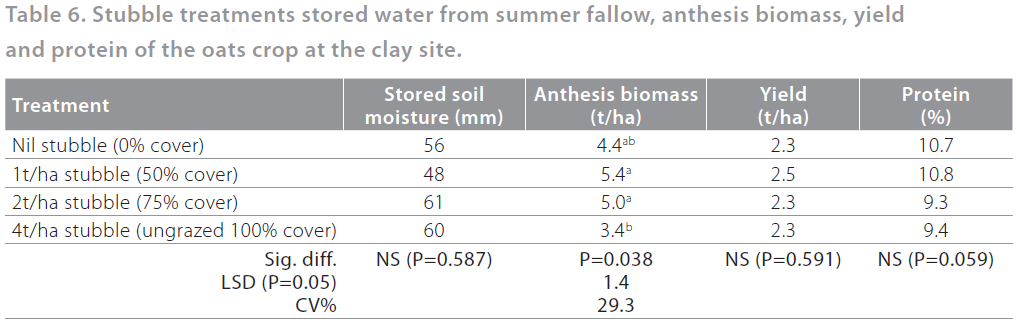
It is apparent from the results that, at both the sand and the clay site, there was no consistency between the treatments, measured stored soil water, anthesis biomass and crop yield. There was no clear pattern to suggest greater and lesser moisture conservation as stubble increases or decreases. It is a distinct possibility that the significant results are due to sampling error and possibly false positives.
There is also a possibility that some of the biomass or yield results were affected by nitrogen tie-up due to insufficient N being applied to the treatments. Even with these possibilities taken into account, it appears that grazing stubbles over the summer fallow period in a southern Mallee environment does not have negative effects on stored soil water.
Commercial practice
Crop stubbles provide a valuable feed source for stock over the summer period. The results from this trial indicate that grazing stubbles does not have a negative impact on summer fallow efficiency and subsequent crop yield. This finding supports the results from a similar trial conducted at Condobolin in the summer following the 2009 cropping season.
The trial conducted by the University of New England and the NSW Department of Primary Industries (DPI), showed that putting sheep onto stubble over summer need not affect subsequent crops if managed carefully. It was found that stubble grazing can be sustained over summer, provided the ground cover is not reduced to less than 2t/ha of standing stubble or 70 per cent cover. Multiple experiments in different environments have shown that there is no yield penalty from grazing stubbles, provided at least 70 per cent cover (about 2t/ha of cereal stubble) is maintained. Growers should make use of this valuable feed source.
Acknowledgments
This project was supported by the Mallee Catchment Management Authority through funding from the Federal Governments Caring for our Country Initiative.