Limited research has been conducted into the grains industry’s contribution to nitrous oxide emissions (N2O), particularly in low rainfall environments. Since the 2002-2009 drought, a more efficient and prescribed approach to nitrogen fertiliser use has taken place. When soil moisture following summer rainfall has been favourable, cropping rotations have been structured to take advantage of leguminous break crops. Nitrogen fertiliser applications that better match crop demand and seasonal conditions have now become common. However, despite these nitrogen use efficiency gains, the level of N2O emissions from the soil remains unclear. This project is designed to investigate this question.
Nitrous oxide is a greenhouse gas which has worldwide agricultural, environmental and political implications. N2O has a global warming potential (GWP) of 310; the GWP of carbon dioxide is 1. This differential is a measure of how much heat a greenhouse gas can trap in the atmosphere. N2O is produced by two chemical processes: nitrification and denitrification. The presence of favourable levels of nitrogen, soil microbes, carbon and moisture influences these processes (DAFF, 2011).
The process of nitrification requires oxygen and a moist, but not waterlogged soil in which ammonium (NH4) is converted to nitrate (NO3). N2O is produced as a by-product.
The process of denitrification occurs in waterlogged soils as oxygen is not required. Nitrate (NO3) is converted into nitrogen gas (N2) and N2O is an intermediate product.
The overall intention of this study is to:
• communicate to growers and agribusiness when, how, why and to what extent N2O
emissions affect farming systems
• increase farmer knowledge of N2O emissions created by fertiliser and legumes
• reveal options to reduce N2O emissions
• provide information about nutrient use efficiency which maximises productivity.
Take Home Messages
• To manage N2O emissions in low to medium rainfall environments, growers need to
match nitrogen supply to crop demand.
• Lowest emissions were measured where nitrogen levels were least, while highest
emissions occurred where nitrogen levels were greatest.
• Applying late nitrogen to increase wheat protein is not economic when segregation
price differentials are small.
Aim
To measure:
• nitrous oxide fluxes in a wheat crop when different rates of nitrogenous urea fertilizer
were applied
• the effect on wheat yield and quality of applying fertiliser at zero, medium and high
urea rates.
Method
A complete randomised block design was used. Three urea application treatments of zero, medium and high were established and measured for N2O emissions, yield and protein. Rainfall forecasts were closely followed and urea applications occurred prior to rainfall events during the season. Static chambers of approximately 30cm diameter were positioned between crop rows of 30.5cm (12 inch) spacing in replicate one only.
N2O was drawn from air tight chambers via medical syringes into evacuated vials. Measurements of N2O were taken mid-morning at intervals of 0, 30 and 60 minutes; one day prior, one day after and approximately seven days following a rain event. Ambient and soil temperature were measured and soil samples (0-10cm) were obtained for moisture and nitrogen at each sampling.
Samples were analysed at the University of Melbourne.
Replicated treatments were harvested and grain quality was analysed. The difference in income between each urea treatment was determined.
TRIAL 1: BIRCHIP
Location: Birchip
Replicates: 4
Sowing date: 19 June
Target plant density: 130 plants/m2
Crop type: Derrimut wheat
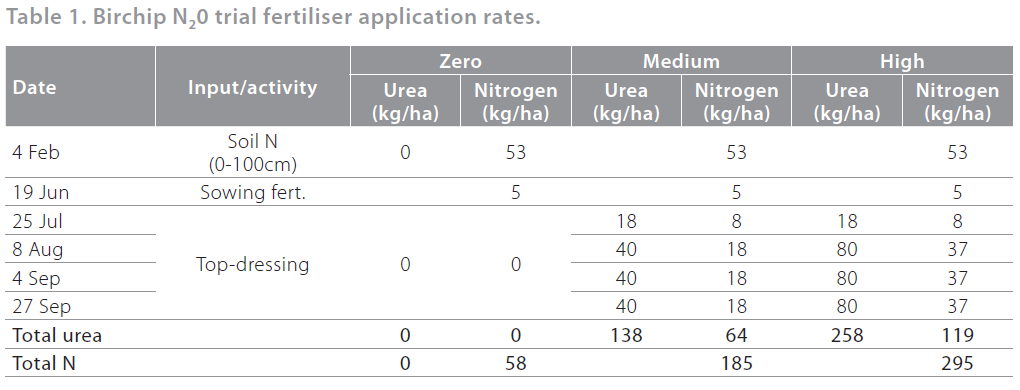
Fertiliser: at sowing MAP (50kg/ha)
Herbicides: 2 September Axial® (300mL/ha) + Velocity®
(670mL/ha)
Seeding equipment: BCG Gason parallelogram (knife points, press wheels,
30cm row spacing)
N2O flux: 27, 29 September and 5 October. Flux data for Birchip
site not available at time of printing.
Rainfall: 28 September – 5.5mm,
GSR – 146mm
Starting soil moisture: 54mm
TRIAL 2: RUPANYUP
Location: Rupanyup
Replicates: 4
Sowing date: 19 June
Target plant density: 130 plants/m2
Crop type: Derrimut wheat
Herbicides: 11 September Amicide 625® (1L/ha) + Lontrel
(150mL/ha)
Fertiliser: at sowing MAP (55kg/ha)
Seeding equipment: BCG Gason parallelogram (knife points, press wheels,
30cm row spacing)
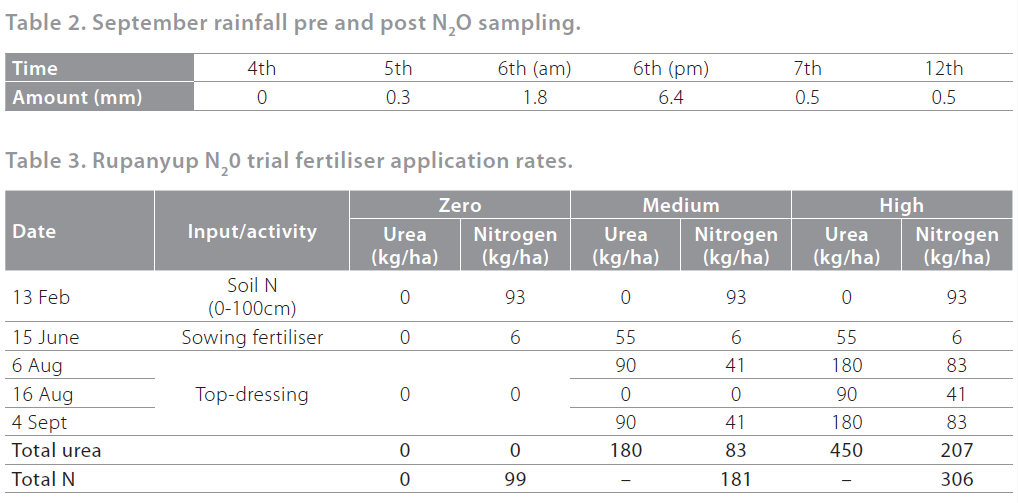
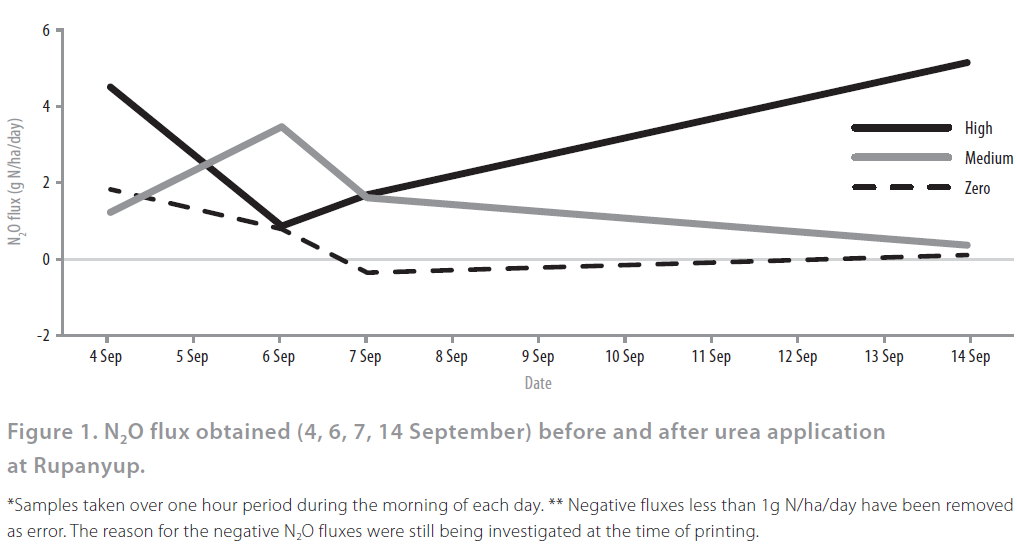
N2O flux: Recorded 4 Sep, 6 Sep, repeated the next day (7 Sep)
due to a very small rain event prior to the 6 Sep sampling
and 14 Sep.
Starting soil moisture: 42mm
GSR: 204mm
Results and interpretation
Yield, quality and income
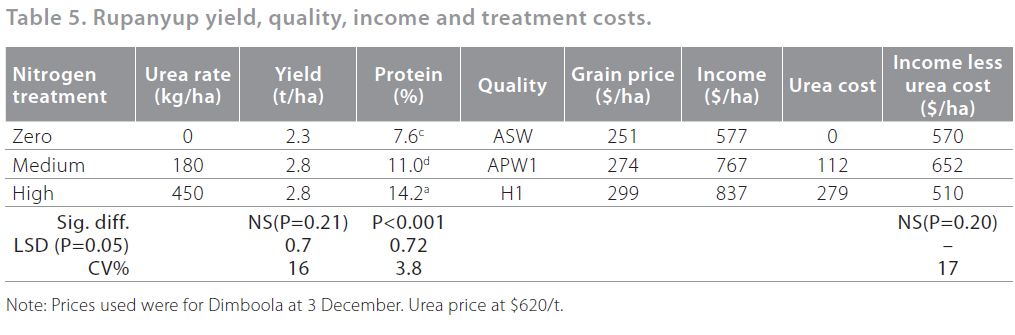
Due to delayed sowing, yields were just below average at Birchip. There was no yield difference between treatments. Low growing season rainfall meant that additional nitrogen did not increase yield. However, higher urea application increased protein and therefore grain quality. When the return was based on income less urea cost, no difference occurred between treatments.

Similarly to Birchip, sowing was late at Rupanyup and consequently yields were below average for the season. No differences between yield resulted when treatments were compared, but protein was different. Higher nitrogen application increased both protein and quality parameters. However, no significant difference was achieved between the return of each treatment when the urea cost was deducted from the income.
Rupanyup N2O flux
Typical of previous work in low-medium rainfall areas, N2O losses were generally low from a productivity perspective, even at peak levels (4.5g N/ha/day). While nitrogen levels (0-10cm) were quite high where large amounts of fertiliser had been applied (Table 7), it is hypothesised that soil moisture levels were not sufficiently high to result in large emissions. In general, lowest emissions were measured where nitrogen levels were lowest, and higher emissions where nitrogen levels were highest. This aligns with the theory of the drivers underpinning N2O emissions as outlined above.
Commercial practice
High nitrogen applications in September can increase wheat protein, but this will not be economic if the price differential between segregations is small. This trial also highlighted the well known fact that high nitrogen application will not increase yield if growing season rainfall is low.
From a commercial perspective, observed N2O losses align with previous work in this area, representing a relatively low loss of N from the cropping system. For this reason, it is suggested that the best way to manage these emissions in low to medium rainfall environments is to employ strategies that best match nitrogen supply to crop demand. Using tools such as soil testing, paddock history, seasonal forecasts and/or Yield Prophet® can help guide fertiliser application.
Over the next two seasons, this project will aim to demonstrate the use of these tools and the resulting impact on N2O emissions.
References
DAFF ‘Reducing nitrous oxide emissions fact sheet’ 2011. (www.daff.gov.au/climatechange/australiasfarming-future/climate-change-and-productivity-research/emissions_reduction2/nitrous_oxide_research_program/fact-sheet-reducing-nitrous_oxide_emissions) Accessed: January 4, 2013.
Acknowledgments
This project is funded by DAFF; project AOTGR1-956996-222 ‘Efficient grain production compared with N2O emission’.