Crop establishment can be difficult, especially when sowing into marginal moisture. In the past, there have been opportunities to sow early (March and April) following a significant rainfall event, but growers have been reluctant to sow this early. Over the past decade, the advantages of sowing early have been evident, especially in years with dry springs and hot finishes. However, while early sowing does optimise yield potential and reduces the risk of heat stress during grain filling, it also increases the frost risk during flowering.
With the adoption of wider row spacings, plant numbers have been found to decline. Sowing earlier into warm soils, provided emergence occurs shortly after, can increase biomass production, allowing the crop to compensate for the reduction in plant numbers. Varieties also differ in their ability to produce biomass and in terms of their establishment and yield, new varieties may perform differently when sown early and late.
The barley time of sowing (TOS) trial is part of a tri-state initiative (NSW, SA and VIC) investigating variety-specific management practices of new and currently-grown varieties. With a return to ’good’ seasons growers, have returned to canola production. These canola trials have been created in response to the demand from our members wishing to hone the agronomy associated with the production of this crop.
Take home messages
• In 2012, early sown barley and canola gave the highest yields and gross returns. The early sown crops were able to withstand frosts and avoid the worst of the dry spring.
• Despite the different growth habit (erect vs prostrate) of many of the barley varieties, no one variety responded better to the altered sowing times or density than any other. Growers should plant all barley varieties at their chosen timing and plant density, and make their selection on the basis of other factors (e.g. disease resistance).
AIM
To compare alternative agronomic practices that may improve establishment of new and current barley varieties in wider row spacings.
To determine the best time to sow canola for each of the maturity lengths, and whether plant density needs to be decreased when sowing earlier.
Method
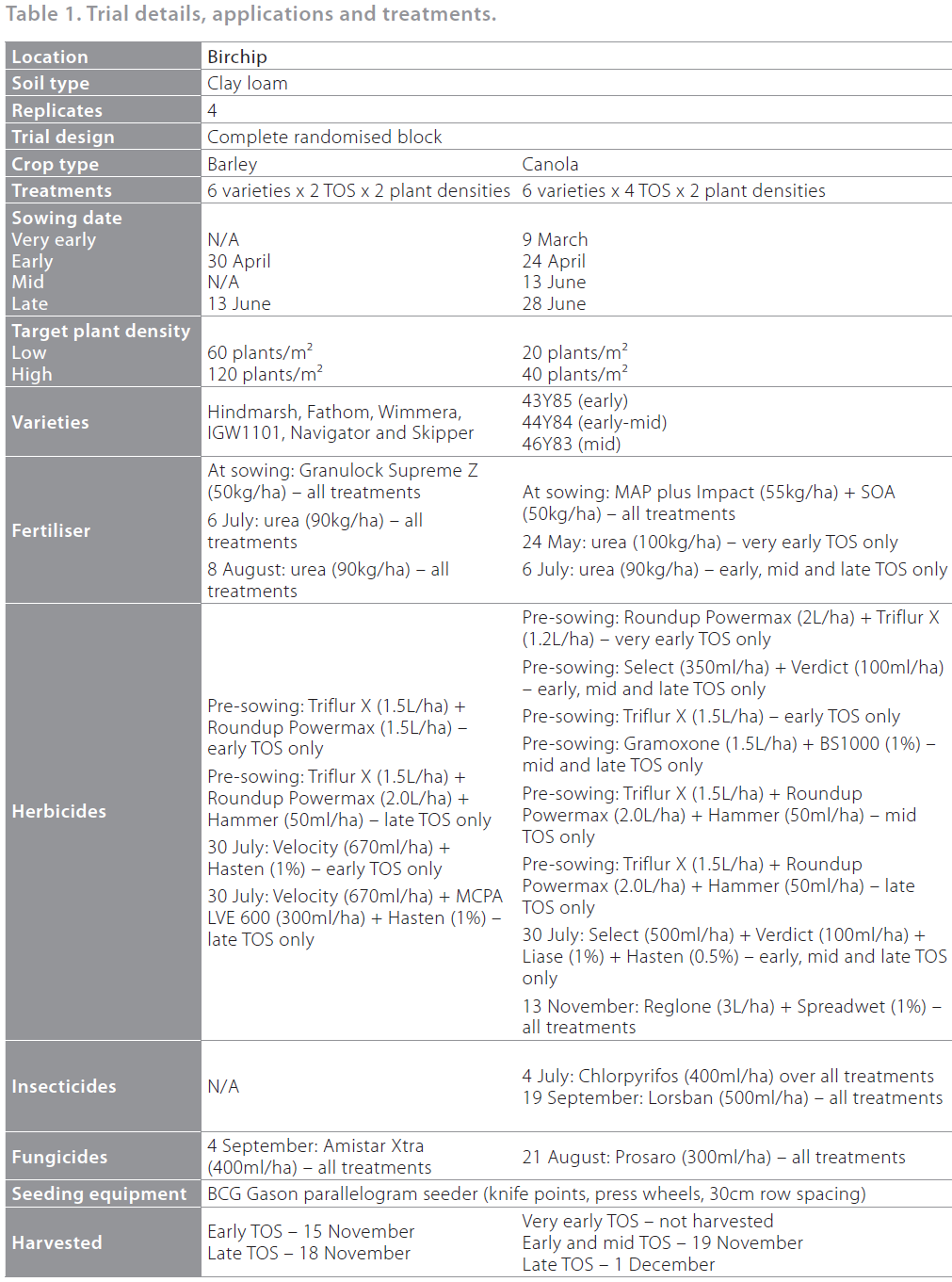
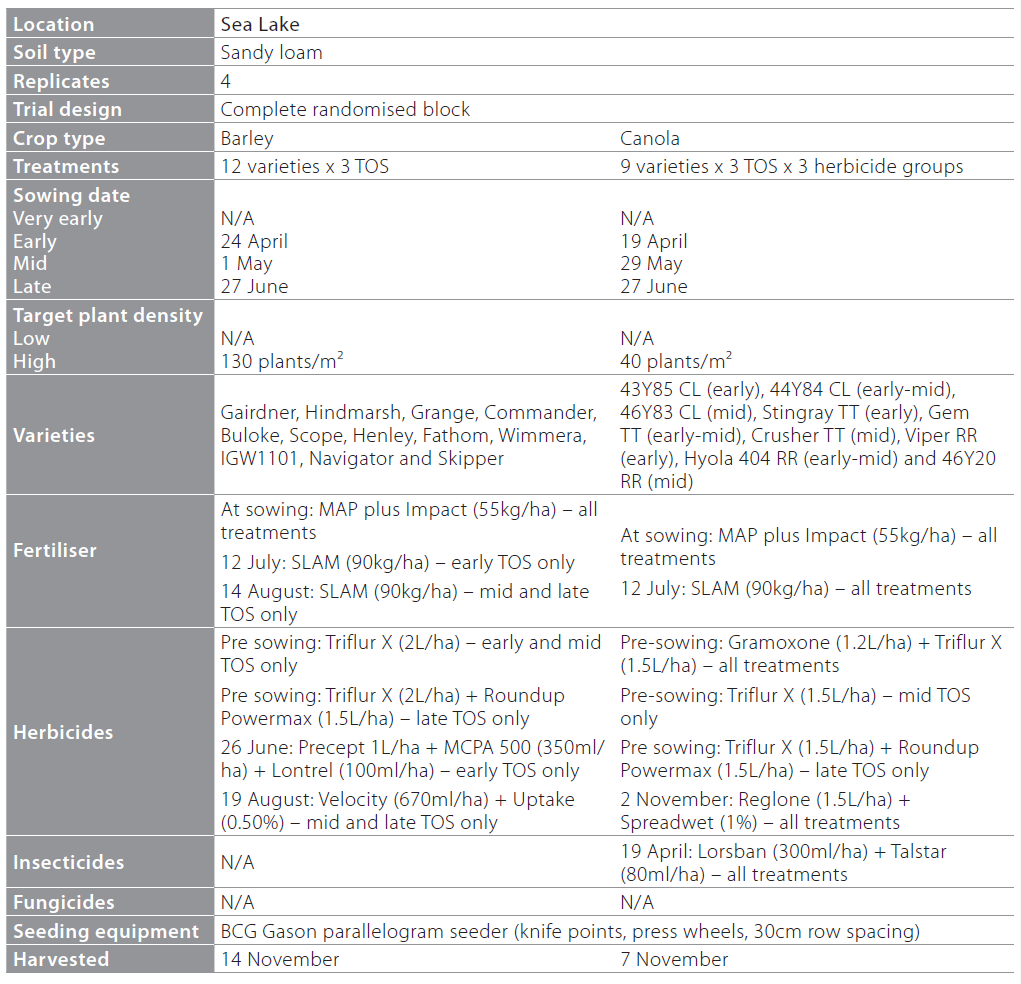
Time of sowing barley and canola trials were established at Birchip and Sea Lake. Each trial incorporated different treatment factors around the TOS. Table 1 outlines the trial details, applications and treatments. Each trial was replicated four times and managed to maximise yield (e.g. weed and disease free). Nitrogen applications were based on crop requirements determined by soil testing and Yield Prophet®. Emergence was scored on trials where this was an issue.
Results and interpretation
BARLEY TOS
TRIAL 1: BIRCHIP (2 TOS X 2 PLANT DENSITIES X 6 VARIETIES)
Following substantial rainfall in March, the Birchip trial site had elevated levels of stored soil water and prospects for the season were good. Both times of sowing, early (30 April) and late (13 June), were conducted within a short proximity and rain and germination occurred close to the sowing date.
Crop establishment was generally good, with the exception of Navigator, which in all reps was patchy and had variable plant numbers. This is believed to be due to a poor seed source. The trial was well maintained: not adversely affected by weeds, pests or diseases. Despite receiving well below average growing season rainfall, the varieties yielded very well, with a site mean of 2.9t/ha, largely due to the stored soil water and the cool finish to the season.
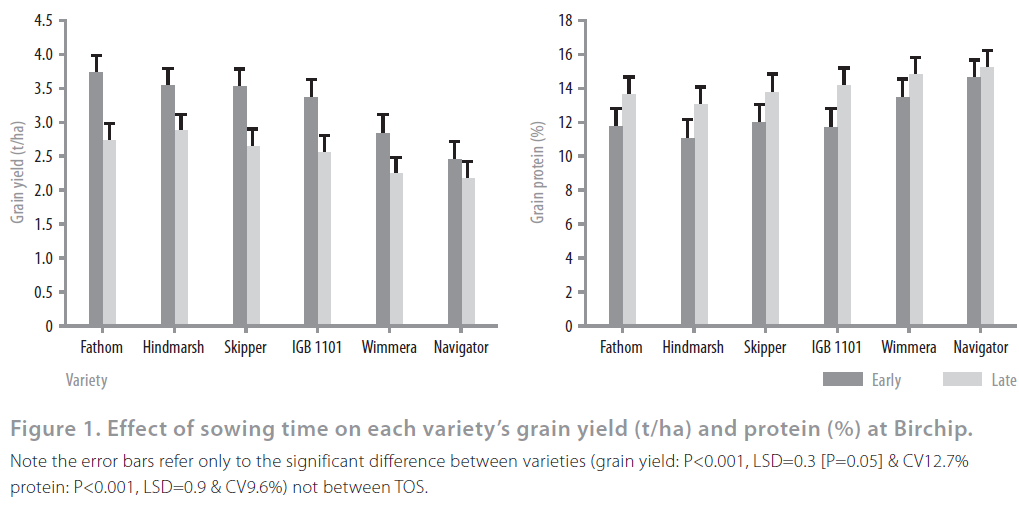
The earlier sown crop yielded best in this trial, which, in light of the cool finish which should reduce any negative effect of later sowing times was somewhat surprising. The early TOS achieved a mean yield of 3.2t/ha as compared with the late, which achieved a mean yield of 2.5t/ha (P=0.040). Time of sowing had an opposite effect on grain protein with the early TOS 12.4% (mean value), while the late TOS achieved a mean protein of 14.1% (P=0.015). As yield increased, protein declined, but neither TOS treatment produced protein sufficient to achieve a MALT1 specification, although the early TOS could have achieved MALT3 specification. TOS also produced a significant difference in test weight: the early TOS achieving a mean of 68.2kg/hl compared with the late TOS mean test weight of 65.5kg/hl (P=0.018). While there is a difference in the test weights between both TOS, all were above the recieval standard of 65kg/hl required to meet MALT specifications.
Altering the barley plant density did not produce a significant response in grain yield, protein or test weight. All remaining quality specifications (e.g. screenings) did not yield a significant response to changes in TOS or plant density.
Figure 1 shows the effect of sowing time on each variety’s grain yield (t/ha) and protein (%) at Birchip. Fathom, Hindmarsh, Skipper and IGB 1101 had significantly higher yields than Wimmera and Navigator for both TOS. As noted previously, the seed source of Navigator was believed to be poor. In the early TOS results, Wimmera and Navigator had significantly higher protein than the remaining varieties. For the late TOS, Wimmera and Navigator were significantly higher than Hindmarsh only. No significant interactions were observed in this trial between variety TOS and plant density.
TRIAL 2: SEA LAKE (3 TOS X 12 VARIETIES)
Like the Birchip site, the Sea Lake site received good rainfall in March, ensuring good levels of stored soil water. However, rainfall around sowing times was limited. Despite this, all TOS treatments germinated at sowing and emerged shortly thereafter. Crop establishment was generally good, with the exception of Gairdner and Navigator, which was patchy and had variable plant numbers (in all reps) believed to be due to a poor seed source. In addition, BCG did not have access to Grange seed at the early TOS. The trial was well-maintained; it was not adversely affected by weeds, pests or diseases. Despite receiving well below average growing season rainfall, the varieties yielded very well, with a site mean of 2.5t/ha, again due to the stored soil water and the cool finish to the season.
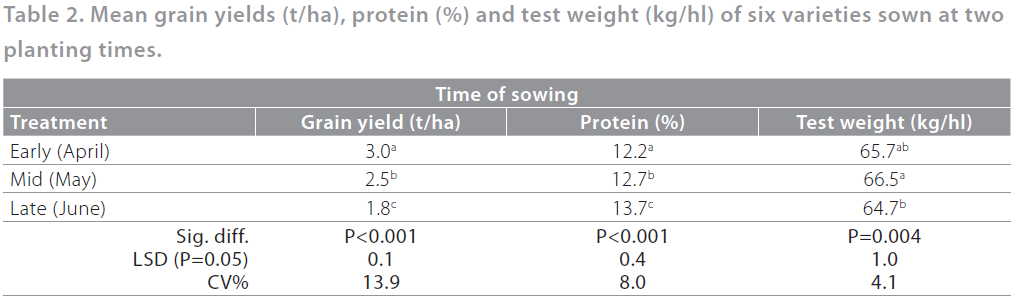
Consistent with the Birchip trial, there was a TOS effect which favoured early TOS. This was even evident between the early and mid TOS treatments which were only sown seven days apart. The early, mid and late TOS achieved mean yields of 3.0, 2.5 and 1.8t/ha respectively (Table 2). Again, as yield increased protein decreased with the early, mid and late TOS treatments producing mean protein levels of 12.2, 12.7 and 13.7% respectively. As was seen in the Birchip trial, no TOS produced proteins necessary to achieve a MALT1 specification, although the early TOS could have achieved MALT3 specification. TOS also produced a significant difference in test weight with the early and mid TOS achieving mean test weights of 65.7 and 66.5 respectively; significantly higher than the late TOS, which did not meet the receival standard of 65kg/hl required to meet MALT specification (Table 2).
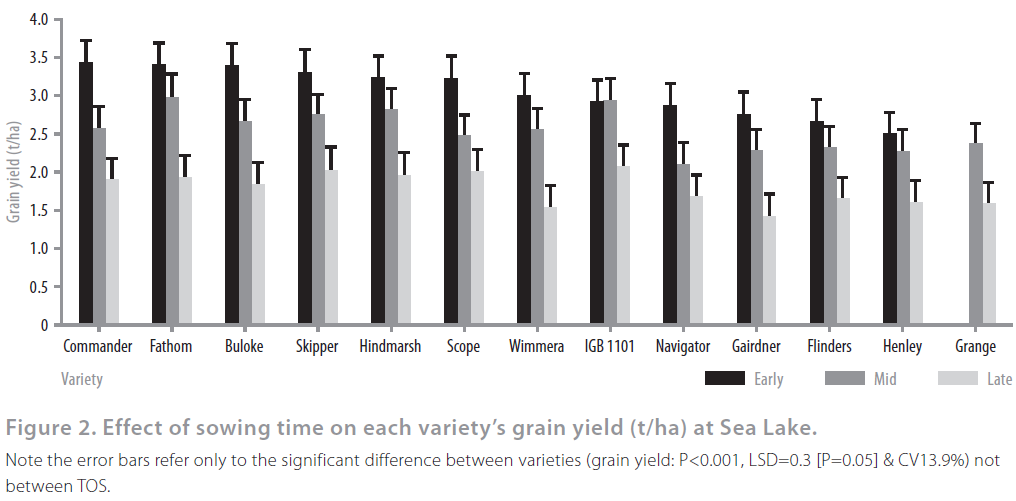
At Sea Lake Commander, Fathom, Buloke and Skipper topped the yields for the early TOS and were significantly higher than all remaining varieties apart from Hindmarsh and Scope (Figure 2). Fathom, IGB1101, Hindmarsh and Skipper topped the yields for the mid TOS and were significantly higher than all remaining varieties apart from Buloke, Commander, Wimmera and Scope. IGB1101, Skipper, Scope, Hindmarsh, Fathom, Commander and Buloke topped the yields for the late TOS and were significantly higher than Wimmera and Gairdner only. As noted previously, the seed source of Gairdner and Navigator was believed to be poor. No significant interactions were observed in this trial between variety and TOS. However, IGB1101 was one of only two varieties which produced comparable yields for both of the early and mid TOS. Henley was the other.
Despite the different growth habit (erect vs prostrate) of many of the barley varieties included in the Birchip and Sea Lake trials, no significant interactions were expressed in the results between TOS, density (Birchip only) and variety in yield, or quality. No variety responded better to the altered sowing times or density than any other variety. In light of this, growers should plant all barley varieties at their chosen timing and at their chosen plant density irrespective of maturity class, and should select their varieties based on other factors (e.g. disease resistance). However, as noted previously, this may not always be the case as climatic conditions change.
Early TOS treatments in these trials generated higher yields, proteins and test weights more likely to meet higher quality specification. The higher yields associated with early TOS created a dilution effect and lowered the protein as compared to the later TOS with lower yields which had higher protein. During the year, the Birchip site experienced 21 frosts (<2°C) during September and October (flowering to grainfilling). Despite this, the early TOS did not suffer any major yield penalty. This is reflective of barley’s higher tolerance to frost compared with that of wheat. Frost tolerance of crops states that ‘barley is thought to be about 2°C more tolerant [than wheat]’ (DAFWA, 2012). It is evident from the results at both sites that the early biomass production and earlier ripening associated with early TOS resulted in higher yields.
With no benefit associated with altering plant density in the Birchip trial, growers may feel comfortable about maintaining their standard plant densities. It is apparent that the barley was able to produce extra tillers in response to the lower plant density. However, in seasons with poor starting soil moisture, poor rainfall at sowing and insufficient nutrients to allow tillers to compensate, growers may need to consider increasing plant density in response to the possibility of poor germination.
CANOLA TOS
TRIAL 3: BIRCHIP (4 TOS X 2 PLANT DENSITIES X 3 MATURITIES)
The BCG main trial site at Birchip received a substantial rain early in March. This provided an excellent opportunity to plant canola into moist soil. Sowing canola in March would be considered as a break from standard practice in the region. The very early treatment sown in March was followed by early, mid and late TOS plantings in the subsequent months. These were established reasonably close to falls of rain. However, these events were small and did not provide even germination. Emergence in the early, mid and late TOS plots was very uneven and patchy. This was confirmed by emergence scores which were counted on the first range of plots and revealed that germination was consistently low across all varieties, and that plant numbers were well below the targeted densities of 20 and 40 plants/m2.
After initial germination, the surviving seedlings received good rainfall, recovered and grew well. The very early TOS grew so well that the stems were anecdotally described as ‘tree trunks’. At the time of the BCG main field day in September, the very early TOS treatments were finishing flowering and were into pod formation. Despite some visual frost damage, they looked to be the highest yielding TOS treatment but unfortunately, this early maturity was also this treatment’s downfall. Because these plots were the only ripe plants in the district they attracted galahs which destroyed them and made harvest results unusable.
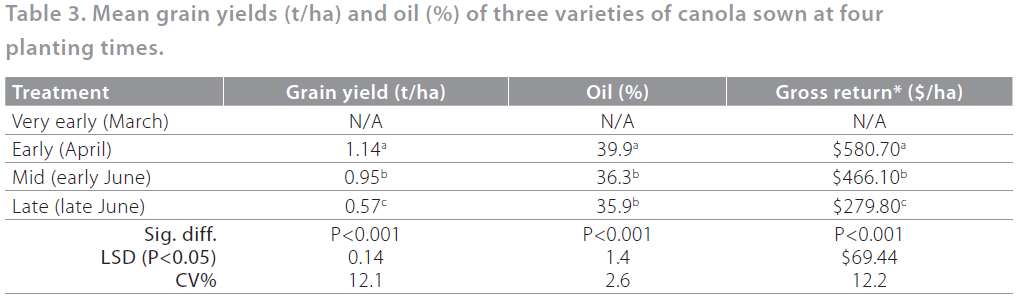
In the trial there was a TOS effect on crop yield, oil percentage and gross return. The early, mid and late TOS achieved mean yields of 1.1, 1.0 and 0.6t/ha respectively, mean oil percentages of 39.9, 36.3 and 35.9% respectively and mean gross returns of $581, $466 and $280/ha respectively (Table 3). Gross return was calculated as grain yield by grain price at Birchip on 3 December ($517/t), with base oil of 42% and earning a 1.5% premium or deduction for each 1% above or below 42%. Given the seasonal conditions and the germination problems, yields exceeded expectations. Oil percentage increased with yield, with the early TOS being significantly higher in oil than the mid and late TOS. The higher yields and oil percentages associated with early TOS also translated into significant differences in gross return per hectare.
No significant interactions were observed in this trial between maturity and TOS. Due to poor germination, plant density was not analysed.
TRIAL 4: SEA LAKE TOS CANOLA (3 TOS X 3 MATURITIES X 3 HERBICIDE GROUPS)
The canola TOS trial at Sea Lake received a substantial amount of rainfall early in March, establishing good levels of stored soil water. The sandy soil type at the Sea Lake site enabled even germination for each TOS, despite limited rainfall. As with the Birchip site, the crop on the early TOS was destroyed by galahs and made the treatment unharvestable. Apart from the galah issues, the trial was well maintained and was not adversely affected by weeds, diseases or any other pests.
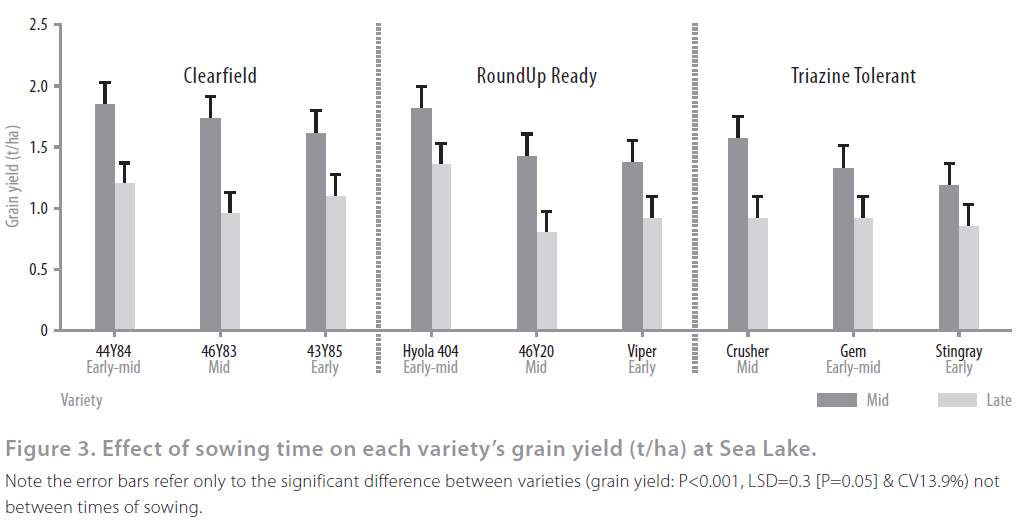
All treatments in this trial produced significant results in grain yield, oil percentage and gross return, but no interactions were realised between treatments (Table 4). Consistent with the Birchip trial, the mid TOS produced significantly higher grain yield, oil percentage and gross return than the late TOS.
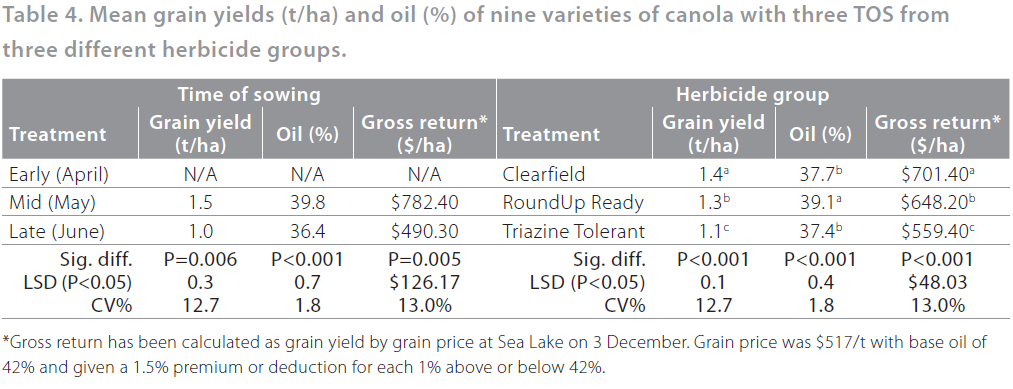
The Sea Lake trial produced significant yield differences between herbicide groups, with the Clearfield (CL) varieties yielding signifcantly higher than the Roundup Ready (RR) varieties which, in turn, yielded significantly higher than the Triazine Tolerant (TT) varieties (Table 4). While this result is based only on one season, it runs counter to the findings from canola varieties (BCG 2011 Season Research Results pp. 54) which states: “(while) each herbicide group includes an equally high-yielding variety, it appears that the TT varieties do not have the yield penalties that were previously observed in TT varieties.” This statement holds true for the CL and RR herbicide groups, as the highest yielding in each of the groups are not different from each other (Figure 3).
The TOS canola trials at Birchip and Sea Lake in 2012 produced very clear results, with earlier times of sowing generating higher yields, better quality grain and higher gross returns. There are some clear advantages to sowing canola early in conjunction with a rainfall event including improved germination through the ability to take advantage of rainfall events when they occur, early ground cover which helps to outcompete weeds, and the ability to avoid the worst of dry and hot springs.
The negatives associated with early sowing are lack of opportunity to control of weeds before sowing, exposure of the crop to increased frost risk, and, in the case of this trial, to pest risks (galahs).The results from these trials indicate that canola has an ability to overcome the negatives associated with early sowing. The herbicide resistant varieties allow growers to control weeds more effectively post sowing so that they do not need to rely on pre-sowing control. While frost does pose a major issue, in the 2012 season the damage from frost appeared to be outweighed by the increase in yield. The issues with bird damage would probably be mitigated by having a whole paddock of early-sown canola rather than a few small plots.
In the Birchip trial, the very early TOS looked very good, but due to the bird damage, no solid conclusions can be made. This will need further investigation in future seasons. Further to this, problems associated with germination at the Birchip site prevented any meaningful data being produced in relation to the interactions between plant density and TOS. This too will require further investigation in the future.
Commercial practice
In the production of barley and canola, the yield and quality benefits associated with early establishment are substantial, particularly in seasons with a hot dry spring. However, recent seasons have highlighted some of the unpredictable risks associated with early sowing, with poor germination, mice and locusts having a significant impact on establishment and yield. The trials in 2012 showed that getting crops up and growing early significantly improves yield potential. Paddock selection is critical to the success of early sowing. Avoid weedy paddocks or paddocks with an elevated pest risk.
The barley trials showed no significant effect of altering plant density, despite the different growth habit (erect vs prostrate) of many varieties. With no benefit associated with altering plant density, growers may feel comfortable about maintaining their standard plant densities. Given good soil moisture and adequate nutrition, barley is good at compensating for low plant density in that it produces extra tillers, maintaining yield potential. Further to this, no barley variety responded better to the altered sowing times than any other. Growers should plant all barley varieties at their chosen timing, and select their varieties based on other factors (e.g. disease resistance).
Acknowledgments
The barley trials were funded by GRDC; project DAN00138 and the canola trials were funded by BCG members through their membership.