BACKGROUND
Insect and other invertebrate pests represent a significant challenge to sustainable grain production in many parts of Australia. Pests causing damage to crops at critical stages can be detrimental to yield. Farmers often rely heavily on broad-spectrum insecticides to control insect pests. This can lead to problems such as pest resurgence, the emergence of secondary pests and the development of insecticide resistance. Integrated Pest Management (IPM) moves away from conventional practices and routine application of broad-spectrum chemicals. IPM is based on regular monitoring of crop plants and an understanding of pest biology, crop phenology and the role of beneficial insect species in keeping pest damage levels below unacceptable levels.
Although IPM has been adopted in other agricultural sectors, there has been relatively little uptake in broad-acre farming systems. With support from GRDC, cesar and BCG undertook a 2-year trial (2010-2011) at Charlton to determine whether IPM is the best option for farmers in the region to manage pests. This trial forms part of a national project involving a total of five replicated trials across southern Australia. Results from 2010 can be found in the BCG 2010 Season Research Results manual, page 122.
TAKE HOME MESSAGES
- insect pest pressure was generally low in Victoria and Southern NSW for 2011
-
there were no significant yield differences between the different pest control treatments, with the site mean being 4.92t/ha
- selective insecticides promote and encourage beneficial species which can be useful in combating harmful pest species attacking crops
AIM
To give farmers a better understanding of the different pest management tools available and to identify which work best in certain circumstances. This knowledge will help reduce farmers’ reliance on broadspectrum insecticides.
METHOD
This trial was set up on a large scale, each plot measuring 50m x 50m. In 2010, plots were established in a long-term pasture with no recent insecticide history to maximise the abundance and diversity of insects and other invertebrates present at the commencement of the study. Canola was planted in 2010 and was sown to wheat in 2011.
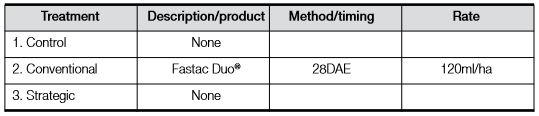
The trial consisted of three treatments:
- control: no insecticide input
- conventional: application of insecticides following typical farming practice in this region
- ‘strategic’ approach: application of insecticides only when needed, following adequate monitoring of pest and beneficial species and assessments of plant damage. ‘Selective or soft’ chemicals were given preference
Invertebrates were assessed in every plot throughout the year. Several collection methods were used, including vacuum sampling, pitfall traps, direct visual searches, sweep netting and extraction from soil core samples. Plant-based assessments were also conducted throughout the growing season: plant count, plant height, plant cover and assessment of pest feeding damage to the crop. Dry matter cuts were also taken prior to harvest and used to calculate the harvest index. Yields were measured with a plot harvester by taking 30m long strips in the center of each plot.
Location: Charlton
Replicates: randomised block design with 4 replicates
Sowing date: 18 May 2011
Seeding density: 93 plants/m2
Crop type: Correll wheat
Fertiliser:
18 May 50 kg/ha MAP + Impact® (400ml/kg)
16 August 100kg/ha Urea (46% N)
Herbicide:
20 July Ally® (5g/ha)
Lontrol® (150ml/ha)
Estercide 680® (800ml/ha)
Spreadwet® (0.25%)
Seeding equipment: Avon seeder, knife
Table 1. Insecticide treatments used on the IPM trial
Results
Invertebrate pest pressure was low throughout the trial site in 2011. Thus, there were limited differences between chemical treatments.
Plant numbers were monitored at 7, 14, 28 and 42 days after crop emergence (DAE). The conventional treatment had the highest plant counts at 7-DAE with the average being 104.2 plants per m². However, there was no significant difference in plant numbers between the treatments at any stage after emergence (Figure 1). The plant height assessments resulted in similar findings, with there being no significance differences found between any treatments.
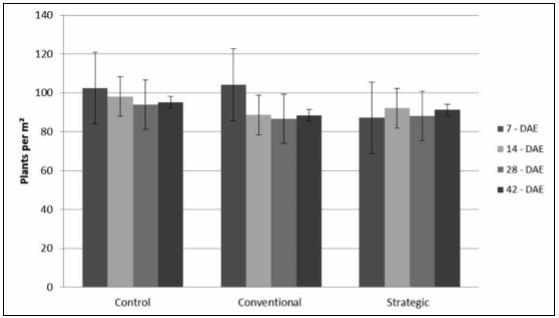
Figure 1. Average number of wheat plants per square metre in plots at 7, 14, 28 and 42 days after emergence. Error bars indicate the standard error of the mean.
Plant damage was assessed at 7, 14, 28 and 42 DAE. Plant damage due to chewing insects remained low during crop establishment. At 7-DAE, the control plots had slightly higher chewing damage than the conventional plots, but this difference was not significant. Plant damage caused by sucking insects increased with time (Figure 2). By 42-DAE, 10% of plants showed sucking damage to the leaf surface area. There were, however, no significant differences between the treatments on any sampling date.
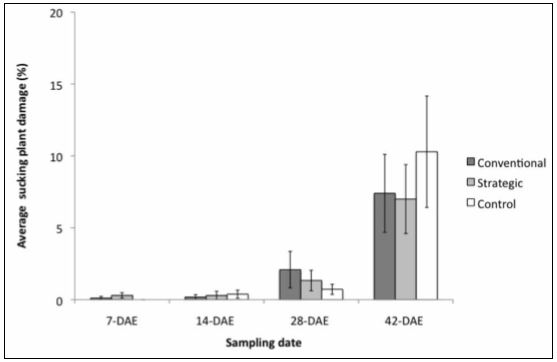
Figure 2. Average percentage of wheat plants with pest ‘sucking’ damage (seen as silvering on the leaf surface) at various days after crop emergence. Error bars indicate standard error of the mean.
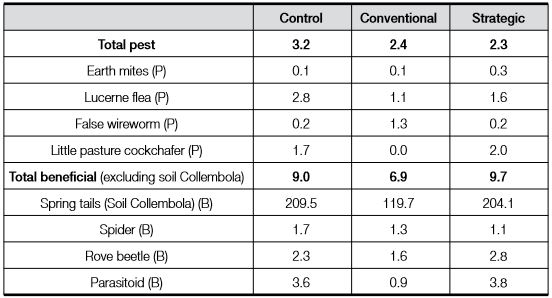
Invertebrates were collected throughout the growing season using various techniques. Pitfall traps deployed between 35 and 42-DAE showed little differences between the control, strategic and conventional strategies. Average total pest numbers were higher in the control plots than the conventional and strategic plots. Those trends were, however, not statistically significant. In contrast, total beneficial invertebrates were lower in the conventional plots (Table 2).
Springtails (Soil Collembola) were the most abundant invertebrates present in all plots, making up more than 50% of the total invertebrates in the pitfall samples. Other invertebrate species, including establishment pests (e.g. earth mites, lucerne flea and false wireworms) and beneficial species (e.g. spiders, rove beetles and parasitoid wasps) occurred in comparatively low numbers (Table 2). For pest species, earth mites (including the red legged earth mite and blue oat mite) were low in all treatments. Lucerne fleas were higher in the control plots, while the false wireworm numbers were higher in conventional plots. It is thought that wireworms may be somewhat resistant to insecticides, indicated by the increasing numbers in the conventional treatments post application. The increased wireworm numbers in the conventional plots also may be due to the decrease in predators for this species, as a result of the broad spectrum insecticide application killing beneficial species as well.
The little pasture cockchafer was completely absent from the conventional plots and was relatively frequent in the control and strategic plots. For beneficial species, spider numbers were similar in all three treatments, while other species such as parasitoids and rove beetles had higher numbers in the control and strategic plots than the conventional plots. This is likely to be a result of the insecticide that was applied to the conventional plots in June.
Table 2. Average numbers of invertebrates collected in pitfall traps from 35 – 42 days after crop emergence. P = pest species, B = beneficial species.
Sweep nets and visual tiller inspections were used to monitor cereal aphids and other spring pests from September till harvest. A marked increase of winged wheat aphids was observed in sweep net samples in mid-October (Figure 3). Aphid numbers were lower in the control plots than the strategic plots, while the conventional plots had intermediate numbers. Aphid numbers decreased over time due to the presence of beneficial insects, natural diseases and weather conditions. Other spring pests remained low, while beneficial invertebrates such as spiders were found in high numbers at all times. No chemical applications were therefore required in any plots during spring.
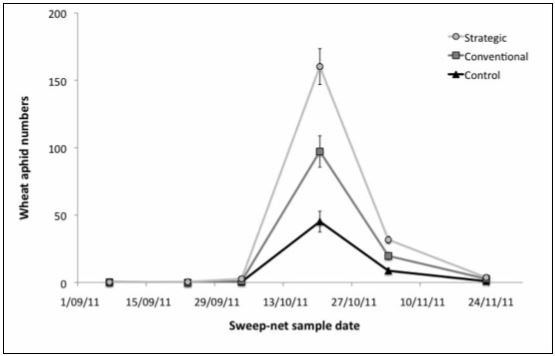
Figure 3. Average numbers of wheat aphids collected in sweep nets at various sampling days during spring
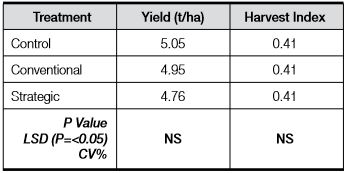
Harvested yields varied with the control treatments recording on average the highest yield at 5.05 t/ha (Table 3). However the differences in yield between treatments were not significant. There was also no significant difference between the harvest indexes, indicating that across all treatments the ratio of straw to grain was not significantly different.
Table 3. Average wheat yields and mean harvest index for each treatment
Interpretation
In 2011, pest pressure across most regions in Victoria and Southern NSW was relatively low. It is therefore not surprising that pest pressure was also low at the Charlton field site during the winter-growing season. The reasons behind this regional trend are unclear. The 2011 season was preceded by very high summer rainfall. This led to extensive flooding in some regions, including the trial site as well as adjacent paddocks. Many pests residing on plants and in the soil may have been affected by flooding. Populations would therefore have been relatively low on and off site prior to sowing and immigration from adjacent areas would have been hindered during the season.
No pest population reached detrimental levels at crop establishment, flowering or grain-fill stages. Therefore, very little damage occurred in any of the treatment plots. Furthermore, as the season progressed, rainfall at the critical times in the crop’s development aided growth and helped plants withstand any damage that occurred. The main pest detected was the wheat aphid, which occurred in low numbers towards the end of the growing season. These aphids were winged, indicating that they had recently migrated to the area. Numbers in the crop never increased to levels that warranted an insecticide application.
In direct contrast, numbers of some beneficial invertebrates were relatively high. These beneficial species contributed to the low densities of pests seen in the crop. Early in the season, high populations of springtails (soil Collembola) were found. Springtails thrive when soil moisture is high. Later in the season, beneficial invertebrates living in the plant canopy, such as spiders, were also high. Some beneficial invertebrates are affected by broad-spectrum insecticides, as was observed in this trial and in the 2010 trial.
Commercial practice: what this means for the farmer
Due to the low pest pressure in 2011, there was no significant difference between the treatments. There was limited feeding damage to wheat plants, and there was no difference in yield responses. Due to the low pest pressure and the absence of a need for chemical control, it is hard to differentiate between the control, conventional and strategic approaches. Routine monitoring and accurate identification of pests and beneficial species can be a lengthy process for growers and their advisors. This trial however, demonstrated that applications of broad-spectrum chemicals are not always necessary to prevent yield losses. This has also been shown at 2010 and 2011 trial sites established in NSW, SA and WA. In about 90% of cases, broad spectrum insecticides as ‘insurance sprays’ at crop establishment have been wasted, resulting in no yield benefit.
Additionally, in 2010 it was demonstrated that a selective insecticide option was equally effective in protecting an emerging canola crop than a combination of two broad-spectrum insecticide sprays in autumn-winter. Seed treatments also help to preserve beneficial invertebrates naturally occurring in agricultural ecosystems, thus minimising the need for future insecticide sprays.
Acknowledgments
This project was funded by GRDC project UWA00134