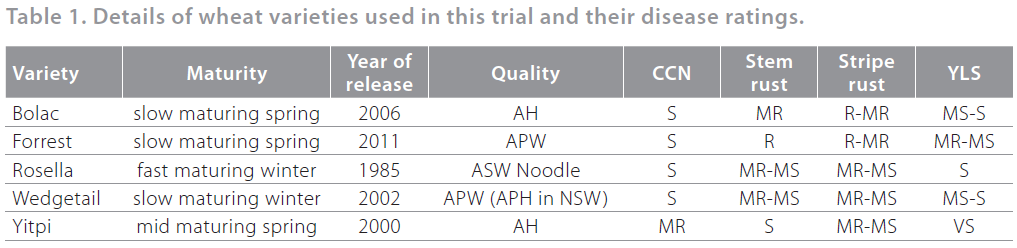
The amount of April-May rain the Mallee receives has declined over the last decade (GRDC ”expanding subtropic zone the clue to dry autumns”) making it difficult to establish spring wheat crops at the traditional time. Winter wheats (such as Wedgetail and Rosella) have a vernalisation requirement, meaning that they need to be exposed to cold temperatures (4-18°C) for a certain period of time before spike development and stem elongation (GS30) begins. This means that, though they can be sown much earlier than spring wheats (as early as late-February), they do not flower too early and risk exposure to frost. Because of this, winter wheats have a very flexible sowing window (>2 months) compared with spring wheats, which have an optimal window of about two weeks. Winter wheats also spend much longer in the tillering phase prior to GS30, and can thus be safely grazed for longer than spring wheat, if used as a dual purpose crop. Unfortunately, Australian breeding programs stopped selecting for milling quality winter wheats early last decade. There are very few cultivars available, particularly for medium-low rainfall zones with alkaline soils.
In 2012, there was a substantial rain in late February and early March (56mm) which in many districts provided the only establishment opportunity until June. The aim of this experiment was to discover how winter wheats performed when sown in response to late-summer rain. Such a strategy may prove to be an adaption to reduced April-May rainfall, one which may improve grain yields by optimising flowering time, and also fill the feed-gap caused by dry autumns.
Take home messages
• Winter wheat (Rosella) sown in mid-March yielded 2.1t/ha, comparable to spring wheat sown in May (2.5t/ha).
• All varieties provided large quantities of excellent feed, and simulated grazing did not reduce grain yield.
• Sowing winter wheat in response to late summer and early autumn rain is a successful strategy for overcoming a drier April-May, but varieties adapted to the Wimmera and Mallee are needed.
Aim
The aim of this trial was to compare the performance of very early sown wheat varieties, their early grazing potential and ability to recover from grazing.
Method
Location: Birchip
Replicates: 4
Sowing date: 14 March
Target plant density: 150 plants/m²
Crop types: Rosella, Bolac, Wedgetail, Forrest and Yitpi wheat
Fertiliser: at sowing MAP (50kg/ha) (10% N, 21.9% P, 1.5% S)
25 July urea (90kg/ha) (46% N)
8 August urea (90kg/ha) (46% N)
Herbicide: at sowing Roundup Attack® (2L/ha) + Triflur X® (1.2L/ha)
Grazing: 16 May (Rosella, Wedgetail, Forrest and Bolac were at mid
tillering and Yitpi was at the end of stem elongation)
Seeding equipment: BCG Gason parallelogram seeder (knife points, press wheels,
30cm row spacing)
Dry matter production was measured and grazing simulated on each variety by mechanical removal of the whole plot on 16 May. One plot of each variety was also left ungrazed as a control. Growth stages were continually recorded throughout the growing season to determine at which stage
the crop was entering the flowering stage of its cycle. Temperature was also recorded for the site to determine impact and severity of frosts.
Grain yield was measured using a small plot harvester, and grain samples were collected for further analysis. Grain yields were adjusted to 11.5% moisture for the statistical analysis of results.
Results and interpretation
An early breaking rain of 56mm fell in late February and early March, ensuring optimum soil moisture for germination. Emergence was observed about a week after sowing. Emergence was even and plants grew well on stored soil water, despite no further rain falling until late May.
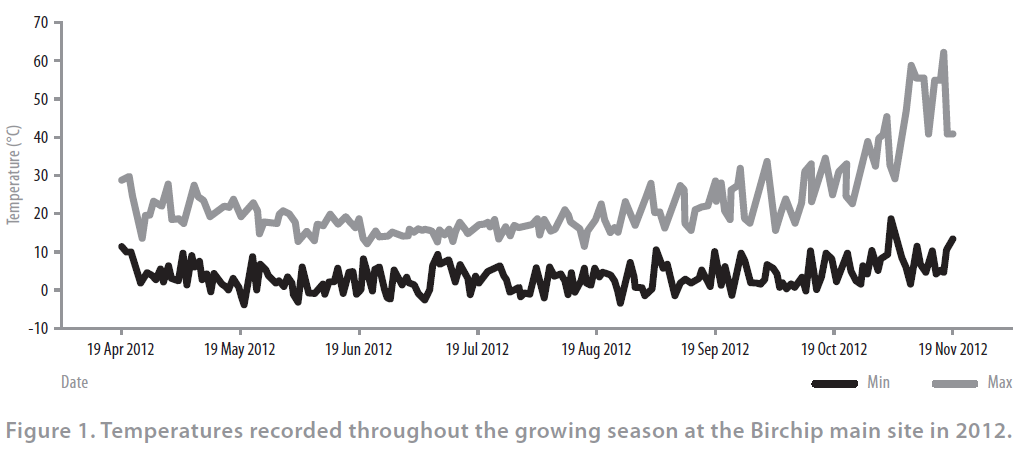
Frosts (defined as air temperature below 2°C) were very common throughout the 2012 growing season, occurring on 78 occasions (Figure 1).
Yield results showed there was no effect of grazing on grain yield. The winter wheat Rosella yielded more than all other varieties except Yitpi (Table 2). Rosella flowered in the second half of September, which is slightly later than optimal for this region. Yitpi yielded surprisingly well, given how early it flowered (late July) and the number of frosts to which it was exposed, although much of the grain yield may have come from secondary tillers. Yitpi sown in an adjacent time-of-sowing trial yielded 2.5t/ha from an early June emergence and 1.6t/ha from a late June emergence (LSD=0.3t/ha). Grazing and variety had no effect on protein (site average 12%), but Bolac and Forrest had higher levels of screenings than the winter wheats and Yitpi. Rosella had excellent test weight, whilst Wedgetail recorded marginal values, which is an unfortunate trait of this variety.
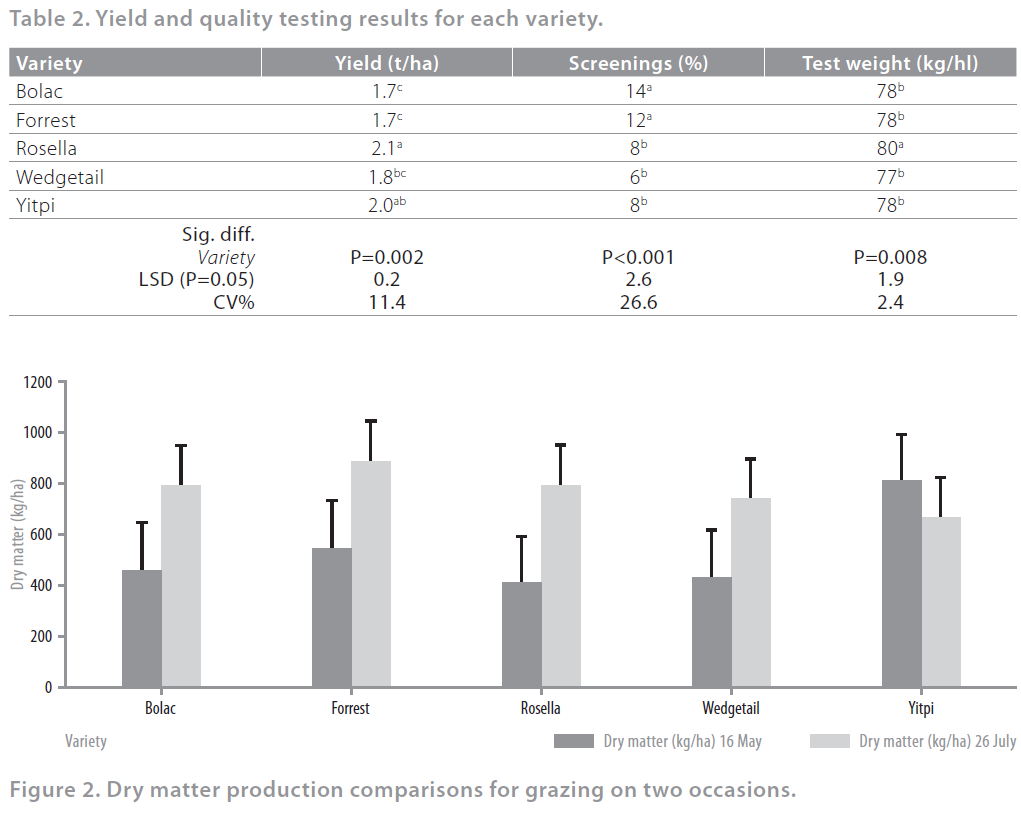
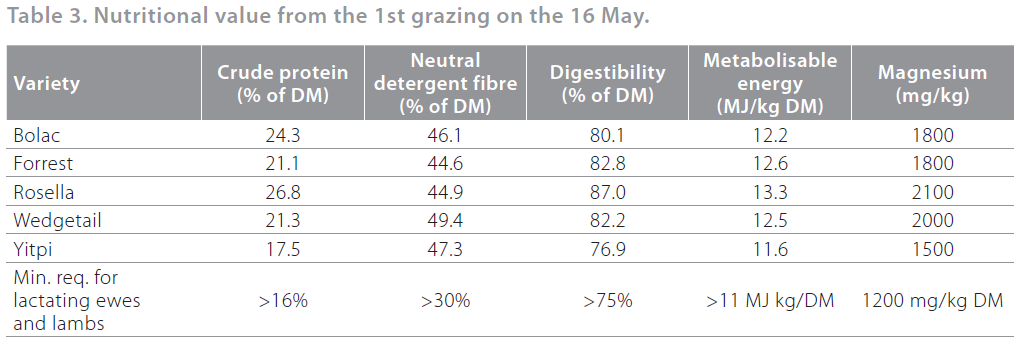
Yitpi had a significantly higher dry matter than the other varieties when it was grazed on 16 May due to its early growth pattern (Figure 2). When a second cut was taken on 26 July, Yitpi was the only variety that did not show increased dry matter than on the occasion of the first measurement. All other varieties had a positive response to grazing and continued to increase biomass. A tissue test for each variety indicated that all crops had adequate nutrition to meet minimum requirements for lactating ewes and lambs (Table 3).
Commercial practice
This trial showed that opportunity exists for growers in the Mallee and Wimmera to plant winter wheats in response to late summer and early autumn rain. Yields of winter wheats were slightly less than those achieved by spring wheats in the first time of sowing in the adjacent wheat time of sowing trial which emerged in early June (Yitpi yielded 2.5t/ha). However winter wheats had greater yields when compared with the second time of sowing which emerged in late June (Yitpi yielded 1.6t/ha). Early planting of winter wheat has additional flow-on farm benefits by providing excellent feed for stock at an otherwise lean time of year, and reducing the area of crop that needs to be planted in the usual window. It also must be remembered that there are no winter wheats specifically adapted to the Wimmera and Mallee: most available milling types were bred by NSW DPI in Temora. Wedgetail has a strong photoperiod requirement which means that it flowers too late in the Mallee, and its test weight will be marginal when new delivery standards come in to force in 2013. Rosella was the highest yielding winter wheat in this trial and most suited to the Wimmera and Mallee regions, but it was released over 27 years ago! Australian spring wheat breeding has increased grain yield at a rate of 25kg/ha per year, putting Rosella at a 0.7t/ha disadvantage to contemporary spring wheats. Whistler (ASW released 1998) and Wylah (AH released 1999) are both milling quality winter wheat varieties of faster maturity than Wedgetail, which may make them more suitable, but no yield data exist for the Wimmera-Mallee.
References
GRDC (www.grdc.com.au/Media-Centre/Ground-Cover/Ground-Cover-Issue-101/Expanding-subtropiczone- the-clue-to-dry-autumns) November 2012.
AcknowledgmentS
This was a trial funded by BCG members through their membership. James Hunt’s contribution was funded by GRDC project CPS00111 ‘Identifying farm scale opportunities to improve WUE: A nationally coordinated systems approach’.