The management of a medic pasture in the Mallee can affect the growth and yield of a cereal crop in the following year. Much research into medic pasture management in the Mallee has focused on the grass component of the pasture, which can host cereal diseases. Research into summer weeds, and drier seasons have, in recent years, highlighted the importance of stored water and also nitrogen for the following crop (see ‘Setting up your season: conserving summer moisture’, pp. 19 and ‘Break crops pay in the Mallee’, pp. 42). If a pasture is to be terminated (killed altogether) and converted into a fallow, it would be good to know the trade-off that is occurring between growth of the pasture and growth of the following crop, so that the timing of termination can be managed appropriately.
The growth of the pasture can be converted into wool and meat, ground cover, and with good medic growth, atmospherically fixed nitrogen. In turn, the pasture uses soil water and nitrogen. Depending on soil characteristics and subsequent rainfall, this may affect the water and nitrogen available to the following crop. How this is used depends on the following season, so the effects of termination timing need to be considered in the context of what is expected next season.
Take home messages
• With pasture growing in a dry spring, not accessing stored water and producing little
biomass, the effect on soil water/nitrogen and on the following crop is minimal.
• Prioritise paddocks which need medic seed set for retaining as pastures, but
terminate more pastures later if feed is an issue.
• In a year when pasture is growing fast and using water and possibly fixing nitrogen,
the trade-off may not be so flat (or simple) and will depend more on the following
season (unpredictable).
Aim
To measure the trade-off between medic pasture growth and yield of a following cereal crop, with different termination timing of the medic pasture.
Method
The trial was located in a 157ha grazed, volunteer medic pasture paddock on a calcarosol soil. Some volunteer oats were present from the previous crop. The paddock contained gilgais landforms (crabholes) but a part of the paddock was chosen for the trial where these were less pronounced, and away from headlands, gateways etc.
Four medic pasture termination treatments (Table 1) were laid out in a randomised complete block design with three adjacent replicates, and buffer plots of the January treatment between replicates and at either end of the design. The buffer plots were sampled at each treatment as an attempt to control against spatial variation. Each plot was 2m wide and 28m long, with the long side parallel to the longest fence in the paddock so that the farmers sowing operation did not transfer soil from one plot to the next.
Soil samples were taken before the start (August 26), at the time of the October treatment (October 14), and after the pasture had died (January 9). Soil samples were also taken before sowing the following crop (April 27) and after harvest (December 17).
Dry matter samples were taken from the pasture at each treatment date, and from the 2012 wheat crop at GS30 and GS65. Plots were harvested with a plot harvester to measure yield, and grain tested for protein, test weight and screenings.
Location: Jil Jil (20km N Birchip)
Replicates: 3
Sowing date: 28 May 2012 (crop)
Seeding density: 60kg/ha
Crop type/s: Correll wheat (2012) following volunteer medic
(2011)
Grazing: August-February, part of paddock grazed at approx.
4 DSE/ha (varying mobs) with supplementary
feeding (not close to the trial).
Inputs/fertiliser: at sowing MAP (30kg/ha)
Herbicides: 29 March 2012 Roundup Attack® (1.5L/ha) + Goal®
(100ml/ha) (not trial treatments)
25 May 2012 Gramoxone® (2L/ha)
23 July 2012 Velocity® (67ml/ha) +Lontrel®
(100ml/ha) + BS1000® (0.25%) Seeding equipment:
Horwood Bagshaw seeder (knife points, press
wheels, 17cm row spacing)

Results and interpretation
Spatial variation
The buffer plots and January termination treatments were checked for trends in spatial variation for soil water, nitrogen, crop and pasture growth and yield measurements. There were no consistent trends that might justify a more complex spatial analysis (not shown). Measurements from the buffer plots were therefore included in the analysis as extra replicates of the January treatment.
Rainfall
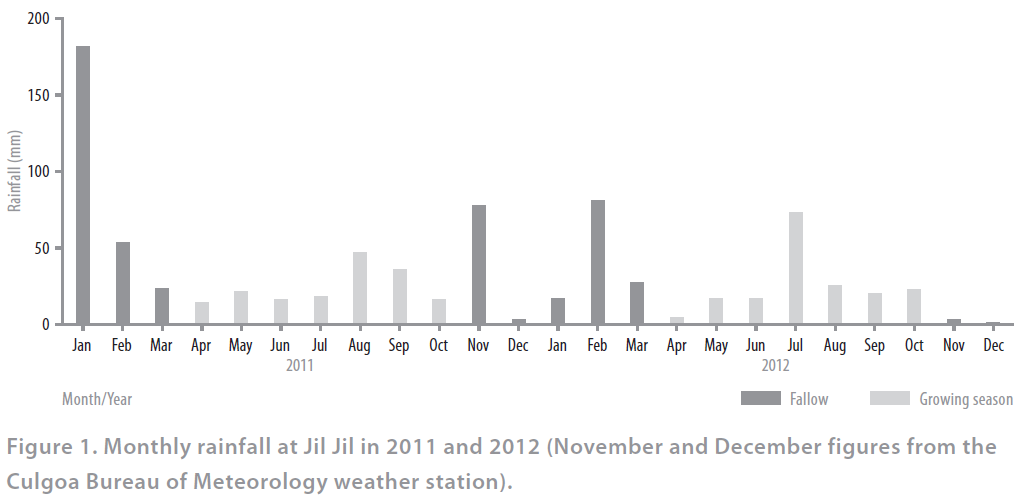
Termination trade-offs are heavily influenced by what the season is like for the pasture, and for the crop that follows it. The 2011 season was quite exceptional, with relatively dry winter/springs (164mm April- October in 2011 and 174mm in 2012) following a record-breaking wet summer in 2010/11 and good rain in summer 2011/12 (Figure 1). Rainfall distribution in the 2012 growing season was more favourable than in 2011, with fewer but bigger, rainfall events and 59mm over three days in July. Rainfall events were small in the 2011 growing season, with only two single day totals above 10mm until the end of September. In the 2011 summer especially there was a good opportunity to store water.
Pasture and following crop growth
Most of the dry matter present at the beginning of the trial in August 2011 was stubble from the previous year’s oat crop. A small amount of medic and some oats were growing amongst it. The amount of dry matter halved in the six weeks after the first termination treatment (Figure 2) but was then relatively constant. The stubble appears to have broken down more slowly with early termination, but the pasture measurements were not accurate enough to determine whether this was real or due to spatial variation.
In the following crop (2012), there were also no significant differences in growth at either early stem elongation (growth stage 30) or anthesis (growth stage 65) (Figure 2).

The live component of pasture in 2011 was very close to zero dry matter on all measurement occasions for already-terminated plots (Figure 3). By early January measurement, most treatments were completely dead.
Relatively little pasture was growing in this paddock, but the timing of termination still appears to have had an effect. Earlier termination (probably while grazing was occurring) has slowed the breakdown of the previous year’s stubble. Presumably since it lacked green pasture, it was also less attractive to sheep, even in 2m wide plots.
In the following crop in 2012 (also Figure 3), all but the late termination had significantly higher biomass N at early stem elongation (3.8% vs. at least 4.2%, P=0.025, LSD=0.15%). This did not translate into a significant difference in total crop nitrogen uptake at early stem elongation because of the variability in crop dry matter measurements (Figure 2).

Seed production
Medic seed numbers were measured on the living pasture component in October and January. At the October measurement, the un-terminated (October and January treatment) plots averaged 71 seeds/m2. No seeds were found on the terminated (August/September) plots (P=0.024 for the difference, LSD=59 seeds/m2). At the January measurement, only one of the January plots had 2 seeds/m2. No others were found.
Soil water, N and Colwell P
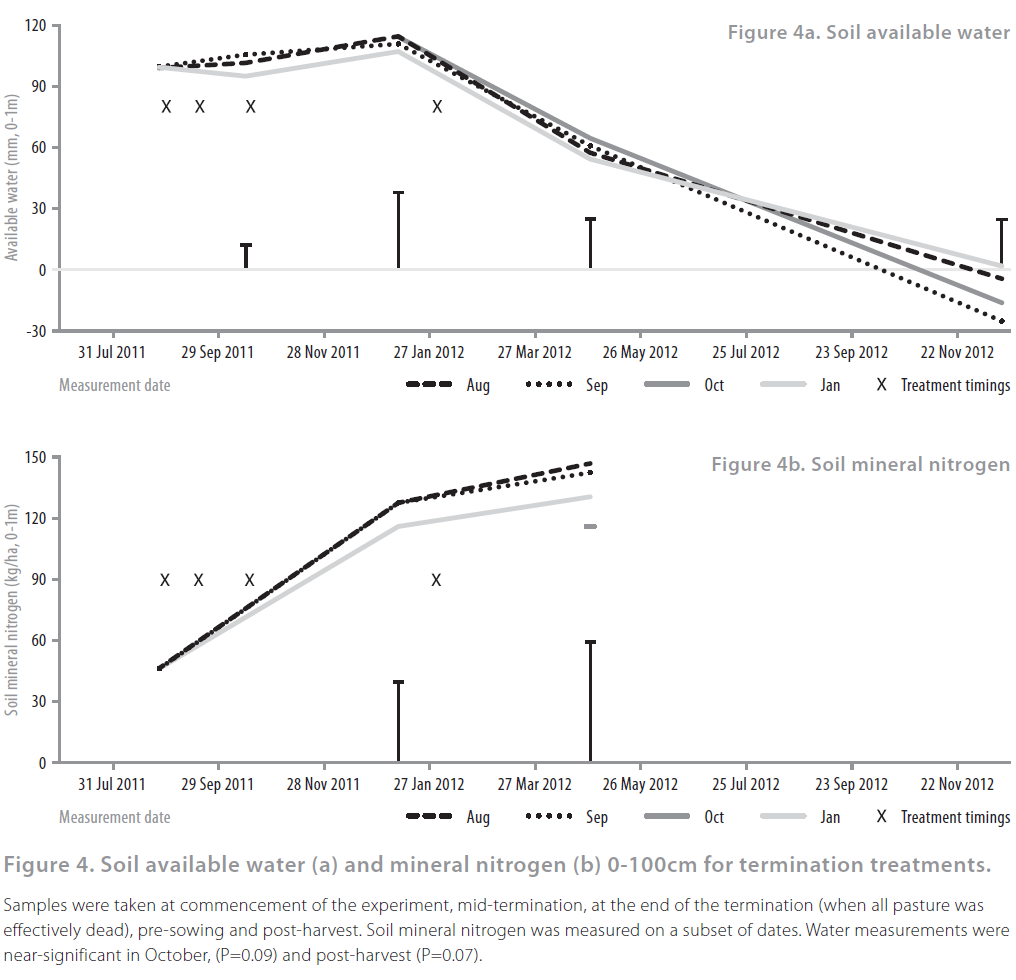
Soil available water was not significantly lower in the January termination treatment in October (P=0.09), compared with the September termination treatment (Figure 4a). The January treatment remained driest until the post-harvest measurement, when it was wettest (again, compared to the September treatment, P=0.07). Soil mineral nitrogen also tended to be lower for the January treatment, compared to the earlier termination treatments (Figure 4b). Again, measurements were quite variable (CV16-22%, LSD=40-60kg N/ha).
Colwell P was measured in January (average 20.5mg/kg, P=0.74) and again pre-sowing (average 22.3mg/kg, P=0.67) but on both occasions there were no significant differences.
Crop yield
Yields from the experiment were quite reasonable (3t/ha) but were not significantly affected by the termination treatments (Table 2). Grain protein was relatively low at 8.9-9.5%. There were no significant differences in test weight. Screenings (not presented) were measured but were low (av. 5%) and mostly a result of threshing damage.

Early terminated plots (any treatment that killed pasture, but especially the August one) may have had more soil water and nitrogen when the crop was sown, but the experimental set-up and measurements on this soil type weren’t intense enough to measure it. Any differences were likely to be small. Available water (to the 2012 crop) didn’t decrease during the 2011 pasture, at all (Figure 4a), which suggests that the medic roots were not accessing the stored water. Analysis of water use at different depths is yet to be undertaken and may confirm whether this is what happened.
The earlier terminated plots also tended to have more biomass during crop growth, and had significantly higher N per cent in biomass at early stem elongation. These plots had slightly, but not significantly, higher yield (the difference, 0.13t/ha, is significant at P=0.06 if the January treatment is compared with all the others). Low grain protein implies that crops would have been sensitive to available nitrogen; there is a strong positive correlation between grain yield and protein (R2=+0.79, P=0.002, 12 samples). In this pair of seasons, the main effect of termination on crop yield is likely to have operated via soil mineral nitrogen.
On the pasture side, delaying termination allowed the consumption or breakdown of at least 1t/ ha more residual stubble, and retained living pasture of 200-250kg/ha until at least late October. This would help to offset the need for supplementary feeding, and increase stock growth rates. Both October and January termination treatments produced an average of 70 green medic seeds/m2 (measured in October). It is likely that more seeds would have been produced after measurement in the January treatment, and most seeds would have been killed by the herbicide in the October termination treatment.
The trade-off in this instance was relatively flat. The spring was dry with little pasture growth, which meant a reduced benefit from using the pasture, and also little cost in grain yield as a result of nitrogen and water use under the pasture. Approximately half of the available water was lost after termination (over summer) in all treatments, which probably reduced the size of treatment differences in dry matter growth and yield.
Commercial practice
With pasture growing in a dry spring, not accessing stored water, and producing little biomass, there is little water/nitrogen use and little effect on the following crop. The timing of termination can be chosen to suit either enterprise, but in that sort of season later termination would probably benefit the grazing enterprise, provided groundcover levels were maintained to prevent erosion. Termination timing would be most critical where early termination might deplete the medic seedbank.
In years in which pasture is growing slowly, termination timing may be less critical, provided grass in the pasture and disease carryover are not an issue.
Farmers should prioritise paddocks which need medic seed set for future regeneration, but terminate more pastures later if feed is an issue.
In a year when pasture is growing fast, using water and possibly fixing nitrogen, the trade-off may not be so flat (or simple) and will depend more on the following season (unpredictable).
Acknowledgments
This project is supported by Northern Victoria Grain and Graze 2 (GRDC project BWD00018; funded by GRDC and Caring for Our Country).