Capturing, storing and making best use of summer rainfall is one of the most effective ways of improving crop yields in low to medium rainfall environments. The benefits that come from storing summer fallow rain have been confirmed by numerous BCG trials (1999 to 2011). Trial results have shown the value of controlling summer weeds in terms of increased yield of the following crop. Even in the exceptional growing season of 2010, weed control in the summer of 2009/2010 delivered a substantial yield increase, predominantly due to enhanced nitrogen (N) availability to the crop (see BCG 2010 Season Research Results pp. 30). In 2011, however, yield benefits gained from summer weed control were essentially due to increased plant available water (PAW), (see BCG 2011 Season Research Results pp. 22).
Take home messages
• For the fourth year in a row grain yield was increased by controlling summer weeds.
• There has been a return on investment in all years of this trial, by controlling summer weeds.
• Retaining or removing stubble has only a minor effect on yield.
Aim
To quantify the effect of paddock stubble management and weed burden during the summer fallow on crop available soil water, nutrients and yield.
Method
This field trial was set up in December 2008, 13km south east of Hopetoun on Warakirri’s Bullarto Downs property. It was established on two soil types 2.3km apart. The sand site with sandy topsoil and clay subsoil is located on top of an east-west dune; and the clay site is in a low-lying flat with clay loam topsoil and subsoil constraints.
At each site, the six stubble treatments were established immediately after harvest each year. On 2 December 2011, stubble treatments were implemented on an existing wheat stubble load of 4.4t/ha at the sand site and 3.2t/ha at the clay site.
The treatments were:
1. standing stubble
2. standing stubble and summer weeds
3. slashed stubble
4. bare earth
5. bare earth and summer weeds
6. cultivation
Stubble in treatments 3, 4 and 5 was slashed with a whipper snipper; in treatments 4 and 5, stubble was then removed from the plots.
Two soil cores per plot (segmented into layers to a depth of 1.3m) were taken on 29 March 2012; PAW and mineral nitrogen were measured.
Following rainfall during December 2011 (35mm) and January 2012 (25mm), summer weeds emerged (volunteer cereals, fleabane and heliotrope). On 5 January treatments 1, 3 and 5 were sprayed with 450g/L glyphosate (2L/ha), 240g/L oxyflurofen (75mL/ha) and wetter (1% v/v).
On 2 February and 23 March 2012, treatments 1, 3 and 4 were sprayed again with 450g/L glyphosate (2L/ha), 240g/L oxyflurofen (75mL/ha) and wetter (1%). Rainfall events included December 18 (35mm), January 8 (8mm) and January 30 (9mm). Cultivation in treatment 6 occurred on 7 March, following 29mm rain.
Herald XT lentils (imi-tolerant) were sown on 4 May at 45kg/ha. Crop biomass was indicated using Normalised Difference Vegetation Index (NDVI) at GS15-22, GS30, GS65 and GS85 with a hand-held GreenSeeker® crop sensor (NTech Industries Inc., Ukiah, California). In addition, cuts were used to measure dry matter production in the lentils at flowering and at maturity. Grain yield was measured with a plot harvester.
Location: Hopetoun
Replicates: 4
Sowing date: 4 May
Sowing rate: 45kg/ha
Plant density: 130plants/m²
Crop type: Herald XT lentils
Inputs/fertiliser: MAP + Zn (55kg/ha) – both sites at sowing
Seeding equipment: knife points, press wheels, inter-row sown, 30cm row spacing
11/12 summer rain: 95mm
Growing Season Rain: 150mm
Results and interpretation
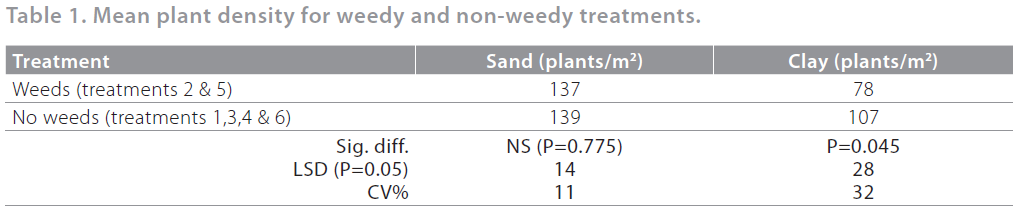
The results of this trial in 2012 have again highlighted the importance of controlling summer weeds. In a year with a lower GSR and a dry spring, yields were still higher when weeds were controlled in the previous summer (Table 2 and 3). At the clay site, crop establishment was better where summer weeds were controlled (Table 1). Weeds did not limit establishment on the sand site; and stubble did not affect plant establishment at either site.
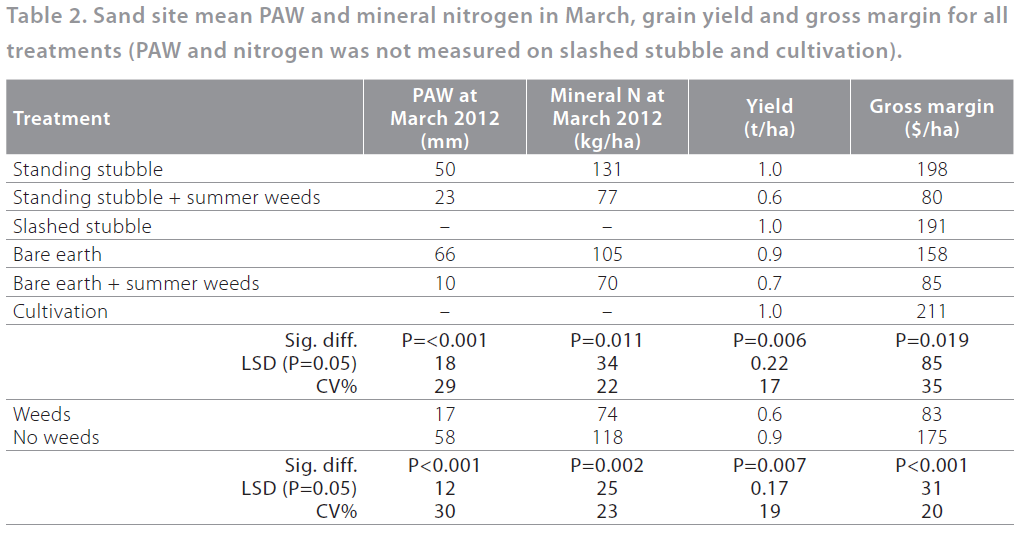
At the sand site, under the standing stubble treatment, an extra 54kg N/ha was measured where weeds had been controlled. Under bare earth, where the weeds had been controlled, an extra 35kg N/ha was measured (Table 2). Due to small differences between stubble treatments we chose to sample only treatments in which we could compare plus and minus summer weeds for moisture and N (pre-sowing and post-harvest).
Lentil yields at the sand site were higher where summer weeds were controlled. Stubble treatments did not affect yield or gross margin (Table 2).
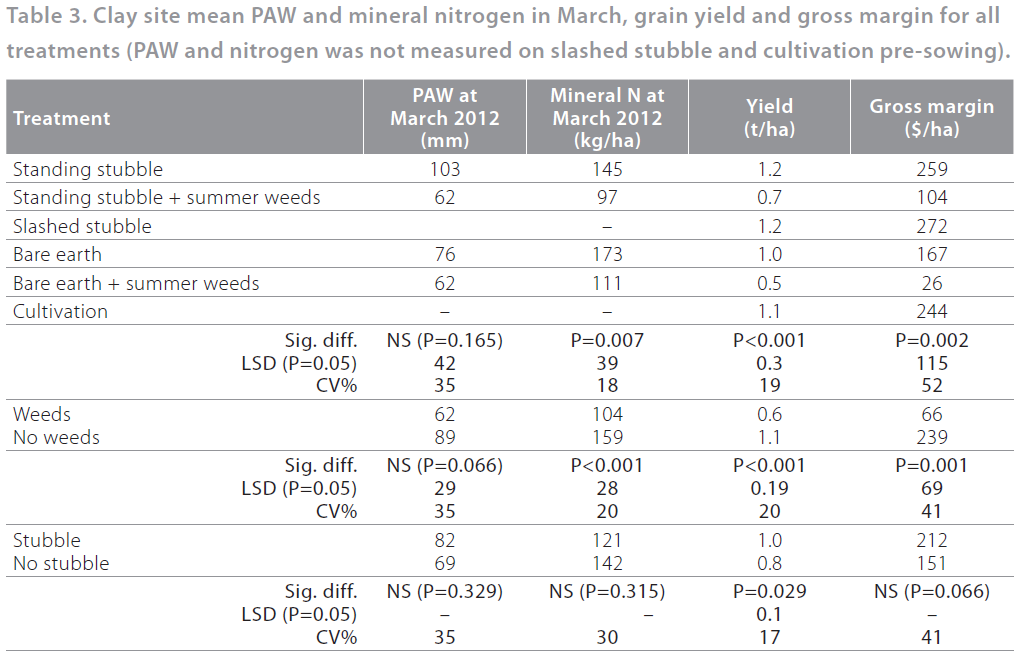
At the clay site, higher PAW and mineral N were recorded in March where summer weeds were controlled (Table 3). The presence or absence of stubble cover did not affect PAW. Lentil grain yield at the clay site was influenced by the absence of weeds and the presence of stubble (Table 3).
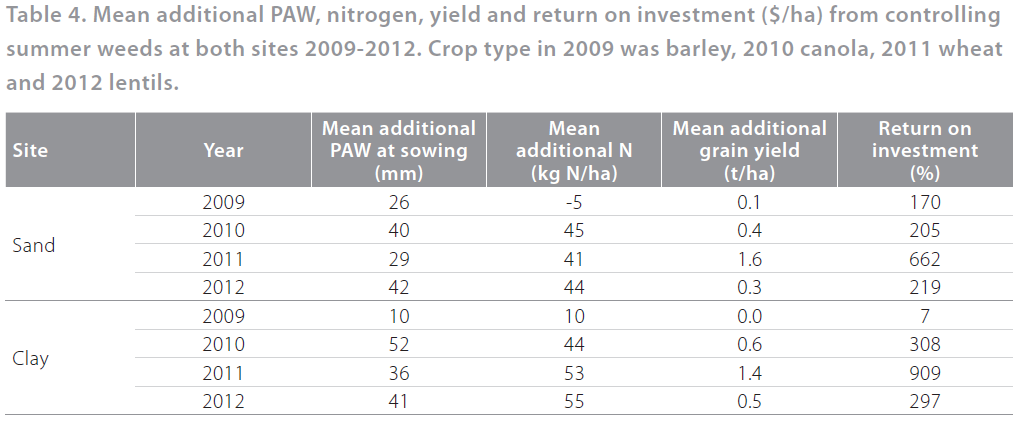
All four years of this experiment highlighted the positive effect of summer weed control on soil PAW at sowing time. It should be noted that 2009 presented a worst case scenario for summer weed control; insufficient rain fell for a yield increasing level of pre-sowing soil water to be stored.
Summer weed control increased soil mineral nitrogen in all years apart from 2009 on the sandy soil. All four years resulted in a positive return on investment (average 347%). The level of return was determined by the amount of summer rainfall. The best return on investment occurred in the wet summer of 2010/2011 (Table 4).
Commercial practice
The results from this and previous years’ trials demonstrate the importance of summer weed control. Even in wet growing seasons such as 2010, there has consistently been a positive return on investment from summer weed control, with substantial yield increases in all but the very dry seasons. Stubble management had a small negative impact on wheat yield at the clay site in 2011 and a small positive impact on lentil yield in 2012. However it should be remembered that the benefits of retaining stubble are mainly operational (no stubble removal required, faster sowing) and environmental (no wind or water erosion) rather than production related.
Acknowledgments
This project was funded by GRDC project BWD00012 ‘Yielding benefits through partnerships’ and CPS00111 ‘Identifying farm scale opportunities to improve WUE: a nationally coordinated systems approach’.
Contributors included: Warakirri Bullarto Downs for hosting the experiments over 5 years; Ian Delmenico of CropRite Pty Ltd for site EM survey; Damian Mowat and Brett Cox of CSIRO for soil water characterisations; John Stuchbery of JSA Independent for agronomic advice and Mel Cann of DPI Victoria for providing soil descriptions.