There are now over 50,000ha of summer-active perennial grasses established on marginal sandy soils in the medium-low rainfall zone of the Western Australia (WA) wheatbelt. They provide year-round groundcover on erodible sands that are risky for regular cropping and help to fill key feed gaps by being able to utilise summer rain and residual soil moisture. The ability to grow and harvest a winter inter-row crop (pasture cropping) by exploiting their high level of winter dormancy is also attracting increasing attention in Western Australia (Ward et al 2012). The winter crops grown between the dormant grasses can be used for grazing or grain.
Based on the first field trials of their kind at Hopetoun (Vic) and Karoonda (SA), the EverCrop project is testing the potential for summer-growing perennial grasses to deliver benefits to Mallee farmers. This builds upon earlier BCG and CSIRO work which explored the potential feasibility of these sub-tropical grasses in the Mallee environment (Whitbread and Craig 2010; Pengelly et al 2006).
Take home messages
• Summer-active perennial grasses such as commercial Panic varieties have persisted, provided year-round groundcover and produced good quantities of pasture over several years in two field trials in the Mallee; growth rates and grazing potential are highest and most reliable in November and April.
• The high level of winter dormancy can allow for opportunistic establishment of inter-row winter species (e.g. pasture cropping).
• In 2012, with low growing season rainfall, pasture-cropped wheat production was penalised; evaluation is ongoing.
Aim
To test the persistence and performance of summer-active perennial grasses in a Mallee environment and the potential for pasture cropping.
Method
In November 2006, a range of summer-growing perennial grasses were established in a replicated trial at Hopetoun (for details refer to Whitbread and Craig, 2010). At Karoonda, five sub-tropical grasses were sown in October 2010 in 50cm spaced rows, at a seed rate of 5kg/ha with 50kg/ha DAP added at the time of sowing. Not all species are reported on here. Plant establishment, persistence and biomass production were assessed at regular intervals. The Hopetoun site was grazed annually, while mowing was used in place of grazing at the Karoonda site. In addition to the field measurements, simulation modelling was used to evaluate likely performance over a long-term range of season-types. The 2007- 2011 biomass data from Hopetoun was used for model validation. The subsequent model simulations of plant growth were generated, using the c4 grass (grasses that are better adapted to summer conditions) module in Grazplan (Moore et al., 1997) using 60 years of climate data from Hopetoun (1950-2011).
In 2012, wheat was sown into the grass plots. At Karoonda this was completed using twin crop sowing rows between the 50cm grass rows. At Hopetoun standard 30cm spacing was used. Soil water and soil biology and disease dynamics under the different systems are being investigated, but the results are not presented here.
Location: Hopetoun and Karoonda
Replicates: 4
Pasture sowing date: Hopetoun: October 2006
Karoonda: October 2010
Pasture type/s: Both sites: Panicum maximum (cv Petrie)
Panicum coloratum (cv Bambatsi)
Hopetoun: Panicum maximum (cv Gatton)
Panicum coloratum (cv ATF-714)
Karoonda: Chloris gayana (cv Katambora – Rhodes)
Digitaria smutsii (cv Premier)
Crop sowing date: Hopetoun: 7 June 2012
Karoonda: 12 June 2012
Crop type: Axe wheat
Fertiliser: Hopetoun: at sowing MAP (50kg/ha)
14 Sept SOA (40 units N/ha)
Karoonda: at sowing DAP (50kg/ha) and Urea (35kg/ha)
Results and interpretation
Pasture growth
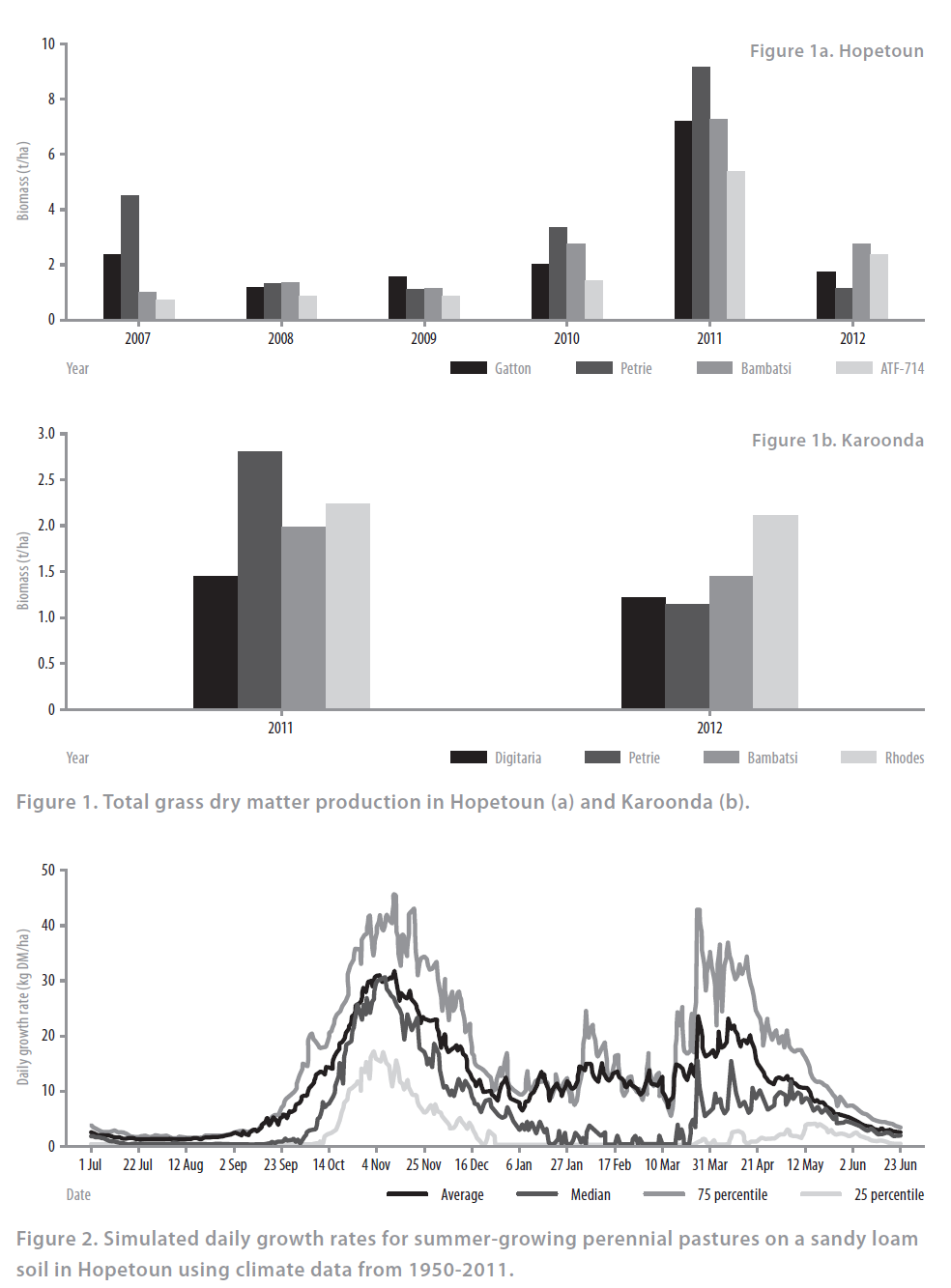
The summer-growing perennial grasses continue to persist after six years at Hopetoun. They produce typical biomass yields of 1.5-2t/ha and have produced over 7t/ha in response to high summer rainfall (Figure 1a and b). There have been no major consistent differences between the Panicum varieties over the years. Rhodes grass has performed well at Karoonda in terms of growth and groundcover, but its stoloniferous (runners) growth pattern does not make it a preferred species if considering inter-row pasture cropping (Figure 1b).
Using the Hopetoun results, the growth simulation model performed very well in estimating biomass production reinforcing the likelihood of Gatton Panic being able to produce useful amounts of biomass in these environments (Figure 2). As experienced in the field, zero growth occurs in winter. Growth rates are typically high in November in response to increasing temperatures and in April, when and if, adequate soil moisture is present. The reliability of good growth is higher in November than April due to unreliable summer-early autumn rain (e.g. see median growth rate in Figure 2).
Wheat production with pasture cropping
Hopetoun
Growing season rainfall in 2012 was 157mm (decile 2). Results show yields of Axe wheat in the absence of pasture cropping (no grasses in plots) to average 1.4t/ha and yields in the pasture cropped plots to average approximately 0.5t/ha. Wheat biomass at maturity was approximately 1.5t/ha when pasture cropped compared with 2.5t/ha in the control where there were no grasses.
Karoonda
Growing season rainfall this year was 258mm (decile 7). Biomass of wheat at maturity averaged approximately 2.0t/ha in pasture cropped plots with Panic species and 3.8t/ha in plots with no grasses. Wheat yields were approximately 0.9t/ha in the presence of the perennial grasses and 1.4t/ha in control wheat plots.
The wheat yield penalties of over 40% demonstrate the likely constraints of pasture-cropping in years without high winter rainfall in a system that utilises preceding summer-early autumn rainfall for pasture production. The size of the yield penalty may also demonstrate the effect of weed management difficulties in pasture-cropped plots.
Commercial practice
These are the first trials of their kind in the Mallee and the potential niche for these plants in low rainfall mixed farming systems is still being evaluated. When summer rainfall patterns are high, potential for summer grasses exists. For those farmers keen to explore new plant options capable of utilising summer and unused winter rainfall on marginal soils, the levels of persistence and pasture production being demonstrated from these commercially available Panicum species are encouraging. Successful performance of a grain crop following a summer grass relies on winter rainfall compensating for autumn moisture use. Next steps include trialling the use of farmer equipment and further investigating the potential for production from inter-sown winter options for grazing or grain.
REFERENCES
Moore AD, Donnelly JR, Freer M, 1997. GRAZPLAN: decision support systems for Australian grazing enterprises. III. Growth and soil moisture submodels, and the GrassGro DSS. Agricultural Systems 55, 535–582.
Pengelly, B.C., Hall, E., Auricht, G., Bennell, M., and Cook, B.G. 2006. Identifying potential pasture species for grazing systems in the Mallee-Wimmera. CSIRO Sustainable Ecosystems, Canberra. pp. 109. www.bcg.org.au/resources/FINALSpeciesAudit_PerennialPastures2006.pdf
Whitbread, A. and Craig, S., 2010. The potential of summer-growing grasses to persist and produce out-of-season forage in the Victorian Mallee. Proceedings of 15th Australian Agronomy Conference. www.regional.org.au/au/asa/2010/pastures-forage/lucerne/6979_whitbreada.htm
Ward P, Ferris D, Lawes R, Palmer N, Micin S and Barrett-Lennard P (2012). Crop yield, pasture yield, and environmental impact of pasture cropping with sub-tropical perennials. Proceedings of the 16th Australian Agronomy Conference. www.regional.org.au/au/asa/2012/pastures/8093_wardpr.htm
Acknowledgments
The Evercrop project is funded through the CRC for Future Farm Industries and GRDC with activities in the low rainfall zone supported by the CSIRO Sustainable Agriculture Flagship.