Like a crop, cereals sown for pasture use will benefit from applications of fertiliser to boost limiting soil nutrients. Pastures in low rainfall areas typically piggyback off residual phosphorus (P) unused from the previous cropping phase or from soil reserves, which is adequate for the pasture growth. Soil nitrogen (N) is more likely to have been utilised or lost from the system and will need replenishing. Some soil N will be mineralised and available for plant uptake, depending on paddock history and the season.
The production of the cereal pasture and subsequent livestock growth rates need to be optimised to achieve the best outcome for the investment in sown pasture.
Take Home Messages
• There was no forage production response to fertiliser nitrogen at Yanac in 2012; a low rainfall, decile 1 season. District experience, however, has seen forage production respond to fertiliser nitrogen in better rainfall seasons.
• Consider the risk associated with the application of fertiliser on pastures. What is the likelihood of achieving a paying response from this investment?
• Ensure forage is meeting the nutritional requirements of stock to realise genetic potential for growth and production.
Aim
To evaluate the feed response of barley and oats to two different N rates applied at sowing and post-sowing, and the economic returns from sheep production.
Method
Location: Yanac
Replicates: 4
Sowing date: 8 May
Target plant density Barley: 130 plants/m² (66kg/ha)
Oats: 200 plants/m² (69kg/ha)
Crop type/s: Commander barley and Winteroo oats
Seeding equipment: BCG cone seeder (knife points, press wheels, 30cm row
spacing)
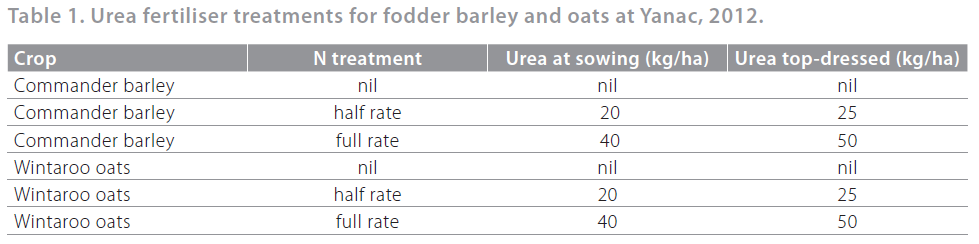
A replicated plot trial was established into cultivated soil at Yanac, north west of Nhill. The site had a starting soil Colwell P (0-10cm) of 42mg/kg and soil N (0-100cm) of 66.5kg/ha. Fertiliser treatments are outlined in Table 1. Urea was top-dressed on 14 August, according to treatment applications.
Crop dry matter (DM) was measured on 18 July (GS14) and of crop re-growth on 11 September (GS37), when plants were 15cm high. Dry matter measurements (hand cuts simulating grazing) were sampled at marked points, and the remainder of the plot was left untouched (un-grazed).
Tissue samples were collected at each time of grazing and analysed for nutritive value.
Anthesis (GS65) DM measurements of un-grazed crop were taken on 24 October to estimate hay production. The trial was terminated the same day to prevent seed set of resistant ryegrass for which there were no herbicide options for control.
Costs for applying urea were calculated using $555/t urea at sowing and $620/t for urea top-dressed, with $5/ha spreading costs. Grazing value was estimated using anthesis DM to calculate the stocking rate possible with 80 days grazing. Gross income was then calculated, assuming lambs were gaining
260g/head/day (Garry Armstrong, pers. comm.) and lamb sale price was $3.50/kg liveweight.
Results and interpretation
Growing season rainfall at Yanac was decile 1 (April to October). A dry start to the season was followed by only 203mm of growing season rainfall, and ended with a dry finish. The season was at decile 1 when plots were top-dressed.
Crop emergence was even, but early DM on 8 July was patchy due to the dry conditions. Oats were slower growing earlier in the season but, by anthesis, produced similar amounts of dry matter to barley.
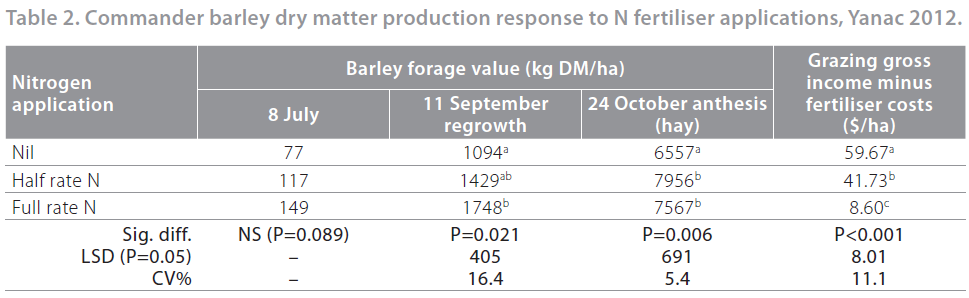
Barley pasture production responded to the full rate of top-dressed urea which resulted in 654kg/ha more re-growth dry matter in September. Hay production increased in response to N fertiliser by 1-1.5 t/ha. No difference in production was measured between the half rate and full rate of urea applied for hay production (Table 2).
Conversely, there was no fertiliser response in oat pasture production to the urea applied at any of the production times (Table 3).
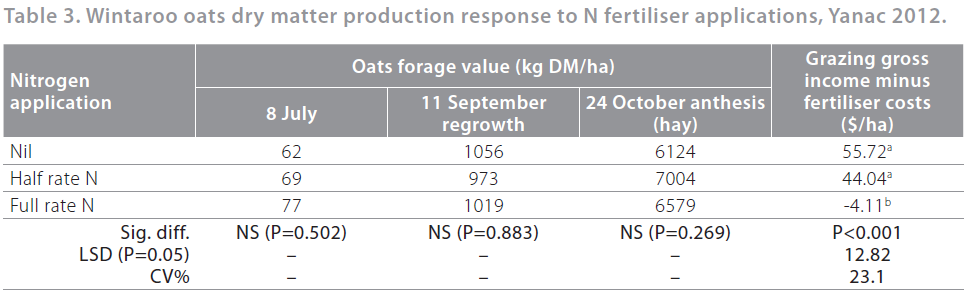
The addition of fertiliser N failed to make an economic gain for barley or oats in 2012 (Tables 2 and 3).
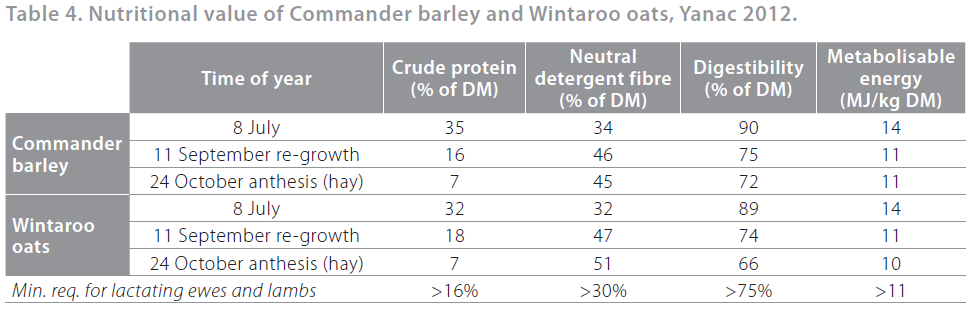
In terms of forage nutrition, there were no noticeable differences between fertiliser treatments. There were, however, changes in nutrition as the season progressed and plants matured (Table 4).
As could be expected in such a dry season with moderate soil N levels, it was not economic to apply N to these cereal pastures. This was due to a combination of: low plant requirements; DM response to N; and lower lamb values. Local experience suggests however that pastures in this area do benefit from N fertiliser in most seasons, and in situations of low soil N.
When making pasture fertiliser decisions, it is important to consider the associated risk. What is the likelihood of a paying response from this application? Risk = likelihood (the chance of adequate rainfall occurring to make use of the fertiliser) x consequence (good pasture response). The results from this study provide an example in which the investment in fertilising the pasture did not give a positive response. This is not to say that the wrong decision was made. To get a positive response from the application, a decile 3 or above finish was necessary (70% chance). It just so happens that the 30% chance of poor conditions resulted in a decile 1 finish. Given the same situation all over again, a grower should make the same decision. It will work in seven out of every 10 years.
It is important to know feed quality to ensure that you are meeting the nutrient requirements of the particular class of animals. The nutritional content of growing plants changes over the season. If you are not meeting your stock’s nutritional requirements, you will not realise the genetic potential for growth and production.
Acknowledgments
This project is supported by Northern Victoria Grain and Graze 2 (GRDC project BWD00018; funded by GRDC and Caring for Our Country).