Grain protein is difficult to manage accurately because it is sensitive to many factors, particularly during grain filling (Mason and Brennan 2009). Weather (rainfall and temperature), the crops ability to uptake nitrogen (N), varietal choice, level of N applied, crop damage (scorching) and yield will affect grain protein. A hot, dry finish in spring generally results in smaller grain and higher protein content. Wheel track damage can also occur from late N applications potentially penalising yield. The final increase in protein is unknown until after harvest.
In the past two seasons, farmers have been able to grow relatively high-yielding crops, but generally, the protein has been lower. One challenge of high-yielding seasons is to meet the additional nutrition requirements of the crop so that grain protein targets are met. Farmers have been commercially advised that applying N late in the season can give significant economic returns. However, attempting to increase protein by applying N at flowering poses problems.
The value of applying N late in the season depends on whether a higher grade quality is achieved and the price differential between grades. Wheat must reach a minimum of 13 per cent (%) protein in order to achieve AH quality; malt grade barley requires 9-12% protein. BCG research has found that to increase barley protein by 1%, 5kg N/ha is required for every tonne of expected yield, (BCG 2011 Season Research Results, pp. 87 – N applied at GS55) to increase wheat protein by 1%, 10kg N/ha was required for every tonne of expected yield (also at GS55).
Take Home Messages
• Nitrogen applications at flowering in 2012 increased grain protein (%) in barley and improved grain quality, but were not economically viable.
• In the Wimmera, 20kg N/ha/t grain at flowering time increased grain protein by 1% in wheat.
• Applying UAN late (GS65) in wheat did not increase grain protein and resulted in no economic returns.
Aim
To increase grain protein (%) in wheat and barley by means of late applications of N applied as UAN.
Method
TRIAL 1: RUPANYUP
Location: Rupanyup
Replicates: 4
Sowing date: 14 May
Target plant density: 150 plants/m²
Crop type/s: Yitpi wheat and Commander barley
Inputs/fertiliser: at sowing MAP (55kg/ha) – treated with impact
7 Aug urea (90kg/ha) – across all plots
4 Sep urea (90kg/ha) – wheat only
Herbicides: at sowing Triflur X® (2L/ha) + Avadex Xtra® (2L/ha)
+ Roundup Attack® (2L/ha)
11 Sept Amicide® (1L/ha) + Lontrel® (100mL/ha)
This research compared increases in grain protein in wheat and barley. A one-off late application of N, applied as Foliar N (UAN 42%v/v) using a hand-held 1.5m boom, was performed on 9 October (GS65), using variable rates (0, 25, 50, 75 and 100kg N/ha) (Table 1). Streaming jet nozzles (04) were used to reduce any effect of scorching. On the day of spraying, conditions were cool, overcast and rain had occurred two days earlier (Table 2).
Crop biomass cuts were measured on the day of foliar N application (wheat GS67, barley GS63).
Table 1. List of treatments and cost ($/ha) for Rupanyup site applied on 9 October.

The growing season rainfall for Rupanyup for 2012 was 261mm. This was approximately 30mm less than the long-term average of 290mm.
Table 2. Rainfall measurements for Rupanyup during October, UAN applied on the 9th October.

TRIAL 2: BIRCHIP
Location: Birchip
Replicates: 4
Sowing date: 1 June
Target plant density: 150 plants/m²
Crop type: Yitpi wheat
Inputs: at sowing MAP (55kg/ha)
Herbicides: 3 Sept Velocity® (670mL/ha) + Axial® (300mL/ha)
+ Uptake® (0.5%)
Seeding equipment: BCG parallelogram seeder (knife points, press wheels,
30cm row spacing)
UAN was applied on 8 October at three different N rates (0, 20 and 40kg N/ha) (Table 3), using 3 different nozzle types. Application was made using a 1.5m hand boom and crop growth stage was flowering (GS65).
The different types of nozzles included:
• TT-02 – wide angle flat spray pattern for uniform coverage in broadcast spraying
• SJ3-04 streaming jet – three solids streams of equal velocity and capacity
• TJ-60 twin Jet – penetrates crop residue or dense foliage and smaller droplets for thorough coverage.
Table 3. UAN (kg N/ha and UAN rate (L/ha) and cost ($/ha) for Birchip site.

The Birchip site received 12mm of rain on 6 October, two days prior to application of the UAN, and three days afterwards (11 October) another 2.5mm fell.
Table 4. Rainfall measurements for Birchip during October, UAN applied on 8 October.

Results and interpretation
TRIAL 1: RUPANYUP
The soil analysis at the beginning of the season measured 60kg N/ha of available soil nitrogen. Soil moisture measured 42mm to a depth of 1m in a Wimmera grey cracking clay. Total nitrogen tissue concentration was 1.37% for wheat and 0.78% for barley prior to N application. Crop biomass measured for wheat was 4.4t/ha and 6.1t/ha for barley. The wheat crop had taken up 60kg N/ha and barley 47kg N/ha at flowering time.
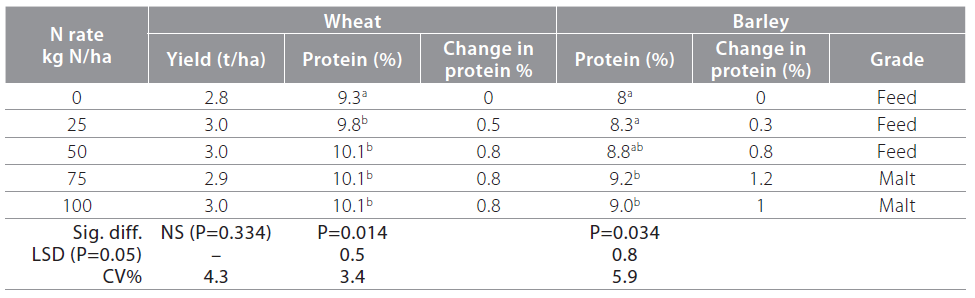
Applying a late application of liquid N at flowering did not have any effect on increasing wheat yield. A difference occurred as a result of the application of N in both wheat and barley in grain protein (Table 5). Applying N at flowering generated a protein response, but increasing the rate did not change grain quality in wheat. All wheat treatments achieved ASW quality.
When nitrogen, at a rate of 20kg N/ha per tonne of grain was applied to barley, protein increased by 1% and reached the level required for malt barley. However, this application cost $130/ha in N. To make a profit, a difference of at least $130 between feed and malt barley would be required (ignoring application costs and crop damage). Currently, the difference is $6.50 (prices taken as at 3 December, consistent with this publication), making late N applications in 2012 economically unviable. Generally, protein levels in the Wimmera reach at least a minimum of malt grade quality. Normally, the grain protein exceeds 12%, putting it into feed grade.
Table 5. Average yield (t/ha) and protein (%) for the nitrogen treatments at Rupanyup.
In the 2012 season, this trial identified that on average 18kg N/ha/t of crop was needed to increase gain protein by 1% (Figure 1).
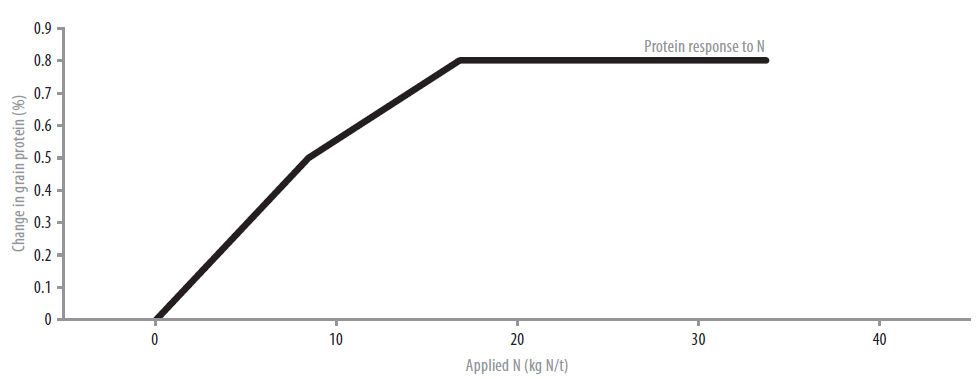 Figure 1. Identifies the relationship between applying nitrogen (kg N/ha) and grain protein (%) at Rupanyup.
TRIAL 2: BIRCHIP
Soil analysis at the beginning of the season indicated that 53kg N/ha was available to the plants to a depth of 1m. Soil available moisture measured 54mm (to 1m) in January 2012. This was a good soil N status given the reasonable crop yields in 2011.
At the Birchip site, N rate did not have an impact on grain yield, but protein (%) was increased when 40kg N/ha was applied at the flowering stage (Figure 2). Nozzle type did not affect yield (P=0.129) or protein (P=0.594). No response was generated between 0kg N and 20kg N/ha. Spring rainfall at the site was low after UAN application.
 Figure 2. Average yield (black line) and protein (grey bars) for the N rates and varying nozzle types at Birchip.
To achieve an increase of 0.5% protein, it was necessary to apply UAN at a rate of 40kg N/ha/t grain. However this was not sufficient to increase the protein to a minimum of 10.5% or APW grain quality (Table 5). These results showed that, in a dry spring, with late (flowering) applications of N, protein (%) was only marginally increased and a higher pay grade was not achieved. The $70/ha spent was not economic.
Table 6. Birchip average wheat protein (%) for treatments and change in protein.

Commercial practice
At the Rupanyup site, where wheat-on-wheat was grown, there was a greater need to apply N earlier in the season to ensure the yield potential was achieved for the Wimmera. Historically, a rule of thumb is that 10kg N/ha/t grain is required to increase protein by 1%. In this trial we applied N much later (at flowering) and 15kg N/ha/t grain was needed to achieve an increase in barley protein.
At Birchip, nozzle type did not affect protein or yield. However, if late N applications are to be made, it is important to use streaming jet nozzles to reduce the potential effects of scorching from UAN.
In 2012, results highlight that protein increases in wheat and barley crops at Rupanyup and Birchip were not sufficient enough to justify late N applications because of the drier spring. In the three years that BCG has researched this topic, a viable economic response has not been found. For the application to be viable there are a few factors to consider:
• soil and plant tissue nitrogen status, which will assist in implementing an N budget
• yield potential
• rainfall forecasts
• UAN price ($/ha)
• grain price differentials (difference needs to be larger than the cost of UAN L/ha needed to change the grain grade)
• the paddocks previous grain potential
• the amount of crop likely to be damaged through application (i.e. scorching and wheel track loss).
If you cannot make accurate assessments on these factors, applying UAN late (at flowering) in the hope of a financially beneficial protein increase is a high risk practice. Good Luck!
References
Mason MG, Brennan RF (2000) The Wheat Book, principles and practice. (Eds WK Anderson, JR Garlinge) pp. 87-91. (Publishing Agriculture WA).
Acknowledgments
This project was funded by BCG members through their membership fees.