Canola crops are being successfully grazed in higher rainfall areas, but less is known about the ability of canola to recover from early grazing in a Mallee/Wimmera environment.
To successfully graze any dual purpose crop, it is desirable to minimise the effect on crop yield, although you may concede a small yield penalty through increased livestock returns. Research and grower experience in NSW (J. Kierkegaard, CSIRO, pers. comms.) has shown that for canola this means:
i. Taking advantage of early sowing opportunities: two to three weeks earlier than usual. The first half of April is ideal. The later the crop is sown, the longer it takes to reach adequate biomass, and the less time it has to recover. Growing early means grazing early. Oil percentage of grain should not change with grazing, unless the flowering date is moved.
ii. Making the best variety choice: a variety with either a longer growing season or a dual purpose capability will recover better. However, any variety can be grazed. Choose suitable varieties for weed control; do not compromise on this. Hybrids (imi-tolerant and Roundup Ready) generally produce superior biomass, and are easier to manage weed control in relation to grazing than Triazine Tolerant varieties due to shorter chemical withholding periods.
iii. Increasing plant density: increase sowing rates and early seedling protection to ensure sufficient plant establishment.
iv. Increasing available nitrogen (N). Apply more nitrogen than normal to stimulate biomass production. Top-dressing is best left until after grazing to avoid nitrate toxicity.
v. Tackling blackleg: use blackleg resistant varieties. Grazing can open up the stem and allow infection. Avoid MS or S varieties.
Take home messages
• Subsoil moisture and an early sowing opportunity meant that grazing did not affect yield or the gross income return of canola at Sea Lake in 2012.
• Dry conditions increased canola tissue nitrate levels to toxic levels as plants matured.
• Canola has a shorter grazing window than cereals, and requires careful grazing management to avoid high tissue nitrate situations, and roughage to balance fibre.
Aim
To evaluate a vigorous hybrid canola variety in a low rainfall Mallee environment for its grazing value at different growth stages, and its ability to recover from grazing.
Method
Location: Sea Lake
Replicates: 4
Sowing date: 19 April
Target plant density: 40 plants/m²
Crop type: 43C80 hybrid canola
Inputs/fertiliser: 19 April MAP (55kg/ha)
12 July Slam (90kg/ha) top-dressed
14 Aug urea (90kg/ha) on ‘mid cabbage plus nitrogen at
budding’ treatment only
Seeding equipment: BCG Gason parallelogram seeder (knife points, press
wheels, 30cm row spacing)
A replicated plot trial was established on vetch stubble at Sea Lake. Plots were rolled post sowing to facilitate seed-to-soil contact. Standard in-crop herbicides were used to control weeds. A small amount of damage was inflicted on some plots early in the season by rabbits, and later galahs; some plots suffered severe damage and were excluded from the analyses.
In the trial, dry matter production was measured, grazing simulated using mechanical removal and yield assessed for six grazing treatments including grazing at:
• 6-8 leaf
• mid cabbage
• late cabbage
• 6-8 leaf and late cabbage
• mid cabbage plus nitrogen at budding
• ungrazed.
Tissue samples were collected at the time of grazing and tested for nutritive value.
Plots were terminated using Reglone (1.5L/ha) on 20 November, and harvested on 30 November with a small plot harvester.
Results and interpretation
The season at Sea Lake began with 58mm in March, followed by only 102mm of growing season rainfall (April to October), and ended with a dry finish, resulting in a decile 1 season.
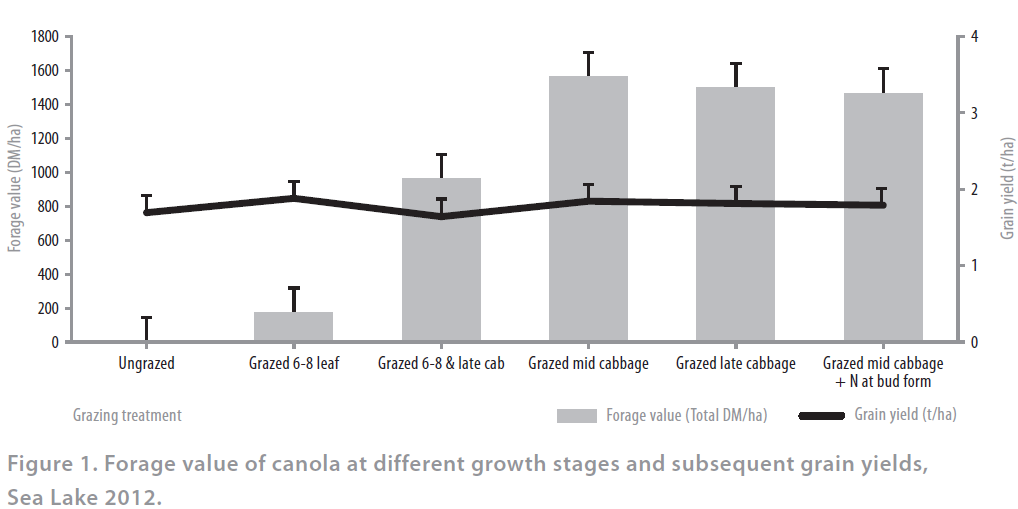
Forage value, or dry matter (DM) production, was greater for canola grazed at mid or late cabbage stage than at 6-8 leaf or if grazed twice at 6-8 leaf and late cabbage (Figure 1). At the time of the 6-8 leaf grazing, plants were small and moisture stressed due to the site receiving less than 10mm of rain in the eight weeks post sowing. The twice grazed treatment (at 6-8 leaf and late cabbage) didn’t recover well after the first graze and total DM suffered.
The mid cabbage grazed + N treatment did not respond to the extra nitrogen at bud formation. At this stage it is likely that plants already had adequate N because the season had been dry, soil N at sowing was 111kg/ha and the crop had received a top-dress N application.
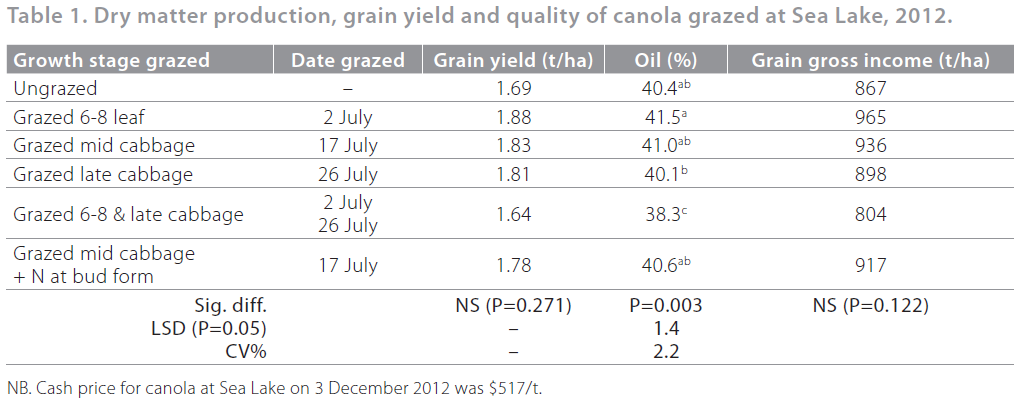
Grain yield was not affected by grazing (Table 1). Oil percentage of grain, however, was highest for the earliest grazing at 6-8 leaf, and was reduced by grazing at late cabbage. The reduction in oil in the late-grazed canola could have been due to a shift in flowering date further into the dry spring, but flowering date was not measured to confirm. All oil quality was lower than 42%, but this was not sufficient to affect the return for the canola.
Feed tests demonstrated that the forage value of grazing at all growth stages provided adequate protein and energy for lactating ewes and growing lambs. Crude protein ranged from 28.3-33.8% (require >16%) and metabolisable energy ranged from 12.9-13.5 MJ ME/kg (require >11%). While fibre increased as plants matured, fibre was low, ranging from 22.8-28.3% (require >30%) so provision of hay would be recommended. Nitrate levels in samples were generally high. At mid-cabbage, nitrate was 2600ppm which is considered safe. All other samples were over 4000ppm which has an impact on animal growth and can be toxic.
Commercial practice
The capacity for canola recovery depends strongly on seasonal conditions conducive to regrowth, and the time available for the crop to recover an adequate biomass to set yield. The later grazing occurs, and the longer it continues, the less time there is for this to occur.
Surprisingly, given the dry season in 2012, (simulated) grazing canola did not affect grain yield or quality; it is likely that success was due to the early sowing opportunity, and crop recovery was dependent on subsoil moisture and the ability of canola to extract moisture from depth.
When grazing canola, extra care is necessary, as it is likely that it will be a different feed source from the paddock the stock came from. If coming off grass onto canola, stock will eat out all the grass first. Introduce animals gradually for short periods at a time and observe them closely for any abnormal behaviour; ruminants will take a week or two to acclimatise to the brassica. After 2-4 weeks, weight gains will be achieved. This was seen at Birchip in the summer of 2011/12 when lambs grazing Winfred forage brassica grew at a rate of 110g/day after 20 days and at 330g/day after 40 days.
Nitrate poisoning can occur after a dry spell, when soil N levels are higher and it is taken up by the plant after rain or irrigation. Animals begin to be affected (subclinical) at tissue nitrate levels over 2000ppm, and toxicities occur above 4000-5000ppm. Nitrates are also an issue in dark, overcast weather. To avoid nitrate poisoning introduce stock gradually, later in the day with full bellies. Also provide roughage (which will also prevent scours), and observe animals closely. Wait for three weeks after top-dressing, or leave top-dressing until after grazing.
If contemplating grazing a failed canola crop to recover some of the growing costs via livestock, consider the possibility of nitrate poisoning, and be aware of chemical withholding periods for both pre and post-emergent herbicides.
Canola doesn’t have the same sodium and magnesium supplement requirements as wheat.
Grazing had no significant economic consequences on the canola crop at Sea Lake in 2012. The main value of this practice is that it provides growers with a place to put their animals while other legume pastures are establishing or while grasses are being sprayed out of pasture crops. However, with necessary introductory periods for grazing, low fibre and nitrate poisoning risk, weed management and chemical witholding periods to consider, the window for grazing canola is short. Generally, the overall risk to crop and livestock production is higher than for cereals.
Further assessment of grazing canola in a low rainfall environment is needed to properly assess the feasibility and risk of the practice. This trial will be repeated in 2013.
Acknowledgments
This project is supported by Northern Victoria Grain and Graze 2 (GRDC project BWD00018; funded by GRDC and Caring for Our Country).