In farming, there is always the temptation to reduce the number of operations as long as yield is not compromised. Canola has a greater requirement for nitrogen (N) and sulfur (S) than cereal crops on a per tonne basis. Unlike wheat, to which N may be applied up until flag leaf emergence, canola demands much earlier application (prior to bud formation). Many canola crops would require two applications of N during a season; at the two-to-four leaf stage and again at mid to late cabbage. Applying more N at sowing may reduce the need for the first application at the two to four leaf stage. However, the risk of seed burning is much greater and may affect establishment. It is commonly accepted that, as a rule of thumb, when sowing on wide rows, no more than 10kg N/ha should be applied (deep-banded) at sowing.
The adoption of no-till seeding equipment and stubble retention has led to wider row spacings to improve stubble handling and thrash flow. Wider row spacing increases the concentration of fertiliser in the sowing row if rates are not reduced. For example, the amount of fertiliser in the rows at 40kg urea/ha is much lower on 15cm than 30cm spacings. Canola’s ability to compensate in yield from poor establishment is well known; this makes it suitable to be sown on wider row spacings (greater than 30cm). Canola is particularly sensitive to seed burning from even small amounts of N, especially in marginal moisture. As such, rates would need to be adjusted if wider rows were to be adopted.
Take Home Messages
• Applying urea with the seed, even deep-banded, can affect establishment and slow growth and development.
• There was no advantage in applying nitrogen at sowing (deep-banded).
• The effects of seed burn on canola are much greater on sandier soils than clay. Dry soils are also more susceptible than wet soils: if applying up-front N, rates should not exceed 10kg N/ha (22kg/ha urea) on 30cm spacing, and seed should be separated by at least three to four centimetres from the nitrogen fertiliser.
Aim
To determine the effect that urea and GranAm (SOA), deep-banded at different rates, has on canola establishment.
Method
Location: Sea Lake
Replicates: 4
Sowing date: 24 April
Target plant density: 40 plants/m²
Crop type: Stingray canola
Fertiliser: 24 April MAP (50kg/ha) – 10% N, 21.9% P
Herbicides: 17 April Triflur X® (2L/ha) – all plots
2 Nov Reglone® (1.5L/ha) – all plots
Fungicide: 17 April Flutriafol (400ml/ha) – on fertiliser
Insecticide: 17 April Chlorpyrifos (300ml/ha) – pre-sowing
17 April Talstar (40ml/ha) – post-sowing
Seeding equipment: BCG Gason parallelogram seeder (knife points, press
wheels,30cm row spacing)
Sowing depth: 2cm (canola and MAP)
6cm (nitrogen fertiliser)
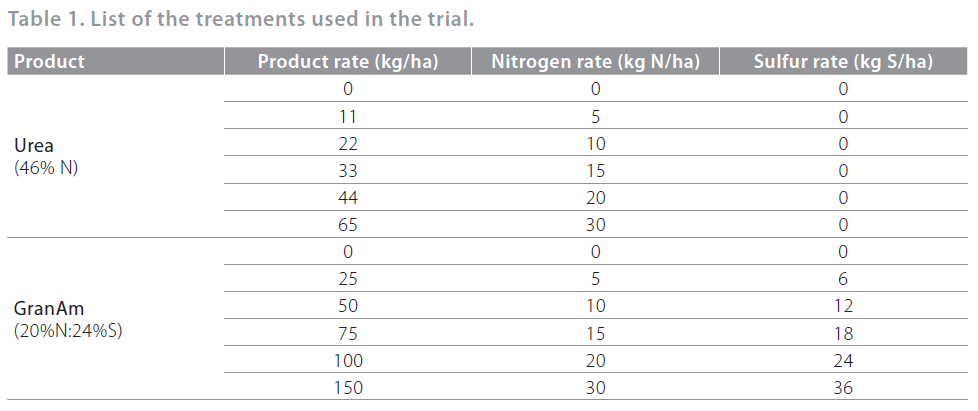
The nitrogen fertiliser treatments were deep-banded at 6cm, while the seed and mono-ammonium phosphate (MAP) were placed at a depth of 2cm. The product treatments used in the trial were urea (46N:0P:0K:0S) and GranAm (20N:0P:0K:24S). GranAm is commonly known as sulphate of ammonia (SOA).
Soil moisture at sowing was marginal: a drying topsoil with moisture at depth. Due to the large volume of fertiliser that needed to pass through the cone at one time, especially with the higher rates of SOA, the trial was sown at 3.5km/hr. The trial was not balanced with additional N and S during the season.
Data recorded throughout the season included establishment as well as biomass (at flowering).
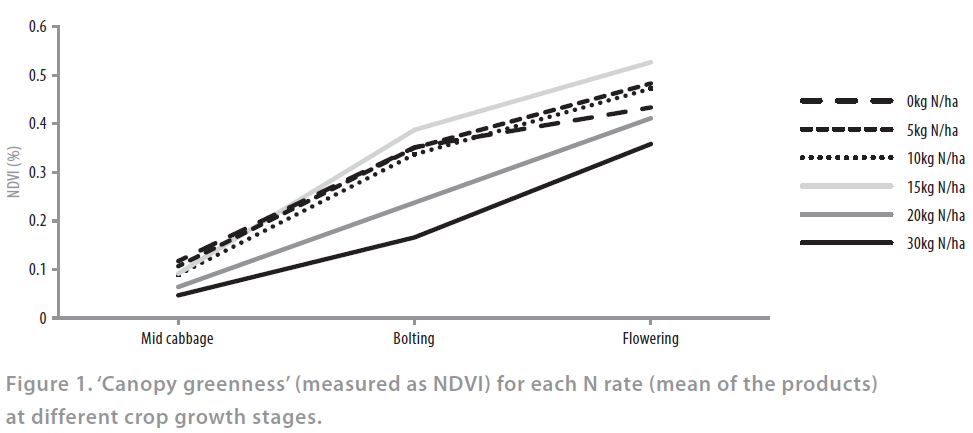
A handheld GreenSeeker® was used on individual plots at regular intervals (mid-cabbage, bolting and flowering) to determine differences in the ‘canopy greenness’ of each treatment. The GreenSeeker measures the light reflectance from the crop canopy at different wavelengths, measured of normalised difference vegetation index (NDVI). The reflectance in the red and infrared wavelengths is strongly influenced by chlorophyll content (‘greenness’) which is related to the leaf area and biomass of the crop.
The trial was harvested using a plot harvester on 19 November 2012. A sub-sample was retained to determine the individual grain quality for each treatment.
Results and interpretation
At emergence, it was obvious that the higher rates of N had affected plant establishment. While there was no difference between the two products (urea and SOA), the number of established plants reduced as N rate increased (>15kg N/ha) (Table 2).
It was apparent at flowering that the site was N and S responsive. Soil tests at sowing showed low topsoil S (3.4kg S/ha) and a moderate amount (111kg N/ha) of plant available soil nitrogen down to 100cm. It was expected that the N levels would have been higher given vetch hay had been grown in 2011. The below average rainfall would have meant less N was mineralised, and the site was likely to be responsive to N. Without these nutrients being balanced, the effects on establishment are not unique and the true effects can be masked by the additional nutrition, especially when the site is responsive. For example, even though there was a significant effect on plant establishment, the additional N may have enabled those treatments to compensate for the loss.
‘Canopy greenness’ measured at three stages during the season showed that the N-response occurred at flowering (Figure 1). At rates less than 20kg N/ha, there was a ‘positive’ rate response to N. There was no difference between the untreated and the rates below 15kg N/ha prior to the flowering measurement. The NDVI values also found differences between the products at flowering. The means of the SOA treatments were higher than those of the urea treatments (P=0.005, LSD=0.04, CV14.6%), suggesting a likely response to sulfur. This response was not incremental with additional S. A reduction in biomass was also observed, with higher rates of N having a notably lower NDVI value at each of the timings. The gap between the untreated and the 20kg N rate, (despite the differences at establishment), was insignificant at flowering. This is probably due to the additional N it received, allowing the crop to compensate. It is also possible that the control had become nitrogen stressed. The effect of the 30kg/ha rate was still significantly lower.
The higher rates of N also delayed the growth and development (phenology) of the canola. This, again, was most evident at flowering. The crops that received the lower rates of nitrogen reached peak flowering two weeks prior to those that received the higher rates. Biomass was also measured at flowering, confirming the results of the NDVI (Table 2). The biomass cuts were taken when the untreated plots reached full flowering, which was arguably earlier than most of the N-affected treatments. The higher rates subsequently had significantly lower flowering biomass.
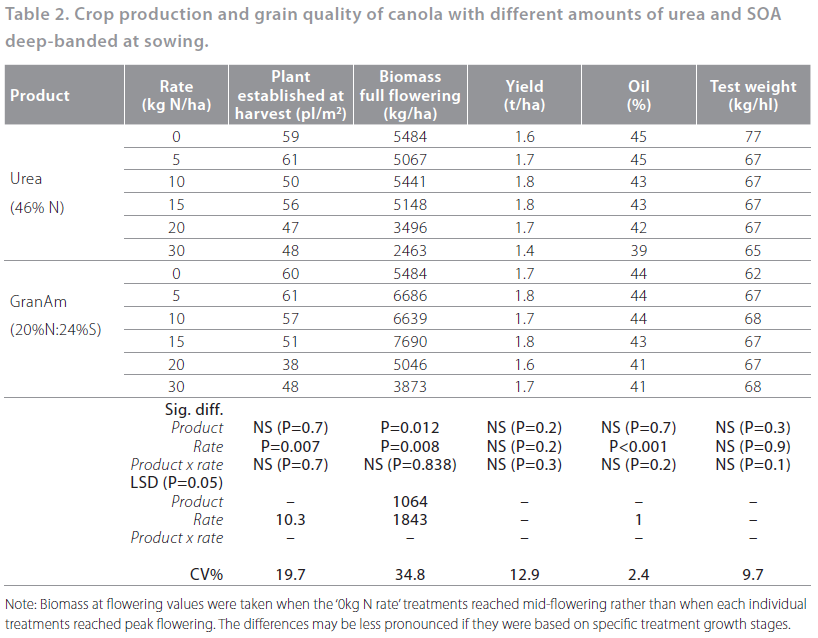
Differences observed at flowering did not translate into grain yield. There were no significant differences between any of the treatments measured at harvest (Table 2). The mean yield of the treatments was 1.7t/ha. The increase in NDVI and biomass at flowering from additional N also did not increase yields. The product difference observed between urea and SOA also did not translate into yield, with the mean of the two products being statistically equal.
Oil content was the only grain quality measurement that was affected by the up-front N. Increasing the rate of N decreased the oil content (Table 2): the higher rates of N had the lowest oil content. Test weight was not affected by any of the treatments. The mean test weight achieved in the trial was 68kg/hl.
Commercial practice
Neither yield impact nor benefit was observed in this trial as a result of applying N at sowing. The effect of the higher rates on establishment alone delayed the phenology compared with the other treatments from the start of the season. The additional nitrogen is likely to have contributed to the plants compensating in the form of more vigorous growth. Poor establishment has also been known to affect yield in other seasons.
While there can be efficiencies made through fewer operations, the benefit of ensuring adequate nutrition and good establishment outweighs those gains. This is especially the case when high risk crops such as canola are involved.
It is extremely difficult to quantify what are ‘safe rates of N fertiliser’ that can be applied to canola crops at sowing. The amount of damage is influenced by many factors, to the extent that a safe rate in a dry soil can be half that of a wet soil of the same soil type. Canola grown on sandier soils is more sensitive than crops grown on loams and other heavier textured soils. As a commercial practice, growers should balance the advantages of applying N with the increased risks of poor emergence. If the intention is to improve early vigour by applying increased N at sowing, it would be preferable to select a variety that delivers good early vigour. In high stubble loads, where N tie up is likely early, consider spreading N prior to or shortly after sowing (at the next forecast rainfall event).
References
BCG Fact Sheet ‘Nitrogen in No-till 2007’
Acknowledgments
The trial was funded by BCG members through their membership.