Many Australian and international studies have demonstrated that wheat grain yields can often be increased by including legumes in cereal-based cropping sequences (Kirkegaard et al. 2009; Seymour et al. 2012). These yield improvements arise through legume effects on either beneficial soil biology, enhanced nutrient availability, soil structural characteristics, soil moisture carry-over, and/or control of cereal diseases and insect pests (Kirkegaard et al. 2009; Peoples et al. 2009).
Vetch has proven to be a valued option as a break crop in the Victorian Mallee because it grows well in alkaline soils and has the potential to contribute large amounts of biologically fixed nitrogen (N) to the farming system through its symbiotic association with the soil bacteria rhizobia (Peoples et al. 2012). Growing vetch also provides an opportunity to control resistant grass weeds because of its multi-option end-use. It can be grazed, cut for hay to prevent setting seed, brown manured at the time of weed seed set or harvested for grain. When deciding whether to spray out or graze vetch, growers must consider the potential benefits it may be delivering to the subsequent crop rotation including profitability, carry-over of residual soil moisture, weed control, and enhanced N supply. Ultimately these benefits will be determined by the balance between the inputs of fixed N, the subsequent N mineralisation of the legume residues, the utilisation or sparing of soil water reserves, and the efficacy in preventing seed set of problem weeds.
This project examines the specific trade-offs that occur between the timing of the termination of a vetch crop and its effects on N fixation, soil moisture, and N availability for a two-year vetch/wheat rotation.
Take home messages
• Nitrogen fixation by vetch was closely related to dry matter (DM) production (26kg N fixed per tonne DM accumulated). The later the termination, the higher the calculated inputs of fixed N.
• Both soil water reserves and mineral N were highest at the end of the 2012 growing season following the earliest (June and July) termination timings.
• To establish the best time to terminate a vetch crop, weigh up the benefits being delivered by vetch (biomass accumulation and N fixation), the need to conserve moisture and time required for N to mineralise for the next crop.
Aims
To determine whether rhizobial inoculation of vetch enhances the amounts of N fixed.
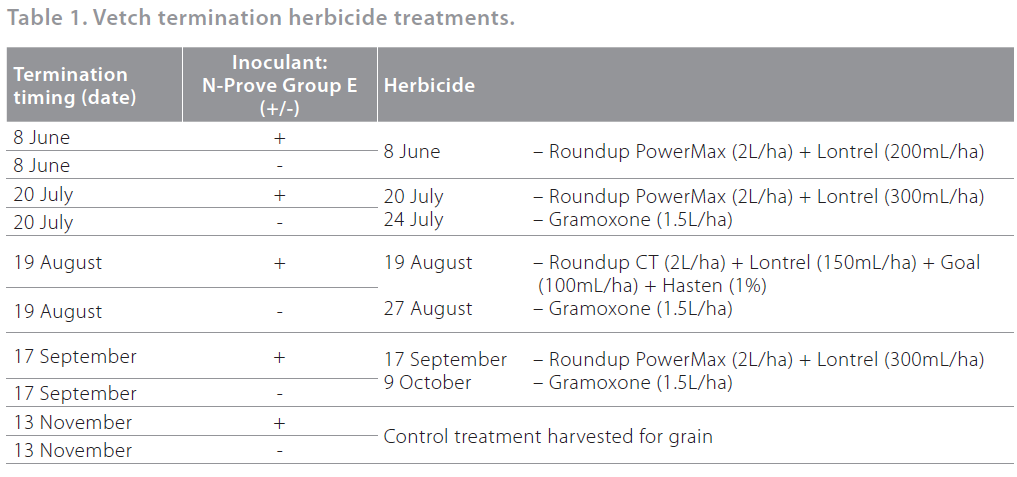
To evaluate the effect the timing of vetch termination has on inputs of fixed N, and on residual soil moisture and mineral N measured at the end of the 2012 growing season.
Method
The trial was a complete randomised block design. Experimentation included four termination timings, a maturity control that was harvested for grain, and plus and minus Rhizobium leguminosarum bacterium, group E (N-Prove peat formulation) inoculation treatments (details in Table 1).
On 6 June and 17 September, three vetch root systems were excavated from each treatment, washed and nodules were counted.
Prior to each termination timing, vetch biomass cuts were taken from each plot. Shoot biomass was dried at 70°C for 24 hours and then weighed to obtain shoot dry matter. Samples were subsequently analysed for 15N and %N content using a mass spectrometer. Unfertilised wheat and canola located within the experimental area were sampled at the same time as each vetch termination treatment. These were utilised as non-legume, non-N-fixing ’reference plants‘ to provide a measure of the 15N signature of the plant-available pool of soil N. Estimates of N fixation were calculated by means of comparisons of the 15N composition of vetch samples with those of the reference plants (Unkovich et al. 2008).
Control treatments were harvested on 16 November.
On 26 November, soil samples were collected from all inoculation ‘plus’ treatments and gravimetric measures of soil moisture and analysis for soil mineral N (0-15, 15-30, 30-60, 60-90, 90-120cm) were measured. Soil sampling will be repeated prior to sowing the 2013 wheat crop to quantify treatment effects on soil water and mineral N.
Location: Birchip
Replicates: 4
Sowing date: 13 March (following 23mm rainfall 1 March and 15mm on
5 March)
Target plant density: 60 plants/m²
Crop type: Morava vetch
Herbicide: Simazine (700g/ha) + Treflan (1.5L/ha) +
Roundup® (2L/ha)
Fertiliser: Superfos (40kg/ha [6.16kg P/ha])
Seeding equipment: BCG Gason parallelogram (knife points, press wheels,
30cm row spacing)
Results and interpretation
Impact of inoculation on vetch nodulation and N fixation
There were no significant differences (P=0.05) measured between vetch nodulation scores for plus and minus inoculation treatments for either the 6 June or 17 September sampling times. At 6 June the plus inoculation mean was 36 and the minus inoculation mean was 38. At 17 September the plus Inoculation mean was 112 and minus Inoculation mean was 146. There were also no significant differences detected in either shoot dry matter (data not shown), or the 15N derived estimates of vetch reliance upon N fixation for growth. It should be noted that 64% of the shoot N accumulated by vetch was calculated to come from the atmosphere for both treatments at the June sampling and 91% in September.
In many respects, the lack of an inoculation response was surprising, given that neither vetch, nor any other legume (lentils, field peas, faba beans) with similar rhizobial species requirements had been grown in the paddock since 2001. The results suggest that sufficient rhizobia had survived in the soil since 2001 to adequately nodulate the vetch sown in 2012.
Effect of termination timing on biomass and inputs of fixed N
Shoot biomass
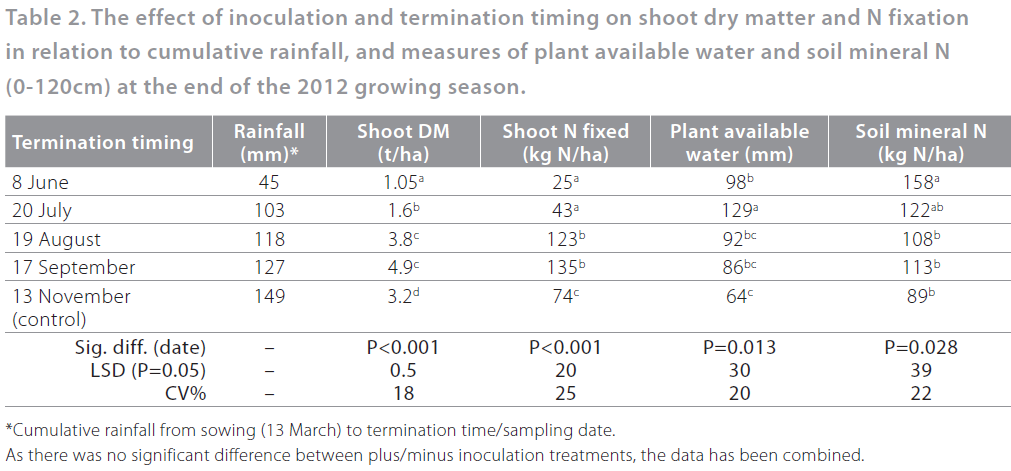
Progressive increases in mean shoot biomass were measured between June and September, reflecting the normal pattern of plant DM accumulation over the growing season (Table 2). However, standing biomass measured at the time of crop maturity in November (control) was significantly lower than that determined in August or September (Table 2). This was explained by the considerable pod and leaf drop prior to the November sampling as the result of a very dry spring: only 9mm fell between the August and September termination dates, and 22mm between the September biomass sampling and maturity harvest (Table 2).
Shoot N fixed
There was a close relationship between the amounts of shoot N fixed and biomass accumulation, with an average of 28kg N fixed per tonne of shoot DM determined at the September sampling. The later the termination treatment was applied in the growing season, the higher were the calculated inputs of fixed N (from 25kg fixed N/ha in June to 135kg fixed N/ha by September; Table 2). The difference in estimates of amounts of N fixed between September and November can be accounted for by the drought-induced senescence and loss of biomass and N at the end of spring.
Grain yield
There was no difference (P=0.05) between vetch yields. The average grain yield of the control treatments was 0.7t/ha. However, the harvesting process caused yield variation and yields obtained were lower than expected.
Effect of termination timing on soil moisture and mineral N at the end of the growing season
Soil water
Measurements undertaken after grain harvest indicated that the soil water content was significantly higher where vetch had been terminated early in the growing season than under the control treatment. The control continued to extract soil water until maturity (Table 2). This is consistent with the notion that early termination timings could help to conserve plant available soil water and/or allow the partial recharge of the soil water reserves to provide a carry-over of residual soil water for the potential benefit of the wheat to be sown in 2013. However, contrary to expectations, soil water following the June termination was lower than that of July despite 58mm of rain that fell between treatments (Table 2). It is possible that this may have arisen due to delays in control of weeds that germinated in the June termination plots. The small non-significant differences in soil water content (between the end of season measurements following the August and September termination treatments) and the control reflected the low spring rainfall.
Soil mineral N
There was a general trend in the concentrations of soil mineral N (i.e. nitrate and ammonium) measured at the end of the growing season. Soil mineral N was lower in the control where plants had been allowed to grow to maturity than where the vetch had been terminated earlier in the year.
However, only under the June termination treatment was the soil mineral N statistically significantly higher than the August or September termination times and the control treatment (Table 2). Two contributing factors may explain the observed trend in data. Firstly, as long as the vetch continued to grow, it would be assimilating some N from the soil: it is not surprising to detect lower soil mineral N concentrations in the control and late termination treatments than in those where the vetch had been killed in June. Secondly, the release of N from organic plant residues is mediated by microbes in the soil. This is a slow process that requires the soil to be moist to stimulate microbial activity. The higher mineral N values observed following the June and July termination treatments could also be related to the commencement of the decomposition of vetch residues in the soil.
Commercial practice
The optimal time to terminate a vetch crop is essentially a trade-off between inputs of fixed N, the subsequent supply of soil water and N for the next crop, and the efficacy in preventing seed set (lowering future costs of control) of problem weeds. Weed control is not considered in the current study which has focused specifically on soil water and N.
Vetch termination should be early enough in the growing season to conserve some soil water. It should also allow time for N to be mineralised from the plant residues, but still late enough to allow enough vetch biomass to accumulate and N to be fixed to theoretically be of benefit to a following crop.
In 2013, wheat will be sown across the trial and yields will be compared between treatments. This will determine whether any of the vetch termination treatments result in higher wheat grain yields in 2013 than achieved by allowing the vetch to grow through to maturity.
We will then be able to determine if additional grain generated in 2013 will provide an income that exceeds the planting and herbicide costs incurred in 2012 in addition to the income lost by terminating the vetch crop rather than harvesting grain (control grain yield in 2012 = 0.7t/ha worth approximately $193/t).
The outcomes will depend heavily on the amount and pattern of rainfall that occurs over the summer autumn fallow and the 2013 growing season.
References
Kirkegaard JA, Christen O, Krupinsky J, Layzell D (2008) Break crop benefits in temperate wheat production. Field Crops Research 107, pp. 185-195.
Peoples MB, Brockwell J, Herridge DF, Rochester IJ, Alves BJR, Urquiaga S, Boddey RM, Dakora FD, Bhattarai S, Maskey SL, Sampet C, Rerkasem B, Khan DF, Hauggaard-Nielsen H, Jensen ES (2009) The contributions of nitrogen-fixing crop legumes to the productivity of agricultural systems. Symbiosis 48, pp. 1-17.
Peoples MB, Brockwell J, Hunt JR, Swan AD, Watson L, Hayes RC, Li GD, Hackney B, Nuttall JG, Davies SL, Fillery IRP (2012) Factors affecting the potential contributions of N2 fixation by legumes in Australian pasture systems. Crop and Pasture Science 63, pp. 759-786.
Seymour M, Kirkegaard JA, Peoples MB, White PF, French RJ (2012) Break-crop benefits to wheat in Western Australia – insights from over three decades of research. Crop and Pasture Science 63, pp. 1-16.
Unkovich M, Herridge D, Peoples M, Cadisch G, Boddey B, Giller K, Alves B, Chalk P (2008) Measuring plant-associated nitrogen fixation in agricultural systems (ACIAR Monograph No. 136).
AcknowledgmentS
This project was funded by GRDC, Project CSP00146: ‘Facilitating increased on-farm adoption of broadleaf species in crop sequences to improve grain production and profitability’. James Hunt and Tony Swan (CSIRO) for their assistance in data interpretation and statistical analysis.