Soil organic matter is derived from decaying plant and animal matter. It consists of four different components:
• partially broken down plant material >2mm (labile)
• decomposing plant material 0.05 to 2mm (labile)
• humus as decomposed material <0.05mm (permanent and stable)
• charcoal (permanent and stable).
Humus has many functions in the soil: it retains water (improving the water holding capacity of the soil); binds positive ions (protecting them from leaching); increases microbial activity (contributing to a release of plant available N); improves the structural stability of the soil (holding soil particles together) and chemically acts to buffer soil acidity.
Only the humus and charcoal are regarded as permanent (slow to break down); the other fractions, broken down and decomposing plant material, are labile (not permanent). Humus, the stable remnant of decayed soil organic matter, has a relatively constant ratio of Carbon:Nitrogen:Phosphorus:Sulphur. One tonne of carbon as humus contains approximately 80kg N, 20kg P and 14kg S.
No-till and stubble retention increase the partially broken down and decomposing plant material in the soil BUT, do not automatically increase soil humus content. Soil humus can be increased only if soil C (decomposing plant material) is available together with the appropriate amounts of N, P and S (additional to the nutrients that are normally used in crop production). The extra amount of nutrients required is worked out from the type and amount of stubble left over after the last crop.
BCG is involved in a long-term investigation looking at nutrient and stubble practices and their impact on soil organic matter.
Take home messages
• Soil organic matter consists of a labile (non-permanent) and stable (humus) fraction.
• No-till increases the labile fraction of soil organic matter, but not the stable fraction.
• Additional nutrients will be required to ‘fix’ the labile fraction to humus.
AIM
To identify nutrient and stubble management practices which result in increased soil organic matter.
Method
The long-term trial was established at BCG™s main research trial site in 2012. To increase soil organic matter, the main treatments were to: (i) compare stubble treatments (stubble retained vs. stubble removed) and (ii) apply additional nutrients to assist the breakdown of stubble to humus. Soil samples (0-10cm and 10-30cm) were collected prior to sowing and will be analysed for total soil C, and the fractions of soil organic matter (labile and humus). Prior to sowing each year each treatment will be re-sampled to observe changes in soil C.
Location: Birchip
Replicates: 4
Sowing date: 1 June
Crop: Correll wheat
Sowing rate: 80kg/ha to target 150 plants/m²
Stubble treatments: Canola stubble
(i) stubble removed;
(ii) stubble worked;
(iii) stubble standing
Fertiliser treatments: (i) normal practice (MAP 35kg/ha)
(ii) plus additional nutrients (urea 30 kg/ha + SOA 12 kg/ha)
All plots were top-dressed with urea (65 kg/ha) on 8/8/2012
Herbicide: 1 June TriflurX® (2 L/ha) + Roundup PowerMax® (2 L/ha)
+ Hammer® (50 ml/ha)
Seeding equipment: BCG cone seeder (knife points, press wheels, 30cm row
spacing)
RESULTS AND iNTERPRETATiON
In the first year of trial work there were no significant differences in yield between stubble treatment or additional nutrient applications (Table 1). Differences were not expected because the additional nutrients applied were targeted at improving the breakdown of stubble to soil organic matter (especially to humus) and this will take some time to be achieved.
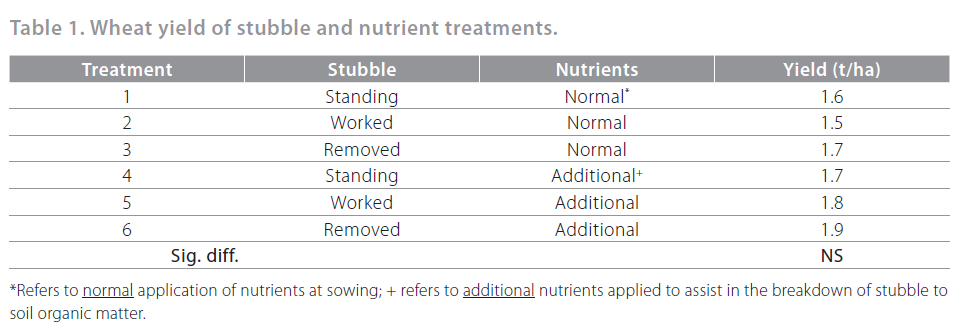
It is not expected to observe differences in soil condition and hence in yield, until at least the third year of the project (2014). We know that changes in soil C are slow and often difficult to detect.
Commercial practice
It is possible that in the future farmers may get paid for sequestering carbon as soil organic matter through the CFI (Carbon Farming Initiative). This trial is part of a National program where farm groups are investigating management options to sequester soil carbon. In south east Australia, BCG is working with seven other farming systems groups to learn more about soil C: its significance, its functions, the benefits of increasing soil humus content, how the humus content can be increased and whether it is worthwhile to invest in additional nutrients to do so. The farming systems groups include:
• Victoria: BCG, MSF and SFS
• NSW: FarmLink and CWFS
• SA: Hart and EPARF (through Ag Ex Alliance)
• Tasmania: SFS.
Acknowledgments
Each of the farm groups is undertaking a three-year trial supported by the Commonwealth (Department of Agriculture, Forestry and Fisheries) and the GRDC (Grains Research Development Corporation).